Thomas Francis Meagher and The Irish Brigade

Twenty-Four Hours a Free Man
The Early Life of Thomas Francis Meagher
"The white in the centre signifies a lasting truce between the Orange and the Green, and I trust that beneath its folds the hands of the Irish Protestant and the Irish Catholic may be clasped in generous and heroic brotherhood." — Thomas Francis Meagher, presenting the Irish tricolour, 1848
I. Waterford and Dublin, 1839–1848
The Suir ran brown and full past his father's counting-house window that autumn he turned sixteen, home from Stonyhurst for the last time, and Thomas Francis Meagher stood at the glass a long while before he went in to be examined on his Latin.
He was good at the examination and knew it, which was, his masters had always agreed, both his great gift and his great difficulty. Clongowes Wood had taught him rhetoric the way it taught every son of the Catholic merchant class sent there — as armor, a thing a boy from a country still governed by men who despised his religion might need to survive a room. He had proven, by fourteen, that he could out-argue boys three years his senior. Stonyhurst, across the water in Lancashire, had refined the gift into something closer to a weapon, and he had come home from it not entirely sure what there was left in Waterford large enough to use it on.
His father had an answer ready, as his father generally did. Thomas Meagher the elder was the town's first Catholic mayor since the penal years had finally, grudgingly, lifted their worst weight, a merchant grown wealthy enough on the Newfoundland trade to sit where his own father could not have sat, and he wanted for his son exactly what every self-made man wants for an heir: the same climb, continued, upward, respectable, safely within the lines the law still drew around a Catholic family however rich it grew. A career at the bar, perhaps. Eventually a seat, if the times allowed it, in a corporation his own father had been barred from entering.
"You'll do nothing rash," the elder Meagher said, not quite a question, across the ledger books that autumn evening, the tallow candle throwing both their shadows long against the counting-house wall. "There's a way to change a country, Thomas, and it isn't shouting at it from a platform."
His son said nothing rash in reply, that year. But he had already begun reading the newspapers his father found less useful than his ledgers — the Nation, with its unsigned essays that seemed to Thomas, at seventeen, to be the only writing in Ireland actually telling the truth about the country he'd come home to: a population reduced by law and custom to tenancy on its own soil, a parliament that sat in London and had sat there since the Union extinguished Dublin's own, and an old lion of a leader — Daniel O'Connell, the Liberator, the man who had won Catholic emancipation by sheer weight of moral argument and mass petition — now grown, in the young men's private judgment, cautious past the point of usefulness.
He gave his first real speech to the Waterford Total Abstinence Society at nineteen and discovered, with something like alarm, that a room of several hundred people could be made to go entirely silent by the right sentence delivered at the right pace. It was not a comfortable discovery. It was, he would tell a friend years later, on a ship bound for a country neither of them yet imagined, rather like discovering as a boy that you could throw a stone with unusual accuracy — you did not stop being afraid of what a thrown stone could do. You simply could not, after that, un-know that you could throw it true.
The speech that made his name, and very nearly ended it, was delivered in Dublin in the summer of 1846, in a hall packed to its doors with men who had followed O'Connell for a generation and did not expect, on that particular evening, to hear one of the movement's own younger orators tell them that moral force alone had not freed a single enslaved people in the history of the world, and that Ireland ought not delude itself into believing it would be the first.
He did not call for rebellion, precisely — he was careful, that night, in the way of a man who has rehearsed exactly how far a sentence can go before it becomes a different kind of sentence altogether, the kind a government prosecutes. He called instead for the right to choose the sword, should the moment ever demand it, and to be honest that such moments had existed in every free nation's history and would, he believed, exist again.
"Be it in the defence, or be it in the assertion of a people's liberty," he told the hall, his voice pitched to carry to the last bench without ever seeming to strain for it, "I look upon the sword as a sacred weapon." He paused there, long enough for the silence to become its own kind of applause. "And if, my lords, it has sometimes taken a drop of blood — and sometimes many thousand drops of blood — to lift a nation from bondage into the light, I, for one, will not curse the means by which that liberty was won."
O'Connell's son, in the chair, called it treason to the movement's founding principle before Meagher had fully sat down. The split that followed — the moral-force men on one side, the younger group who would soon call themselves the Irish Confederation on the other — cost him friendships he had counted since Clongowes. It also earned him, within a fortnight, a name the newspapers would not let go of for the rest of his life. Meagher of the Sword. He was twenty-two years old, and he had not, in point of fact, ever held one in earnest.
France gave him the flag two years later, and he never afterward spoke of that spring without something in his voice that had not been there before or after it — the closest thing to pure, uncomplicated joy the record shows him permitting himself in the whole of a short and largely unjoyful life. Paris in the spring of 1848 was a city that had just put a king to flight and replaced him with a republic inside of three days, and Meagher and William Smith O'Brien had gone across the Channel as an unofficial deputation of the Irish Confederation to see whether the new French government might be persuaded to look kindly on a small nation attempting the same trick.
The French government gave them courteous nothing, in the end — Lamartine, the poet turned foreign minister, was far too careful a man to hand an English ally's rebellious province a single rifle — but a group of Irish residents in Paris gave Meagher something that outlasted every gun would have. A flag: green, white, and orange, three bars run vertical in the French manner, the white laid deliberately between the other two.
He carried it home rolled in his luggage and unfurled it first from the window of the Waterford Mechanics' Institute and then, a week later, from a balcony on Dublin's D'Olier Street, above a crowd that had come expecting a speech and got, instead, a piece of silk that made half of them weep before he said a word.
"The white in the centre," he told them, when he did finally speak, "signifies a lasting truce between the Orange and the Green, and I trust that beneath its folds the hands of the Irish Protestant and the Irish Catholic may be clasped in generous and heroic brotherhood."
He could not have known, saying it, that the flag would outlive the failed summer that followed it by more than a hundred years, would be raised over a free Dublin parliament long after every man in that crowd was dead, would become simply the flag, need no further explanation at all. He knew only, that evening, that for the first time in his short career as an orator he had made something rather than merely argued for it, and the difference pleased him more than any ovation had.
The rising, when it finally came in July, came badly, and without him at its center.
The government struck first — suspended habeas corpus, moved to arrest the Confederation's leadership before they could organize anything more than speeches — and what resulted was not the disciplined rising the younger men had imagined in Dublin drawing rooms but a scattered, hungry, half-armed affair conducted by exhausted men in a country three years into a famine that had already killed or exiled a quarter of its people and left the rest with little appetite, whatever their politics, for one more catastrophe.
Meagher was not present at Ballingarry on the twenty-ninth of July, when what remained of the effort collapsed in a Tipperary widow's cabbage garden — a skirmish so slight and so absurdly domestic in its setting, a stone farmhouse and a walled kitchen garden, two dozen police holding the house against a crowd of a few hundred poorly armed men, that it would be remembered for a century afterward under a name that sounded almost like a joke: the Battle of Widow McCormack's Cabbage Patch. He was elsewhere in the county, trying, by then rather desperately, to raise a second force that never materialized. It made no difference to the government. He was arrested near Cashel on the thirteenth of August and charged, along with William Smith O'Brien, Terence Bellew MacManus, and Patrick O'Donohoe, with high treason against the Crown.
The trial opened at Clonmel that autumn in a courtroom too small for the crowd that wanted into it, the four accused seated together in the dock through weeks of testimony that both sides understood, from the first morning, could end only one way. The jury convicted him on the twenty-third of October. The presiding judge, before pronouncing sentence, asked, in the formal manner the law required, whether the prisoner had anything to say for himself.
He had prepared for the question for weeks, and what he gave the court, standing in the dock in the particular stillness of a man who has decided fear is no longer the most useful thing available to him, was not a plea. It was, in its way, the last and best speech of his Irish career — measured, unrepentant, addressed less to the judge in front of him than to whatever reader might one day find the transcript.
"I am here to regret nothing I have done," he told the court, "to retract nothing I have said. I am here to crave, with no lying lip, the life I consecrated to the liberty of my country." He did not raise his voice. Several present would remark afterward that this, more than anything shouted at Dublin in 1846, was what convinced them the newspapers had been right to call him something more than a talented boy.
The sentence, read that afternoon, was death by hanging, drawing, and quartering — the full medieval formula, still technically on the statute books, though every man in the room including the judge who pronounced it understood it would never in fact be carried out. Public outcry, in Ireland and rather more usefully in a Britain that had begun to find public disembowelments an embarrassment to a modern nation, produced the commutation within months. Transportation for life, to the other side of the world, was judged the more civilized sentence.
He was twenty-five years old when the ship left Kingstown harbor in the summer of 1849, and he did not look back at the receding coastline for as long as it stayed in view — not, he told a fellow prisoner, because he could not bear to, but because he had already decided he was coming back, and a man who intends to return does not need to memorize the leaving.
II. Van Diemen's Land, 1849–1852
The colony gave its state prisoners a peculiar kind of captivity, and it took Meagher the better part of a year to understand that this was by design rather than oversight.
A ticket-of-leave — the instrument that governed his exile from the day he stepped off the transport ship at Hobart — was not a cell. It was a district: several hundred square miles of the island's dry, eucalypt-silvered interior assigned to him as the whole of his permitted world, a boundary he could not cross without written leave from a magistrate who might, or might not, choose to grant it. Within the district he could rent a cottage, keep a horse, receive visitors, write letters that the authorities did not trouble to read as closely as London believed they did. He could not leave it. He could not, under any circumstance the law recognized, go home.
It was, he came to understand, a punishment specifically engineered for a man like him — not starvation, not chains, but the particular slow erosion of a talker and an actor being handed nothing whatsoever to talk about or act upon, in a landscape so foreign to everything he knew that even his contempt for it required new vocabulary. The gum trees did not lose their leaves in a winter that came, disorientingly, in June. The birds made sounds that belonged to no bird he had ever catalogued. The light itself was wrong — harder, flatter, without the soft Atlantic haze that had lain over every childhood memory of the Suir.
He built himself a cottage above Lake Sorell, in the island's cold central highlands, close by two fellow exiles similarly sentenced, and the three of them made, for a time, a small transplanted Ireland of argument and reading and the kind of gallows humor that men develop when their actual gallows sentence has been quietly withdrawn but nothing has come to replace it. He fished the lake. He rode the district's tracks until he had them memorized to the yard. He wrote — letters, mostly, smuggled and legitimate both, to a network of sympathizers on three continents that he was already, without quite admitting it to himself, assembling into something resembling a second political career, conducted entirely by correspondence from a cottage eleven thousand miles from anyone who could vote for him.
He met Catherine Bennett at a neighboring farm in the spring of 1850. She was the daughter of a settler named Bryan Bennett, himself a former convict — transported years before for mail robbery, his sentence served out, his ticket long since expired into full and ordinary freedom, the particular Australian alchemy by which a man's crime became, given enough years and enough acres cleared, simply his history rather than his condition. Catherine had been born in the colony and knew no other country; Ireland, to her, was a story her father told, not a grief she carried. Meagher found this, at first, faintly strange in her, and then, within a season, found it one of the things about her he had come to rely on. She did not need Ireland explained. She did not need it mourned in front of her, nightly, the way his fellow exiles required of one another as a kind of ongoing liturgy. She let him simply be a man on a lake in the highlands, for the length of an evening, and it was a mercy he had not realized until she gave it how badly he had wanted.
They married on the twenty-second of February, 1851, at a small ceremony that drew half the scattered exile community and a good deal of official disapproval nobody troubled to act on. By the following winter she was carrying his child.
The letter he sent the district magistrate on the third of January, 1852, was, by every account of the men who read it that morning, a document of extraordinary and almost insolent formality.
He had spent the autumn arranging what could be arranged from inside a ticket-of-leave's narrow permissions: money moved quietly from his father in Waterford, funds that would in time reach a friend recently arrived in the colony from America for exactly this purpose — a fellow Young Irelander, Particular John Smyth, a restless and resourceful man the exiles had taken to calling simply P.J., who had crossed an ocean on the understanding that Meagher, of all the state prisoners scattered across Van Diemen's Land, was the one most likely to be worth the risk of springing loose. An American ship's passage had been quietly secured. A route north to the island's wilder coast had been scouted. What remained was the one act that could not be delegated to anyone else: the formal renunciation, in writing, of his parole.
I hereby give you notice, the letter informed the magistrate, in language a barrister could not have faulted for its precision, that I have this day resigned my ticket-of-leave, and that at the expiration of twenty-four hours from the delivery of this notice I shall consider myself a free man, and at liberty to take any steps I may think proper to effect my escape.
It was, in its way, the last and strangest speech of his career — an announcement of his own crime delivered in advance, in writing, with his signature attached, to the very authority charged with preventing it. He had always believed, and would say so for the rest of his life, that a gentleman did not slip away from a promise in the dark. He would break his parole in full daylight, on the record, having given the government the exact courtesy of warning it did not extend to men it hanged. Whether this was integrity or theater, even his closest friends were never entirely certain, and he himself, pressed on it years later in New York, only laughed and said that a man in his position had needed, badly, to feel that he was choosing something rather than merely fleeing it.
The twenty-four hours ran out at noon on the fourth. The police, alerted well before the deadline and thoroughly unamused by its formality, were already riding for the Lake Sorell district by the time he mounted and left the cottage — left Catherine there, seven months gone with child, with an embrace that both of them would afterward describe, in letters neither fully expected the other to survive to read, as briefer than either wanted and longer than was safe.
He rode north for three days through country that grew wilder and drier the further he went from the highlands, sleeping rough, moving by tracks a sympathizer had mapped for him in advance, twice hearing, at a distance he judged accurately enough to be grateful for, the particular sound of mounted police moving fast on a road he had left an hour before. The rendezvous point was the coast near Waterhouse Island, a low scrub-covered spit of land off Tasmania's rough northeastern shoulder, exposed to the full uninterrupted weight of the Bass Strait swell, and it was there, waiting for the arranged ship that did not come on the first day, or the second, that the escape came closest to its quiet failure.
He had food for perhaps three days. He had, by the fourth, none, and no fresh water he trusted, and the particular flattening of thought that real hunger brings — he would recognize the sensation again, years later and continents away, on a battlefield in Virginia, and understand only then how completely the body takes command of a mind that believes itself to be reasoning independently. He watched the horizon. He rationed, for a while, the idea of hope itself, the way a starving man rations food, permitting himself only small measured doses of it so that despair could not arrive all at once and finish the job hunger had started.
The whaler Elizabeth Thompson came into the strait on the tenth day, an American vessel out of a New England port, her master willing — for reasons of sympathy, or payment, or both, the record does not fully untangle it — to take aboard a gaunt, sun-blistered Irishman who came off Waterhouse Island in a borrowed boat and did not, for some hours after he was hauled over the rail, entirely trust that the deck under him was real.
They ran the ship south and east and around the great grey shoulder of Cape Horn, into an ocean Meagher had never seen and would never see again, and up the whole long spine of the Atlantic to Brazil, where he transferred to a second vessel bound at last for New York. He stood at the rail through a great deal of that crossing, by his own later account, doing very little but watching water go by and turning over, without ever quite resolving it, the one calculation that would not let him alone: that he had left a wife within weeks of her time, in a cottage eleven thousand miles behind him, on the strength of a promise — spoken hastily, meant entirely — that he would send for her the moment there was anywhere safe to send her to.
He did not yet know, crossing that ocean, that the child would be born within the month, a son, and that he would learn of the birth and of a death that followed it within the same season, by the same slow and merciless post.
III. New York, 1852–1862
Castle Garden gave him a welcome he had not entirely prepared for.
He had expected, arriving in May of 1852, to be a curiosity — an escaped convict, a name the American papers had followed with the same appetite they gave any good adventure story. He had not expected the crowd that met the ship, nor the dinners, nor the torchlight procession that escorted him up Broadway as though the city had elected, collectively and without consultation, to treat his arrival as a small national holiday. America, he understood within a week of landing, had no ticket-of-leave to offer a man and no interest in his politics except as they might be retold at a banquet. It offered instead the one thing eleven thousand miles and a decade of prosecution had not managed to give him: a country that did not care in the least what he had been convicted of, so long as he was amusing about it now.
He was not, that first American summer, capable of being amused about very much. The letter carrying word of his son's death — Henry Emmet Fitzgerald Meagher, four months old, taken by a fever in the same highland cottage where the boy had been born the same season his father fled it — reached him in June, within weeks of the crowds and the dinners, and he kept the grief of it largely to himself in the manner of a man who has been taught since boyhood that a public figure's private losses are not the public's business. He wrote to Catherine that summer with a tenderness the surviving letters still carry plainly across a hundred and seventy years, and he began, immediately and without much ceremony, arranging the money and the passage that would bring her to him.
She came the following spring, crossed the same ocean by a rather more comfortable route than her husband had managed, and stayed with him in New York through a winter that both of them would later describe, in the small fragments of it that survive in letters, as the one truly uncomplicated season of their marriage — no district magistrate, no twenty-four-hour notices, simply a husband reading law by lamplight and a wife learning the shape of a city neither of them had chosen but both, for a while, found they could bear. She was carrying a second child by the time homesickness, or her own mother's failing health, or some private calculation neither man nor archive has ever fully explained, sent her back across the Atlantic to Waterford in the winter of 1853.
She died there in May of 1854, of typhus, within days of giving birth to a son who would survive her — Thomas Bennett Meagher, raised from infancy by his grandfather in a country his father was, by the law of the land that had exiled him, still forbidden to enter.
He did not go home for the funeral. He could not have, even had grief alone been the only obstacle; a convicted traitor under sentence of transportation for life does not simply book passage back to the jurisdiction that convicted him, whatever has died there. He built, instead, in the years that followed, the only kind of life the situation left available to him — reading for the New York bar, lecturing on his own escape and exile to halls that paid well and never tired of the story, writing for the Irish-American press, marrying again in 1855 a young woman named Elizabeth Townsend whose father did not, at first, entirely approve of an Irish revolutionary for a son-in-law and came, over years, to be won over by the same gift for a room that had first split O'Connell's movement a decade before. Meagher of the Sword became, through the 1850s, simply Meagher of New York — a lawyer of modest success, a lecturer of considerable local fame, a man whose most dangerous act in any given week was generally an editorial.
The war that changed this arrived in April of 1861 the way American news generally reached him — by the newspapers his old habits had never let him stop reading closely — and it put in front of him, within days, a question he had spent a decade in New York not quite admitting he still carried.
He had sympathies, privately, for the aristocratic order the Southern states claimed to defend, sympathies that sat awkwardly beside a public record built entirely on the language of liberty, and he would say so, candidly, to friends who pressed him on it. But he had none whatsoever for a country's dissolution, and a great deal, freshly and urgently, for the specific proposition that a nation which had taken in a starving, treason-convicted exile and made nothing at all of the conviction owed something in return when its own house caught fire. He had, besides, a colder and more strategic calculation running beneath the loyal one, one he did not trouble to hide from the men he began recruiting that summer: an army of trained, blooded Irishmen, forged in American service and American gratitude, was precisely the instrument a still-unfree Ireland would need, someday, when its own hour came round again. He had told a Dublin hall in 1846 that liberty sometimes wanted a drop of blood. He had not stopped believing it. He had simply, for the moment, run out of an Ireland willing to supply the occasion.
He went to war himself that July as a captain of Company K, Sixty-Ninth New York State Militia, and stood in the chaos above Bull Run on the twenty-first when a Confederate shell took the horse out from under him and put him, briefly and without much ceremony, flat on the Virginia grass with the wind gone entirely out of him. He came up with his sword still in his hand and the regiment's green colors visible through smoke thirty yards off, and what came out of him then was not a speech — there had been no time to prepare one, and the field allowed no leisure for it — but the one line that would follow him, quoted and requoted, for the rest of the war.
"Boys!" His voice, trained on a decade of Dublin halls, carried further across that field than most men's could have. "Look at that flag — remember Ireland, and Fontenoy!"
It was an old reference and most of the men running past him in the retreat that afternoon would not have placed it, but enough did — the Irish Brigade of the old French army, a century gone, that had broken an English line at Fontenoy shouting the same battle-cry the Sixty-Ninth still carried, Faugh a Ballagh, clear the way — and it did what he had, without quite planning it, learned across two decades of platforms that the right sentence at the right instant could do. It gave men something to be, for the length of a bad afternoon, larger than the fear currently governing their legs.
Bull Run was a defeat. It did not feel, in Washington in the weeks after, like the origin of anything except recrimination. But Meagher came out of that field with a conviction he had not carried into it, and he spent the autumn that followed turning the conviction into paper — petitions, private letters, a direct appeal to a Secretary of War not naturally inclined to trust an Irish militia captain's judgment about anything, arguing that the Sixty-Ninth ought not simply be reconstituted but expanded, built outward into a full brigade of Irish regiments that could stand, trained and disciplined and unmistakably marked as what they were, at the center of the Union's line.
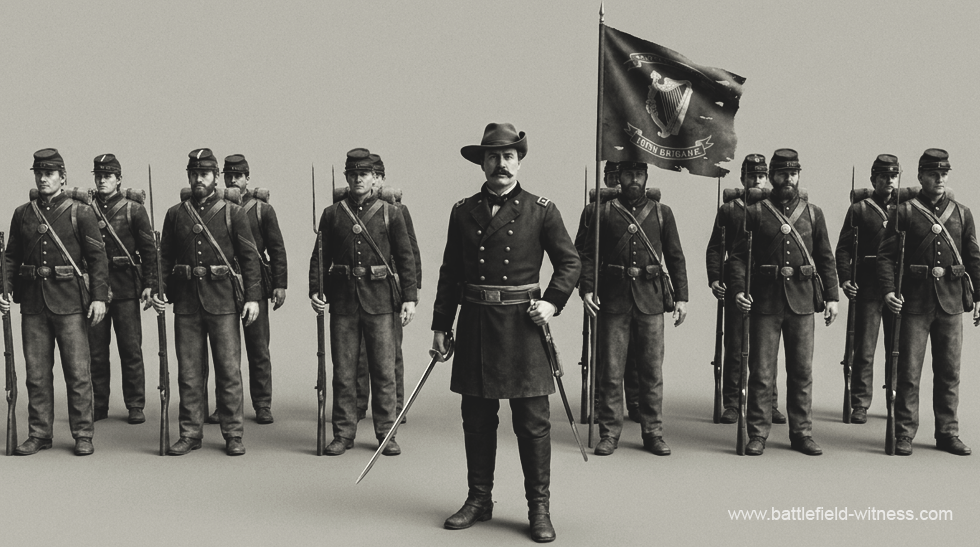
Secretary Cameron authorized it in September. Meagher was commissioned brigadier general the following February, and stood that winter on a New York parade ground in front of three regiments — the Sixty-Third, the Sixty-Ninth, the Eighty-Eighth — while a set of green silk colors, gold harp and sunburst worked into the field exactly as the flag he had unfurled from a Dublin balcony fourteen years before had been, were carried out and presented to each regiment in turn, to a silence that broke, each time, into a roar the parade ground could barely hold.
He had left Ireland a condemned man with a death sentence commuted by royal mercy into exile. He stood on that ground a general, in a country that had given him, in ten years, everything his own had taken away — and he understood, watching the new colors catch the raw February light, that he had also just finished building, out of grief and exile and a decade of speeches given to rooms that had nothing to do with Ireland at all, the instrument he had spent his whole adult life believing a free people eventually needed. He did not yet know what the instrument would cost. Very few men, watching a flag go up for the first time, ever do.
Within the week the brigade began its march south, toward a war that would take it, before that first green silk had worn a season, into a swamp outside Richmond where a boy named Michael Óg Cavanagh would watch him ride the review line for the first time and decide, on the strength of a coat button and a joke about Sergeant Driscoll's teeth, that the newspapers had gotten the shape of the man wrong in almost every particular except the one that mattered.
Sources
This narrative dramatizes documented events in Meagher's life. Key facts — the 1846 "Sword Speech" and its aftermath, the 1848 presentation of the Irish tricolour, the Clonmel trial and transportation, the 1852 escape from Van Diemen's Land, the marriage to and death of Catherine Bennett, the Bull Run "Fontenoy" episode, and the 1861–62 formation of the Irish Brigade — are drawn from the standard biographical record (Wikipedia, the Dictionary of Irish Biography, the Australian Dictionary of Biography, and the New York State Military Museum's unit histories), cross-checked against The Emerald Standard report supplied for this project. Dialogue and interior detail are imagined; the events, dates, and named participants are historical.
More to read:
 Anders Lawerny