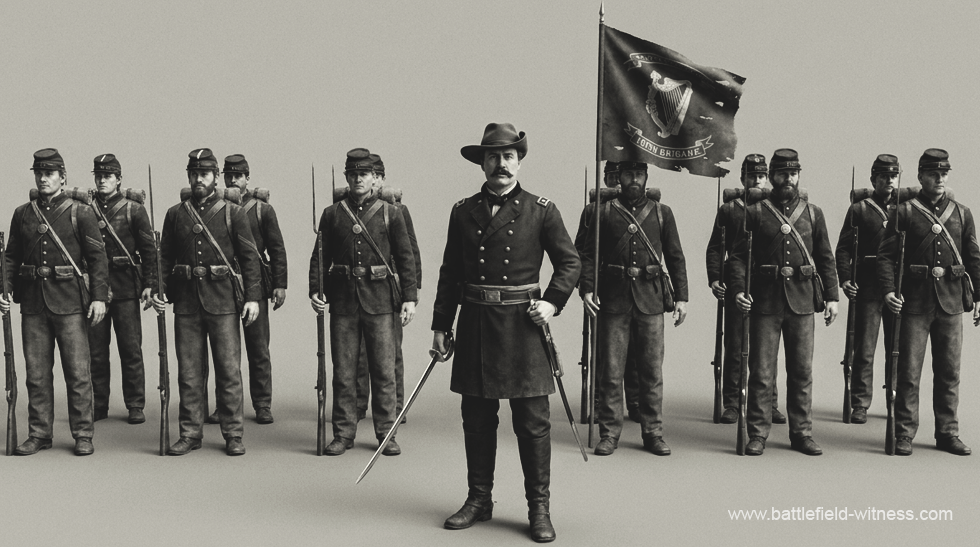
The Irish Brigade

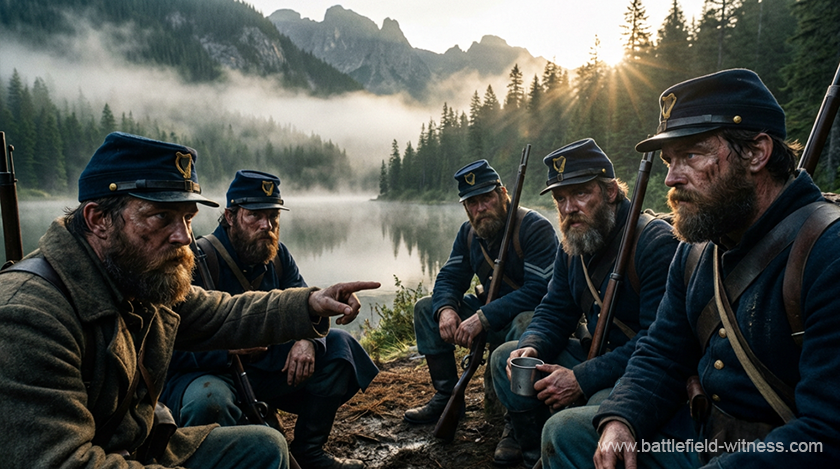
Clear the Way
A story of the Irish Brigade, Army of the Potomac, 1861–1862
I. Castle Garden, August 1861
He came off the ship at Castle Garden on a Tuesday morning in the third week of August, with four shillings and sixpence sewn into the coat lining and a bruise on his left cheekbone from the last night at sea, when the man in the bunk above him — a pig farmer from Roscommon who'd been watching his bread — had reached down and taken it, and Cormac had broken his nose.
The bruise was yellowing by the time the emigration agent looked at his face, then at his hands, then at his face again.
"Trade?"
"Labourer."
"Previous trade?"
"There was none previous."
The agent stamped his paper.
New York didn't smell like anything he'd imagined. He'd been told it was a great city, a clean city, a city built on money and possibility. What he smelled, walking north from the Battery with a man named Dolan who had a cousin somewhere in the Points, was the tanneries and the rendering works and the river and the unwashed mass of humanity piled up against itself like wet turf. The heat was different here — not the Irish wet-cold but a wet-hot that pressed against you like a hand.
"You'll get used to it," Dolan said.
"I'm already used to it," Cormac said.
He was nineteen years old and had been fighting since he was twelve — for food, for space on a road, for a girl named Brigid Callahan who he'd forgotten entirely by the time the ship was three days out of Cobh. He was built like a labourer who had never quite made it to labourer — lean through the middle but wide through the shoulders, with the kind of hands that looked larger than they were. His hair was black. His eyes were grey-green, the colour of the sea off the Old Head before a storm.
The Five Points was a grid of narrow streets where the buildings leaned toward each other overhead like men having a private conversation. It stank of cabbage and pigs and lime and something chemical he'd later identify as opium, drifting out of the dens on Orange Street. Dolan's cousin lived in a building on Mulberry that held, by Cormac's estimate, somewhere between forty and fifty people, distributed across six rooms.
He slept on the floor the first night, using his coat as a pillow, listening to Dolan snore and a child cry two floors up and the sound of something — a cart, a drunk, a dog — moving through the alley below. He didn't sleep much. He lay with his eyes open in the dark and thought: so this is it, and then he thought nothing at all.
II. Five Points, September 1861
He found work on the docks inside a week, carrying iron ingots off barges from the New Jersey shore. The work paid fifty cents a day when there was work, which was most days, and the foreman — a Tipperary man named Kehoe with a broken thumb that hadn't healed straight — gave preference to Irish men because the Italians and the Negroes worked for less and Kehoe resented them for it with a vigour that Cormac found both familiar and exhausting.
He found trouble faster than work.
The third week on the docks, a man from Galway accused him of taking more than his share from a load, and Cormac told him he was mistaken, and the man from Galway said he wasn't, and Cormac hit him hard enough to put him against a piling. Kehoe didn't fire him. Kehoe deducted two days' pay and told him the man from Galway had a reputation for lying and that he'd had it coming, and Cormac took this as something like approval.
The neighbourhood had its own mathematics — which men you could fight and which you couldn't, which corners belonged to which gangs, which ward bosses could get you work or get you broken. He learned these equations quickly but applied them selectively, which was to say he understood the rules and then ignored them when they annoyed him.
He fought three more times in September. Once outside a groggery on Worth Street — two men, brothers, who'd been rolling drunks off the canal docks and had decided he looked like a mark. He was not a mark. He came away with a split lip and a deep satisfaction. Once inside a boarding house when a man tried to steal his wages and he caught him at it and broke two of the man's fingers. The third time — this one shamed him slightly, after — was over a game of cards at Sweeney's saloon on Park Row, where he'd been winning genuinely and a fat man named Halloran accused him of cheating and he'd overturned the table and started in on Halloran before anyone could stop him.
A man named Sheehan separated them. Sheehan was thirty and had a sergeant's way of standing, weight evenly distributed, watching everything with the professional patience of a man who'd seen worse.
"Sit down," Sheehan said to Cormac.
"He called me a cheat."
"You broke his nose."
"He's got another one." Cormac looked across the room where Halloran was being helped up, bleeding freely. "He's fine."
Sheehan looked at him for a moment with an expression Cormac couldn't entirely read — not admiration, not contempt, something between the two.
"Where are you from?" Sheehan asked.
"Cork."
"I knew a Cork man once. He was a headache from start to finish and one of the best soldiers I ever served with."
Cormac said nothing.
"You want to do something useful with yourself," Sheehan said, "come to the hall on Frankfort Street Thursday evening. General Meagher is speaking."
He didn't go on Thursday.
He went on Friday, when there was a second meeting — he'd heard about it through Dolan, who'd heard it through his cousin — and stood in the back of the hall with fifty other men and listened to Thomas Francis Meagher.
Meagher was not what he'd expected. He'd heard the name — everyone had; the man was legend, or legend-adjacent, a figure from the great failed rising of '48 who'd been transported to Tasmania by the English and had escaped and made his way here and turned himself into a lawyer and an orator and now, with the country at war, had gone and gotten himself a commission. He'd expected someone theatrical, someone performing the role of great man. What he got was a man who stood perfectly still at the front of the room and spoke quietly enough that you had to lean forward to hear him.
Meagher talked about Ireland. Not sentimentally — not the Ireland of ballads and dead mothers — but about what had been done to it and what the men in this room had carried out of it. He talked about the war as an opportunity that would not come again in their lifetimes: a chance to prove to this country, and to themselves, and to the English watching from across the Atlantic, what an Irishman could do.
The eyes of the old country are on us, Meagher said. Show them what we are.
Cormac did not consider himself a patriot, not for Ireland and certainly not for America, which had given him fifty cents a day and the chance to sleep on a floor. He did not enlist because of Meagher's speech, exactly. He enlisted because of the way the speech made the room feel — forty men in a hot hall in lower Manhattan, standing straighter than they had been when they walked in — and because Dolan's cousin had told him the army would feed you three meals a day, and because he was twenty years old and had been fighting for eight years and he wanted, for once, to fight toward something rather than just away.
He put his name on the paper that night. Cormac Flynn, 19, Labourer, County Cork, Ireland. He wrote it in a clear, careful hand, because his mother had made sure he could read and write and he was not going to let anyone think otherwise.
"69th New York," the man behind the table told him. "The Fighting 69th."
"All right," Cormac said.
III. Camp California, Near Washington, October–November 1861
The regiment was not yet the brigade. The brigade would come later — the 63rd New York, the 88th New York, and the others gathering under Meagher's green flag like iron filings to a magnet. For now they were the 69th, drilling on a slope of Virginia mud above the Potomac, and Cormac was in Company D, and the man who had been given charge of his soul — in the most practical and immediate sense — was Sergeant Finbarr Doyle.
Doyle was from Bantry. He was thirty-six years old and had spent seven years in Her Majesty's 8th Regiment of Foot before buying his discharge and emigrating, and he stood five feet nine inches tall and had the build of a man who had been doing difficult physical work since childhood. He had a scar along his jawline from a Sepoy bayonet in India, which he mentioned once and never again. He ran Company D as though it were his personal property and the men in it were something between children and livestock he expected eventually to become useful.
The first week, Cormac received three individual corrections from Doyle. The first concerned the proper method of carrying his Springfield rifle on the march. The second concerned a remark he'd made to a corporal. The third — the significant one — came on the sixth day, when he'd been found behind the supply tent sharing a bottle of bourbon with two men from Company F who'd obtained it through channels that would not survive examination.
Doyle didn't shout. This was the thing about him that took some getting used to. He stood in front of Cormac and the two men from Company F and regarded them with the expression of a man looking at something that has disappointed him for the last time.
"You two," he said to the Company F men, "go find your sergeant and tell him you've been making friends where you shouldn't."
They went.
Doyle looked at Cormac.
"D'you know what it costs," Doyle said, "to be dismissed from this regiment?"
"I wasn't being—"
"Nothing. It costs nothing. Meagher will hand you a train ticket north and you'll be back on the docks inside a week. Is that what you want?"
Cormac said nothing.
"I've been watching you," Doyle said. "Not because you're troublesome — I've had troublesome men. I watched you because you learn fast, when you choose to learn, and you can shoot — I've seen you on the firing line — and you don't flinch. Those three things in one man are worth more than ten docile fools with clean records."
Cormac said: "Then why are you threatening to dismiss me?"
"Because I will. If you make me." Doyle picked up the bottle and looked at it. "There'll be whiskey enough in this war. Men will press it on you the night before a battle. There's a time for it and a time to put it down and know the difference." He set the bottle carefully on a supply crate. "Can you do that?"
"I can do that."
"And the fighting. In camp."
"I haven't—"
"You have. Quinn from C Company. The sutler's boy." Doyle's face showed nothing. "In camp, you're a soldier, and a soldier under my authority. Your fists are mine until I say otherwise. Do you understand that?"
He did not entirely accept this. But he understood it, and the distinction, he was beginning to see, was one that Doyle was willing to live with.
"Good," Doyle said. "Tomorrow you'll help me drill the new men on loading procedure. They're taking forty seconds to reload and that's a death sentence in the field."
He walked away without waiting for an answer.
Cormac stood in the twilight and looked at the bottle on the crate. After a moment he picked it up, corked it, and put it inside his coat, and carried it back to his tent and stored it in his kit, because waste was its own kind of stupidity and he was not a stupid man.
The drilling sharpened him. Not just physically — he was already hard from the docks — but in the particular way that military precision demands: the exact angle of the Springfield on the march, the sequence of cartridge-bite-powder-ball-ram, the way you moved as part of a formation instead of as yourself. He found, to his own slight surprise, that he liked it. The logic of it. The way a company of men, trained to act as one, became something more efficient and more dangerous than any individual. He'd always been able to fight. This was something different from fighting.
By December he could load and fire his Springfield in under thirty seconds.
By February he knew the names of every man in Company D, their counties of origin, their weaknesses, which ones would hold in the field and which ones he wasn't sure about. Doyle had put him in charge of the new men's bayonet practice, and he ran it with a seriousness that surprised him, and a patience that surprised him more.
There it is, he thought once, watching a farmer's son from Kilkenny finally get the thrust angle right. There's the thing he saw in me.
IV. The Sunken Road, Antietam, September 17, 1862
By September of 1862 they had crossed a continent of experience. The Peninsula Campaign — the mud and heat of the Chickahominy swamps, the fighting at Fair Oaks and the Seven Days where men drowned in their own blood in the ditches between the lines. Gaines' Mill, where the Confederate infantry had come through the pine trees in the late afternoon and the brigade had held the line an hour past the point where holding it made any sense, because holding it was the order and Meagher's men did not retreat until the order came.
Each engagement wore the regiment thinner, took men Cormac had eaten beside and drilled with and argued with and, in one or two cases, called something approaching a friend.
Doyle had been wounded at Gaines' Mill — a rifle ball through the meat of his left forearm — and had returned to duty inside three weeks, arm in a sling, refusing a hospital bed with a contempt that the surgeons took personally. He walked differently after that, slightly favouring his left side, though you had to know him to see it.
On the morning of September 17th they were in a cornfield near a town called Sharpsburg, in Maryland, and the Army of Northern Virginia was somewhere ahead of them, and the air already smelled of powder smoke and something green and crushed underfoot, and somewhere to the north there was fighting of a seriousness that carried in the air like weather.
General Meagher rode along the front of the brigade in the early morning and addressed them. His horse was uneasy with the sound from the north and Meagher managed it almost absently, as though the horse were simply a detail to be dealt with while his attention remained on the men in front of him.
"Put a bit of green in your caps," he told them, "so God and your enemies both know who you are."
There was no shamrock to be had in Maryland in September. They tore sprigs of boxwood from the hedgerows and pushed them into their hatbands. Cormac did it without ceremony, the way he did everything now — with his hands and not his feelings, which was the thing Doyle had taught him that had no name but was the most important thing.
He looked down the company line. Mangan to his left, who had been a schoolteacher in Limerick and was now one of the calmest men under fire he knew — not because he lacked imagination but because he seemed to have located, somewhere inside himself, a very still place that the noise couldn't reach. McGrath to his right, twenty-two years old, who had never been to Ireland and spoke with a New York accent and had enlisted because his father had and because the bounty money would pay off a debt. Dolan was there — the same Dolan from the voyage, the same man who'd walked north from the Battery with him — fourth from the right in the second rank, jaw set, not looking at anything in particular.
"Fix bayonets," Doyle said.
The sound was particular: the company fixing bayonets simultaneously, the click and lock of it running down the line like a sentence being spoken in pieces.
They went forward into the cornfield. The corn was high — taller than a man, the stalks as thick as a wrist — and they could see nothing ahead of them, which meant nothing ahead of them could see them, which was either good or bad and there was no way to know which until it became one or the other.
Mangan said something to his left and Cormac said not now without looking at him.
The corn ended.
What was ahead of them was a road. A farm road that ran through a low ground between two rises, sunken below field level from decades of use, its banks worn down to a kind of natural trench — and in that trench, behind those banks, were Confederate infantry, grey and butternut, spread along three hundred yards of field, their rifle barrels resting along the bank, and they had been waiting for some time and they knew precisely how to do this.
The first volley came like a single enormous blow. The men on Cormac's right — McGrath and the two behind him — went down as though the same hand had swept across them. The sound was not loud in the way he'd once imagined it would be; it was more intimate than that, the sound of something passing very close to your ear that would have passed through your head if you'd been standing six inches to the left.
"Advance!" someone was shouting — an officer somewhere behind the line, voice cracking on the word. "Advance — don't stop —"
He advanced. This was the thing about all the drilling: his body knew what to do when his mind became very quiet and very simple, which is what it became under fire. His body went forward because forward was where the training said to go, because stopping was dying, because Doyle's voice was somewhere to his left saying keep moving, keep moving, you're not hit, keep moving.
He fired once, loading and firing as he walked — not aiming at anything specific; there was nothing specific to aim at, only the grey mass along the sunken road — and then the brigade was close enough that rifles became secondary and it became what all of it, at bottom, always became. The particular kind of close work he'd been doing since he was twelve years old, only now with a bayonet and a uniform and two hundred men alongside him instead of alone in a Cork laneway.
The sunken road was a particular piece of hell. The Confederate troops had held it since morning; the bodies were already deep in places, the wounded mixed with the dead, men still firing from beneath the men who'd fallen on them. The smoke was so thick that visibility was a matter of feet. You moved by sound and the position of the sky, which was somewhere above you, which was how you knew up from down.
Mangan was beside him and then was not beside him.
He didn't think about Mangan. He thought about the ground under his feet and the man in front of him.
Doyle found him an hour later, when the road was taken and the firing had moved north and the brigade had been pulled back to reform — what remained of the brigade. They had gone in that morning with several hundred men and come out with far fewer. This was not unusual for a regiment of the Army of the Potomac in the autumn of 1862, but it felt unusual. It felt like something that should not be allowed to become usual, even as it did.
Doyle was bleeding from the side of his head. Not badly — scalp wounds bled extravagantly, as the surgeons had explained more than once — but he had the particular expression of a man who'd been very briefly adjacent to death and had not yet decided how he felt about this.
He looked at Cormac for a moment without speaking.
"Mangan," Cormac said.
"I know."
"McGrath."
"I know."
They stood in the field, which was no longer a cornfield — the corn had been shredded in the first hour of fighting into something that looked like it had come up from underground rather than grown down into it. The smell was things he wasn't going to name. Across the field, surgeons were already moving among the fallen, and someone was bringing water from the creek in buckets, and the sound of the battle had moved away to the north where other men were having their own version of the same morning.
"You held the left," Doyle said finally. "When the line bent, you held the left."
"I didn't — I was just —"
"You held the left," Doyle said again, with a finality that ended the conversation, that indicated these were the facts of what had happened and that Cormac's feelings about his own actions were not relevant to them.
Dolan came up from somewhere. He had lost his hat. He looked at both of them and then he sat down in the field because there was nowhere else to sit, and put his face in his hands — not crying, just resting it there for a moment, the way a man might lean against a wall after carrying something very heavy a very long way.
Neither Cormac nor Doyle said anything.
After a while Doyle said: "There'll be a roll call at four."
"Yes," Cormac said.
The sun had moved. He hadn't noticed it moving. He reached up to his hatband and found the sprig of boxwood was still there, impossibly — still tucked in, slightly crushed, still faintly green. He took it out and looked at it for a moment, this small ordinary piece of a Maryland hedgerow that had become something else for a morning, that had stood in, this morning, for another country and another life.
He put it back in his hat.
He went to find water for the men.
V. After Antietam
They said the battle of Antietam was a Union victory. They said it because McClellan said it, and because the Confederates had withdrawn back into Virginia, and because Lincoln used the outcome, two weeks later, to announce what would become the Emancipation Proclamation. Cormac did not think about it in terms of victory. He thought about it in terms of who was still present and who was not.
In December they would go to Fredericksburg, where Meagher would send them up a hill in Virginia called Marye's Heights and they would go, and go again, against a stone wall behind which Confederate sharpshooters were stacked four deep, because the order came and because they were the Irish Brigade and this was what they did. The hill was paved with Union dead before the day was out.
In May they would go to Chancellorsville. The brigade would keep going until it was nearly gone, until Meagher resigned his commission in protest over the War Department's failure to reinforce his shattered regiments, until the green flag with the golden harp was so shot through it was more air than cloth.
But that was later.
In October of 1862, Cormac Flynn was twenty-one years old and a corporal by Doyle's recommendation — he'd refused the first time, accepted the second, understanding at last what Doyle had understood from the beginning, which was that the promotion was not about him but about the men he'd be responsible for. He had his sprig of boxwood pressed in the pages of the Testament his mother had pushed into his hands on the pier at Cobh, the morning the tide was right and the ship was waiting.
He wrote to her twice a year. She could read but not write, so she had a priest do it, and the letters came back formal and a little stiff, the words not hers but the hand on the paper hers. He could feel it somehow — the way a letter carried more than its language.
He did not tell her what the road at Sharpsburg had looked like. He told her the weather was different in America. He told her the food was plentiful, which was mostly true. He told her he was learning things.
I am learning things, Mam.
He meant it in all the ways it could mean — the drilling and the loading and the bayonet work and the map reading Doyle had begun to teach him in the evenings, the names of generals and the purposes of terrain and the grammar of the country they were moving through. But also the other things: what a man can carry and what he can't. What it is to hold a line when every nerve in your body is telling you to run. What it is to look at the men on either side of you and understand that they are your responsibility now, that their lives are the thing in your hands that you must not drop.
The army moved again in the early light, and he moved with it, and the sound of it — ten thousand men on a road, their equipment and their footsteps and their voices — was a sound he'd come to know so well that he could hear it in the spaces between other sounds. Could hear it even in the silence of a Maryland field on a cold October morning, the ghost of the army moving through the place where the army had been.
Faugh a Ballagh, he thought.
Clear the way.
Based on historical events. The Irish Brigade — comprising the 63rd, 69th, and 88th New York Infantry regiments, and later the 28th Massachusetts Infantry — fought in every major engagement of the Army of the Potomac's Eastern Theater from 1861 to 1865, sustaining some of the heaviest casualties of any Union brigade. At Antietam on September 17, 1862, the brigade's charge against the Sunken Road (Bloody Lane) reduced its effective strength by more than half in under an hour. Brigadier General Thomas Francis Meagher commanded the brigade from its formation until his resignation in May 1863. The practice of wearing green sprigs of boxwood at Antietam — substituted for shamrock in the absence of the plant in Maryland — is documented in contemporary accounts.
More to read:
 Anders Lawerny