The Fall of Atlanta

Part of "Abraham Lincoln and the American Civil War" — Story Three
Atlanta, Georgia — September 2 to September 20, 1864
Private Asa Coyle had expected a battle for Atlanta, and instead got a silence so complete that the regiment's own boots sounded like an intrusion.
They came into the city from the north on the morning of the second, down a road still marked every few hundred yards with the raw earthworks of a siege that had, in the end, simply stopped happening — trenches and gun pits and the chewed stumps of a forest that four months of shelling had reduced to kindling, and beyond all of it, rising out of its own smoke, a city that did not look like a prize so much as a wound. Word had come down the column before they'd covered the last mile: the Rebels were gone. General Hood had pulled his whole army out in the night, and going out had put a match to what he couldn't carry — eighty-one carloads of fixed ammunition and small arms, someone said, though the number changed every time a man repeated it, touched off in the rail yard so that the ground itself had shaken for a county in every direction and half of Atlanta's own citizens had believed, waking to it, that the war had finally come all the way inside their houses.
It was Colonel Coburn's brigade that took the actual surrender — a delegation of Atlanta's leading men, the mayor himself among them, riding out along the Marietta road under a white bedsheet lashed to a fence rail to hand over a city that had, by then, nothing left to defend it with. Asa heard about it the way he heard about most things that happened more than two hundred yards from his own place in the column: secondhand, softened by retelling, arriving already halfway to legend. What he saw with his own eyes, marching in behind the provost guard that same morning, was simpler and stranger than any surrender — street after street of handsome brick storefronts standing intact and utterly silent, curtains drawn in windows that had somehow survived a summer of shelling, and running under the quiet, unmistakable even at a distance, the smell of a fire that had not yet finished deciding what it wanted to consume.
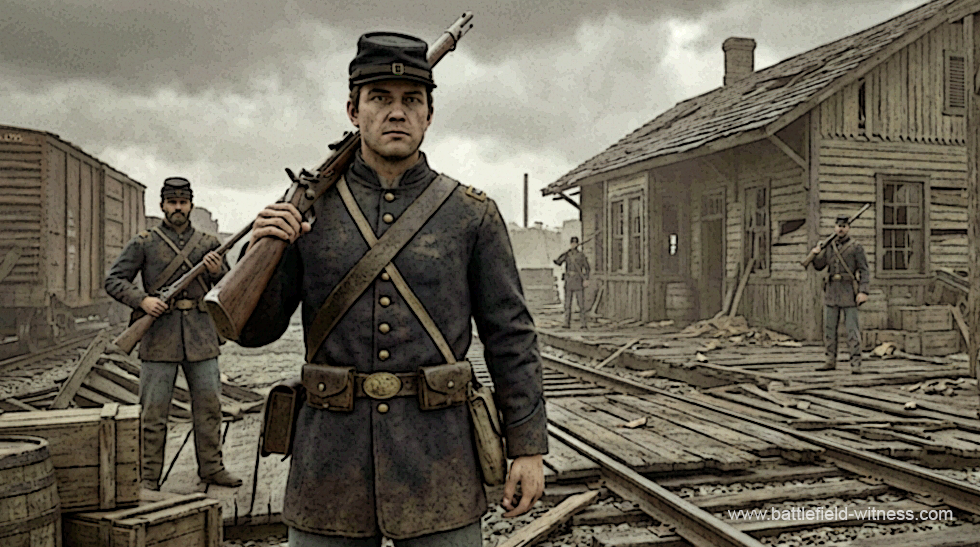
They found what was left of the rail yard by early afternoon, and it was there, more than anywhere else in the ruined city, that Asa understood for the first time exactly what this war had been fought over. Atlanta had not been a town before it was a railroad — the old-timers said the place hadn't even had its own name in the beginning, just Terminus, because that was what it was, the point where four lines out of four different directions ran together and stopped, and everything built up around that fact afterward, foundries and rolling mills and the great iron-roofed car shed downtown, until the town and the tracks were the same thing wearing two different names. Now the car shed stood scorched and half-collapsed at one end, its glass gone, its iron ribs showing black against the sky, and the yards beyond it were a boneyard of split rail and burst boiler iron, engines tipped on their sides where the retreating Confederates had run them together and dynamited them rather than let a locomotive fall into Union hands. Captain Otis put half the company to work that same afternoon clearing wreckage off the Western and Atlantic's own line — the single track that ran a hundred and thirty-eight miles back to Chattanooga and Nashville and, past that, to everything the army actually needed to keep living — because a general could win a city and lose a war in the same afternoon if the road behind him didn't hold.
"Funny thing to fight four months over," Corporal Dresser said, working a bent rail spike loose with the flat of his bayonet. "A depot."
"Wasn't the depot they were fighting over."
"Wasn't it?" Dresser didn't look up. "Man could argue different. Everything this whole war's been about — the cotton, the corn, the guns, the men to carry them — none of it goes anywhere without something like this to carry it on. Might be the depot's the only honest thing in the whole business. Least it doesn't pretend to be fighting about anything but what it plainly is."
Asa thought about that longer than he generally let himself think about Dresser's notions, because there was usually a burr hidden somewhere in them that caught on a man's conscience if he handled the thing too long. He had been with the regiment eleven weeks — since a replacement draft caught up to it outside Marietta in June, three weeks after the telegram about his brother, and he had shot a man for the first time nine days after that, outside a farmhouse near Kennesaw Mountain, and had not yet, eleven weeks in, worked out how to carry the knowledge of it without setting it down somewhere it didn't belong. Atlanta, filling up now with the particular quiet of a captured place, felt like somewhere it didn't belong. It felt, if anything, like the war taking a breath.
The breath lasted five days, and then Sherman's headquarters, set up now in the city itself, began putting out orders that told Asa's company they had not, after all, been sent to Atlanta merely to rest.
The word ran through camp before the paper did, the way it always did — Sherman meant to empty the city. Not the soldiers. Everyone else. Every family that had sheltered through the summer's shelling in cellars and cotton-bale bombproofs was to be gone within days, north to the Union lines or south to Hood's, whichever they chose, but gone, because the city, in the language of the order that finally did come down and get read out to the assembled companies on the parade ground, was exclusively required for warlike purposes and would be held as nothing else from now until the army had no further use for it.
Mayor Calhoun wrote to protest it — Asa learned this from Sergeant Pratt, who'd learned it from a clerk at headquarters, who claimed to have carried the letter himself — describing families with sick children and no possessions left to carry them with, turned out at the start of a Georgia autumn onto roads that led nowhere safe in either direction. Sherman's answer came back within days, and it was Pratt again, reading it off a newspaper reprint by the fire with the particular relish of a man who has found a sentence he intends to remember, who gave Asa the words that would stay with him longer than almost anything else he carried out of that city: War is cruelty, and you cannot refine it.
"That's the whole of it, isn't it," Pratt said, folding the paper. "Man's not wrong. Doesn't make it sit any easier."
"He offer them anything?"
"Wagons. South to the Rebel lines or north to ours, whichever they'll take, and their furniture hauled for them as far as the lines will let a wagon go." Pratt spat into the fire. "Generous, for a man burning down half of Georgia by Christmas most like."
Asa was put on the detail that ran the register at the depot for six days running — not by any particular distinction, only because Captain Otis had asked, in front of the company, whether any man among them could write a fair hand and keep a column of figures straight, and Asa, who had kept his father's feed accounts from the age of eleven, had been fool enough to raise his arm before he understood what he was volunteering for. He spent those six days at a table set up under the wrecked awning of the depot's south end, taking down names for Lieutenant Colonel Le Duc's tally as families came through with whatever a wagon or a handcart or their own two arms could carry — furniture lashed with rope, a rolled carpet, a birdcage with the bird still in it, a grandfather's mantel clock that a boy no older than twelve carried the whole distance himself rather than let it out of his hands. Adults, children, the few servants some families still had and had not yet had occasion or means to free — Asa wrote them all down in the same column, in the fair hand his father had taught him, and did the arithmetic in his head each evening the way he could not stop himself doing arithmetic, and by the ninth day of the thing the number in his own private reckoning stood past sixteen hundred souls, more children than grown men and women put together, walking or riding out of a city that three months before had belonged, however uneasily, to nobody but them.
He remembered one woman particularly, not because anything about her was remarkable but because nothing was — a Mrs. Prentice, by her own account, who gave her name and the names of her four children in a voice so level it took Asa a full minute to understand that the woman was not calm at all, only holding herself the way a plate holds together right up until the moment it doesn't. Her husband was dead at Chickamauga, she said, unasked, as if the fact were simply part of the paperwork and belonged in the register along with everything else. She did not know yet whether she was going north or south. She had family in both directions and could no longer remember, she said, which side had written to her last.
"Take the wagon as far as it goes either way, ma'am," Asa told her, because it was the only true and useful thing he had to offer a woman he would never see again. "Man at the head of the line will tell you where the trains run from."
She looked at him then — really looked, the first person all morning who had — and said, not unkindly, "You're very young to be doing this."
"So's half the army, ma'am."
"That's not an answer." But she took her paper and moved on toward the wagons, and Asa sat with the register open in front of him and did not, for a long moment, write anything at all.
The wagons went out along the Rough and Ready road in trains of a dozen and more, under white flags the army itself provided, to a scrap of railroad crossing eight miles south where Sherman's officers and Hood's own met by daylight in a truce neither side entirely trusted and both, for those weeks, entirely honored — families and furniture handed across from Union wagons to Confederate rail cars at a depot so small it barely rated the name, then on by train to Lovejoy's Station and whatever the Confederacy still had to offer them beyond it. Asa never rode that road himself. He heard about it from the teamsters who did, men who came back close-mouthed and short-tempered in a way that told him more than their words did — that there was something in watching a woman climb down from one country's wagon onto another country's train, in the space of an afternoon, without the war itself ever once pausing to notice she'd crossed a line at all, that did not improve with retelling.
By the twentieth of the month the register had gone quiet, the count settling somewhere past sixteen hundred, and the streets that had held Atlanta's whole civilian life all summer through gunfire and shortage and the daily arithmetic of what could still be found to eat, stood empty in a way that felt, walking them, less like peace than like the specific quiet of a house the day after a funeral, when the visitors have gone and the family left behind must learn to live inside the size of what's missing. Soldiers moved into the handsome brick houses the fleeing families had left furnished and unlocked, because an army needed roofs before winter same as any other family did, and Asa slept for the first time in eleven weeks under an actual ceiling, in a bed that had belonged, three weeks before, to somebody's grandmother, and did not sleep well in it, and could not afterward have said exactly why.
He wrote to his sister that week, the first letter he'd managed since Kennesaw, and found that most of what had happened would not go into a letter at all — not the register, not Mrs. Prentice, not the boy with the mantel clock, not the particular quality of the silence in a captured city on the evening its last legitimate residents were gone from it. He wrote instead that the regiment was resting, that Atlanta had fallen without much of a fight in the end, that he was in good health and had a roof over his head for the first time since Georgia, and signed it the way he always signed his letters home, and did not mention that the roof in question had until three weeks before belonged to a family he had personally counted out of the only house they'd known, in a column, in his own fair hand, at eleven years old already good for something.
The city held through the fall as nothing but what Sherman's order had named it — a warehouse, a rail junction, a fortified rear base with the last of its civilians gone from it — while the rest of the army marched south and west after Hood into Alabama and found him too fast and too far to catch. It would not stay quiet. Within the season Sherman would burn what remained of the place he had spent five months and thousands of men taking, and march the whole of his force out through the ashes toward the sea, and Asa Coyle would march with them, carrying by then a different kind of arithmetic than the one he'd learned at that depot table — but that was still two months off, in September, when Atlanta was only silence, and a register of names, and a city holding its breath for a war that had not finished with it yet.
Historical Note
Atlanta fell without a final battle for the city itself: after the Battle of Jonesborough severed the last rail line into Atlanta (August 31–September 1, 1864), Gen. John Bell Hood evacuated overnight, destroying eighty-one carloads of ordnance and matériel in explosions heard for miles. Mayor James Calhoun surrendered the city on the morning of September 2, 1864, to the pickets of Col. John Coburn's brigade; Sherman's forces, including the XX Corps under Maj. Gen. Henry Slocum, occupied and garrisoned the city.
On September 7, Sherman informed Gen. Hood of his intention to remove Atlanta's civilian population; Special Field Orders No. 67, issued September 8, 1864, declared the city "exclusively required for warlike purposes." Hood, after protesting the order's "studied and ingenious cruelty," agreed on September 9 to a truce at Rough and Ready, Georgia, where civilians and belongings were transferred from Union wagons to Confederate rail cars bound for Lovejoy's Station. Mayor Calhoun and two other citizens petitioned Sherman to reconsider; his reply of September 12, 1864, contains the line quoted in this story: "War is cruelty, and you cannot refine it." Between September 10 and 20, 1864, Lt. Col. William G. Le Duc's registration recorded 1,651 people evacuated — 705 adults, 860 children, and 86 servants, with 8,842 packages of belongings.
Private Asa Coyle and Corporal Eli Dresser, readers of the first story in this series will recognize, are the same fictional soldiers of the 33rd Massachusetts Infantry who march with Sherman to Savannah two months after the events told here; Sergeant Pratt, Captain Otis, and Mrs. Prentice are also fictional. Mayor James Calhoun, Gen. Hood, Gen. Sherman, Col. Coburn, and Lt. Col. Le Duc are historical figures; their documented actions, orders, and quoted words are drawn from the record, though no invented dialogue is placed in their mouths beyond what survives in that record.
Next in the series: Gettysburg.