A historical short story about Roy Chadwick and the Avro Lancaster

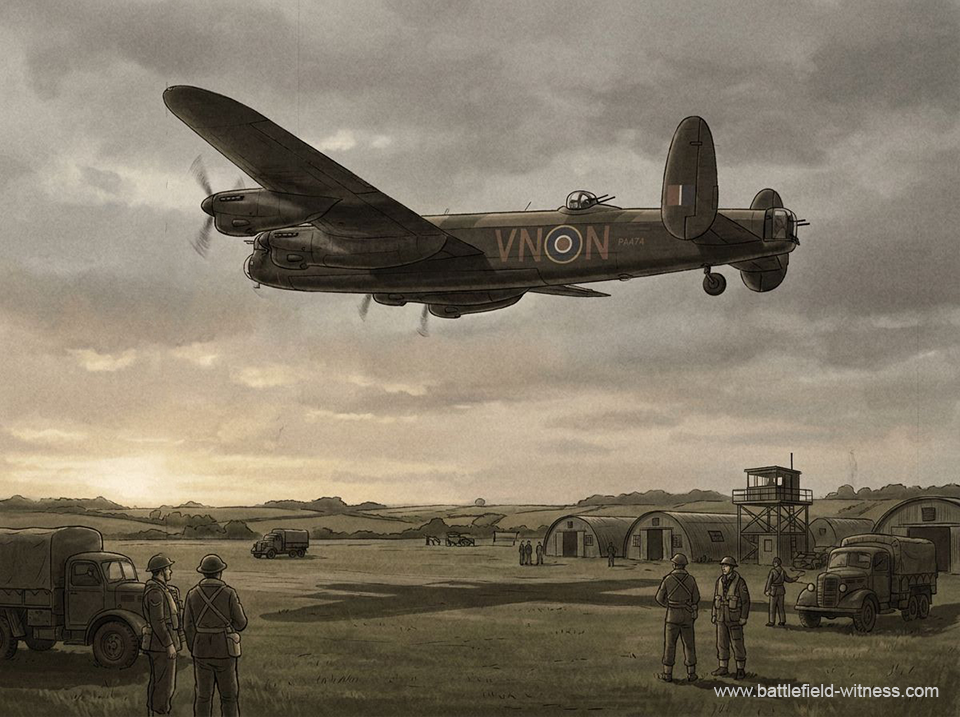
The Shape of the Wing
I. Urmston, Lancashire — Autumn 1904
The silk had been a blouse once. A Sunday one, cream, with a row of covered buttons that Agnes Chadwick had sewn on herself, and the boy knew he would pay for it.
He had cut it along the seams first, because that seemed less like theft, and then cut the panels again until they fitted the frame he had built from split cane and glue that smelled of boiled horses. The wing was a little longer than his forearm. He had doped the silk with his mother's starch and it had dried taut as a drum skin. When he flicked it with a fingernail it gave back a small hard note.
He waited for dusk. That was the rule he had made for himself. In daylight there were the Pickering boys from two doors down, and the man with the coal cart, and grown-ups who would stop and lean on the fence and ask him whether he thought he was the Wright brothers, then, and laugh in the way that meant they had decided something about him. Flying was for cranks. Everyone said so. The newspapers said the two Americans had done it, last December, at a place with a name like a sneeze, but in Urmston it was still something you were not supposed to want in public.
So he went out past the last houses when the light was going brown and the field had a skin of mist on it at knee height. Rooks were coming in to the elms. A train went through somewhere towards Flixton and the sound arrived late, the way thunder does.
He held the model above his head, pointed its nose slightly down, and ran.
It went. Not far. It climbed, stalled, dropped a wing and turned in a lazy, drunken circle and slid into the wet grass twenty feet away. He stood still for a long moment with his hands open.
Then he picked it up and turned it over, very carefully, the way his father turned over a broken governor from the works, and looked at the starboard wing tip. It had flexed. He could see where. The silk had puckered along the third rib.
He was eleven years old. He did not feel triumph. He felt the thing he would feel for the rest of his life whenever a machine did not quite do what he had drawn: a narrowing, a cold attention, as though the whole world had shrunk to the width of one rib.
He walked home in the dark rehearsing what he would say about the blouse. He did not get very far with it. He kept thinking about the rib.
II. Chadderton — June 1940
The drawing office at Chadderton ran the length of the building under a saw-tooth roof, and in summer the north light came down through the glass like milk. Forty boards in rows. Forty men and a scattering of girls, sleeves rolled, heads down, the room full of the dry whisper of pencils and the occasional crack of a set square laid down too hard.
Joan Ashworth had been a tracer for fourteen months. She was twenty, from Failsworth, with ink under her right thumbnail that no amount of Lifebuoy would shift, and she had learned to tell where the Chief was in the room without looking up, from the way the sound changed. Men sat straighter. The pencils got quieter, as if they were afraid of being overheard.
He was behind her now. She knew the smell of him: pipe tobacco, and the faint mineral smell of the cartridge paper he carried about folded in his jacket pocket.
"Miss Ashworth."
"Mr Chadwick."
"That's the Manchester outer wing joint you've got there."
"Yes, sir. Mr Haslam's revision."
He leaned over her shoulder. He was a broad man, not tall, forty-seven that year, with thick dark hair going back at the temples and a face that settled, when he was thinking, into something almost sullen. She had heard that he could look at a drawing for ten seconds and find the one dimension that was wrong. She had seen him do it twice.
He did not find anything wrong with this one. He looked at it for a long time anyway.
"Leave that," he said. "Bring your things into my office. Bring Mellor's span figures too, if he's finished with them."
His office had a window onto the yard, where a Manchester fuselage section sat on trestles under a tarpaulin like a beached whale. There were drawings pinned to every wall, and on the desk a single sheet of cartridge paper weighted at the corners with an ashtray, a slide rule, a tin of Three Nuns and a lump of aluminium casting that might have been a hinge bracket.
On the sheet was a wing.
Joan knew the Manchester's wing. Everyone in the building did. This was that wing and not that wing. It was longer. The centre section was the same, she could see the spar booms, the same fuselage attachment points, but it reached further out on both sides, and instead of the two great nacelles for the Vultures there were four. Smaller. Neater. Slung forward under the leading edge like teeth.
"Merlins," she said, before she could stop herself.
Chadwick looked at her for the first time as though she were a person and not a pair of hands.
"Merlins," he agreed.
Roy Dobson came in without knocking, which was the privilege of the general manager. He was a short, square, restless man who had come up from the shop floor and never let anyone forget it, and he had the loud, flat voice of someone used to being heard over riveting. He shut the door behind him.
"That's it, is it?"
"That's it."
Dobson came round the desk and stood looking down at the drawing with his hands in his pockets. Joan, not knowing whether to leave, made herself small against the filing cabinet and pretended to sort Mellor's figures.
"Twelve foot more span," Chadwick said. "A hundred and two overall. Same fuselage, same centre section. Same jigs for most of it, Roy. That's the point. We don't start again. We take what we've got and we give it four engines that work."
"The Ministry gave us a specification for two."
"The Ministry gave us a specification for two engines that Rolls-Royce hasn't finished." He said it without heat. "You've seen the reports from Boscombe Down. You've seen them as well as I have."
Dobson had. They all had. The Manchester was not yet with a squadron, would not be for months, but the trial flying had already produced a list of Vulture failures that read like a casualty roll. Connecting rods. Bearings. Overheating on the climb. Twenty-four cylinders in an X, two Peregrines married at the crankshaft, and when one part of the marriage failed the whole thing tore itself apart.
"An aeroplane is only as good as the worst thing in it," Chadwick said. "And the worst thing in that one is the thing that holds it up."
"There's talk," Dobson said slowly, "in London. About us building Halifaxes under licence. Handley Page's. Instead."
Chadwick did not answer at once. He picked up the slide rule, opened it, closed it.
Joan had never heard silence like it. She could hear the pencils through the wall.
"Then we'd better be quick," Chadwick said.
Dobson laughed, once, a bark. He bent over the drawing again and put a thick finger on the inboard port nacelle.
"Power eggs?"
"Self-contained. Engine, radiator, cowlings, mountings, the lot. Bolt it on, bolt it off. A crew in a field with a crane could change one in a day." He tapped the trailing edge. "And it all breaks down. Look. Centre section, inner wings, outers, tips. Nose, front fuselage, centre, rear, tail. Every piece small enough to go on a lorry under a railway bridge, every piece wired and piped before it leaves the shop. We'll not be building these in one place, Roy. I know that. You know it. If they want hundreds, they'll be built in bus garages."
He said bus garages as though he had already seen them.
Dobson straightened up. "Manchester Three," he said. "That's what we call it, for now. It's a Manchester. It's a development. Nobody in Whitehall frightens easily of a development."
"Call it what you like," Chadwick said. "It'll fly."
When Dobson had gone, he seemed to remember Joan was there.
"You've a good line," he said. "Steady. I want you tracing the general arrangement for this. You'll not talk about it."
"No, sir."
He was already looking at the drawing again. She was almost at the door when he spoke without lifting his head.
"Have you anyone in the services, Miss Ashworth?"
"My brother, sir. Alfred. He's training. Fitter's course, at St Athan. He wants to fly." She hesitated. "He wants to be a flight engineer, if they'll have him."
Chadwick nodded slowly, as if she had given him a figure and he was carrying it to another column.
"Then we'd better be quick," he said again, to nobody.
III. Ringway — Thursday, 9 January 1941
The cold at Ringway came off the Cheshire plain in a single sheet, with nothing to stop it from the Pennines to the Mersey. It found the gap between collar and neck. It found the bones of the hand through two pairs of gloves.
The aeroplane stood on the apron in front of the experimental hangar with its four propellers still, and in the flat grey light it looked bigger than anyone had expected. It was not painted for war yet. It was not yet much of anything. Its fuselage was a Manchester's fuselage. Its tail still wore the Manchester's three fins, the odd central one sticking up like an afterthought. But the wing was the new wing, the long one, and even standing still it had a look of being about to leave.
BT308.
Chadwick stood a little apart from the group by the hangar door. He wore a heavy overcoat and a trilby that the wind kept trying to take, and he had not spoken for twenty minutes. Men who worked for him knew not to try.
Sam Brown walked out to the aircraft with Bill Thorn beside him. Brown was Avro's chief test pilot, compact and unhurried, a man who flew the way a good surgeon cuts: no flourish, nothing extra. Thorn was younger, broad-faced, cheerful in a way that made people trust him with their aeroplanes. They stopped under the nose and Brown said something and Thorn laughed, and the sound carried thin and strange across the concrete.
Chadwick watched them climb the ladder. He could have told you, then and for the rest of his life, the weight of the aircraft in that moment to within a hundredweight. He could not have told you what he felt. When Mary asked him, that evening, he said, "Cold."
The starboard inner coughed first. Blue smoke, a stutter, then the long, rising, tearing note of a Merlin catching, and the propeller went from four blades to a grey disc. Then the port inner. Then the outers. Four of them together made a sound that was not the sum of four engines but something else, a chord that came up through the soles of the boots and settled behind the breastbone.
Joan was not there. Nobody from the drawing office was there. Chadwick found himself thinking of her anyway, of the steady line she had drawn along the leading edge, and of a brother at St Athan whose name he had already forgotten.
BT308 taxied to the end of the runway. It turned. It paused.
Then it came, and it did not labour. That was the first thing. The Manchester had always seemed to haul itself off the ground by will. This one gathered speed as if it had been looking forward to it. The tail came up. The long wing took the weight. And it was off, clean, the wheels still turning in the air as it climbed out over the frozen fields towards Wilmslow, and the sound rolled back to them over the hangars a full second after it had gone.
Somebody near the door said "Bloody hell," softly, with something like reverence.
Chadwick did not move. He kept his eyes on the aircraft until it was a mark against the cloud, and then until it was nothing, and then he took his pipe from his pocket and filled it with fingers that were too cold to do the job properly, and spilled tobacco on the concrete, and did not notice.
When Brown brought her back, after a flight that seemed to last a week and in fact lasted a good deal less than an hour, he climbed down the ladder and walked straight past the knot of directors to where Chadwick stood.
"Well," Chadwick said.
Brown pulled off a glove, finger by finger.
"She's a lady, Roy," he said. "Bit heavy on the ailerons. Nothing that'll keep you up at night." He considered. "She wants to fly. You can feel it. She actually wants to."
Chadwick nodded. He looked past Brown at the aircraft, at the three fins of the tail, and his face did the thing it did, settled and darkened, and Brown, who had known him for years, laughed.
"You're already changing it."
"The tail's wrong," Chadwick said. "Twin fins. Elliptical. Bigger. The gunner on the top needs to see behind him."
IV. Cheshire — December 1941
The blackout curtains in the dining room were a heavy navy serge that Mary had sewn herself, and they made the room feel smaller in winter, held close around the lamp. Supper was a shepherd's pie that was mostly potato. Rosemary, the younger, had been allowed to stay up. Margaret had brought her homework to the table and was not doing it.
Her father was drawing on the back of an envelope.
"Roy."
"Mm."
"You've stopped eating."
"I'm eating." He took a forkful to prove it. The pencil did not stop. Margaret, at an angle across the table, could see the shape on the envelope: a section of something, an aerofoil, a line of tiny figures down one side like ants.
The first squadron was getting them. Forty-four, at Waddington, in Lincolnshire, in time for Christmas. They were the real thing, with the twin tail and the big fins he had wanted, and Margaret knew because she had overheard him on the telephone in the hall saying it, in a voice she did not often hear, a voice that sounded as though he had been holding his breath for a year and had just been told he could stop.
But he had not stopped. He drew. He always drew. He drew on the backs of menus and the margins of the Manchester Guardian and once, memorably, on the white tablecloth at an aunt's house in Southport, and had been made to pay for it.
"Daddy," Rosemary said. "Did you make it fly?"
He looked up. It was a real question, and Rosemary was at the age when she asked real questions and expected real answers, and he had always given her them.
"No," he said. "Sam Brown made it fly. I only told it how."
"Is that the same?"
He thought about it, actually thought, and Margaret watched her mother watching him.
"No," he said. "It's not the same at all."
Later, when the girls had gone up, Mary found him in his study with the door half open and the lamp throwing his shadow up the wall like something from a magic lantern. There was a letter on the desk under his hand, typed, on Air Ministry paper. She did not read it. She had learned not to.
"They're going to send boys up in it," he said. He did not turn round. "That's what it's for. I knew that. I drew it knowing that. Seven of them. Nineteen, twenty years old." He moved the letter a quarter-inch on the blotter, aligning it with the edge. "Every rivet I specify, somebody's son is sitting behind it."
Mary put her hand on his shoulder. She did not say anything comforting, because she had been married to him for eighteen years and knew that comfort was a thing he could only take sideways.
"Then you'd better get the rivets right," she said.
He made a sound that was almost a laugh. He put his hand over hers, briefly, and then took it back and picked up the pencil.
She left him at it. When she woke at three he was still not in bed, and she lay listening to the house and the silence of the blacked-out street, and thought about a vicarage garden in 1921, and the Avro Baby he had insisted on flying himself, and how it had come down among the rose beds, and how the doctors had said for a while that he might not walk properly again. He had walked. He had walked straight back to the drawing board. She had married him two years later knowing exactly what he was.
V. RAF Waddington, Lincolnshire — January 1944
Alf Ashworth had never seen a sky so big.
That was the first thing about Lincolnshire. In Failsworth the sky was a lid, low, the colour of a gas mantle, propped up on mill chimneys. Here it went on for ever. The land was flat as a table and black with winter ploughing, and the airfield sat on the top of the Lincoln Edge where the limestone ridge ran north, so that from the dispersal pans you could look down and away across fens and drains and beet fields to a horizon that seemed to curve. On a clear evening, standing by the aircraft before take-off, you could see the cathedral. Three towers, eight miles off, on its hill above the city, catching the last of the light.
Every crew on every Lincolnshire station looked for that cathedral when they came home. It was the thing you saw first, if you saw anything. Some men said a prayer at it. Most just said, "There she is," the way you'd say it about a pub.
Alf was a sergeant now, flight engineer, twenty-two, in a crew of 467 Squadron, Royal Australian Air Force, which meant that four of the seven of them talked as though they had gravel in their mouths and called him "Pom" with what he had decided, after some thought, was affection. The pilot, Flight Lieutenant Kenneth Darby, was from a sheep station outside Wagga Wagga and had never seen snow before England. The navigator, Les Pruett, had been a junior schoolmaster in Adelaide. The two gunners were Australians as well, a dairy farmer's son called Mick Haines in the mid-upper and, in the rear turret, a boy from Toowoomba named Danny Shaw who was nineteen and looked fourteen and had the best eyes on the squadron. The bomb aimer, Geoff Lowe, was from Leicester. The wireless operator was a Scot who said almost nothing at all and whom everyone therefore trusted completely.
Their aircraft was R for Robert. She had a Merlin in each nacelle with the hours on them written in Alf's own hand in the log, and a patched panel aft of the main spar where flak over Stettin had come through and gone out the other side without hitting anything that mattered, which the ground crew said was more luck than they'd any right to.
The ground crew were Corporal Ted Fairclough and his lads, fitters and riggers who lived out on the dispersal in a hut made of packing cases and corrugated iron and ran a coke stove so hot you could see the chimney glow red at night. They worked in the open in all weathers. Their hands were split across the knuckles and the cracks were black with oil. Ted had been a bus mechanic in Bolton and he spoke to the Merlins the way some men speak to horses, low and steady and a bit rude.
"You'll bring her back," Ted said, every time, as the crew climbed in. It was not a hope. It was an instruction.
That night was Berlin.
The briefing room had gone quiet when the curtain came back on the map and the red tape ran out east across the North Sea and over Denmark and down, down, deep into the black heart of it. Berlin again. The fifth time for them since November. The navigators were scribbling. Somebody at the back said, "Oh, Christ," without any particular emphasis, as though remarking on rain.
Seven and a half hours, Les reckoned. More if the winds were what the Met man swore they weren't.
They took off at a little after four in the afternoon into a sky going violet over the fens. Alf sat on the folding seat at Darby's right shoulder, the engineer's panel on the starboard wall beside him, its gauges lit dull orange: oil temperatures, oil pressures, coolant, the fuel contents for the six tanks. He watched them the way Danny Shaw watched the dark behind them. That was his war: needles. He had come to know the four Merlins as individuals. The port outer ran a shade hot. The starboard inner always took a breath before it caught. He knew them better than he had known any girl.
Over the sea it was very cold. The heating in a Lancaster was a rumour that reached the wireless operator and stopped there. Danny, at the far end of the fuselage in his turret, would be colder than any of them, sitting in a Perspex bubble with the doors behind him and nothing in front but sky and the slipstream howling through the panel he had cut out of the turret glass so that he could see better. Most rear gunners did that. It meant forty degrees of frost on your face for seven hours. It meant seeing the fighter a second sooner.
They crossed the enemy coast. The searchlights came up, pale blue master beams first, groping, then the white ones swinging over to join them when one held. Flak in the distance like someone striking matches in a dark room. A Lancaster, somewhere off to port, coned: caught in the white cross of the lights, a small silver insect pinned to the night, twisting, diving, and the lights following, and then a dull red flower, and then nothing, and Alf looked back at his gauges because there was nothing else to do with what he had seen.
Over the target the cloud was solid. The Pathfinders' sky markers hung above it, drifting, red and green, and the cloud below glowed from underneath as though the city were a stove with its lid on. Geoff Lowe was in the nose, lying on his belly over the bomb sight, giving the run-up in his flat Leicester voice. Left, left. Steady. Steady. The Lancaster held as if it were on rails. Darby flew her in the old way, two hands, shoulders soft. They had a cookie on board, the four-thousand-pounder, a fat steel drum of amatol with no more aerodynamics than a dustbin, and twelve canisters of incendiaries.
"Bombs gone."
The aircraft rose bodily as four and a half tons left her, a lift you felt in the stomach. Then the photoflash, and then they were turning north, out of it, and that was when the fighter found them.
Danny saw it first. Of course he did. "Corkscrew port, go," he shouted, and Darby threw her over and down so hard that Alf's head hit the canopy frame, and the night was suddenly full of lines of light going past them, red and white, horribly close, horribly slow-looking, and then a sound like gravel flung against a tin roof all down the starboard side.
The starboard outer caught fire.
Alf saw it before the warning lamp came on: the glow under the cowling, then flame streaming back along the wing over the trailing edge, a yard of it, two. His hands were moving before he had told them to. Throttle closed. Pitch. Darby's hand already on the feathering button, the big round button on the panel, pressing it home, and the propeller blades turning edge-on to the wind and slowing, slowing, the great disc becoming four blades again and then four blades standing still. Fuel cock off. Then the Graviner, the extinguisher button, and he thumbed it, and for a long time nothing happened at all.
Then the fire went out. It just went out, like a lamp.
Nobody spoke. In the rear turret, Danny was firing; Alf could feel the hammering of the four Brownings through the airframe. Then he stopped.
"Lost him," Danny said. His voice cracked on it. "I think I hit him. I don't know. Lost him."
"Everybody all right?" Darby said. One by one they answered. Mick in the mid-upper had a cut over his eye from the guns kicking. The Scot said, "Aye." That was all.
Three engines. Berlin behind them and six hundred miles of Germany and Denmark and North Sea in front. Alf did the sums. Fuel. Height. They were losing height slowly. He leaned forward and looked out along the starboard wing at the dead engine, black now, streaked, and at the wing itself behind it, and in the faint light from the fires behind them he could see holes in the skin. Ragged, the edges peeled back like paper.
The wing held.
He sat watching it hold. It was the strangest feeling. He was thinking of his sister. He was thinking of a letter she had written him in 1941, when he was still at St Athan, a letter in which she had said nothing at all about her work, because she was not allowed to, except one line at the very end that he had not understood until much later: I've been drawing something for you. I hope you like it when you meet it.
They saw the cathedral at ten past one in the morning. It was not lit, of course; nothing was lit. But there was a moon behind thin cloud, and the three towers came up out of the dark on their ridge, a darker shape against the dark, exactly where they ought to be.
"There she is," said Les Pruett, the schoolmaster, and his voice was strange.
Darby put R for Robert down on three engines as though she had all four. On the dispersal, Ted Fairclough walked all the way round the aircraft once with his torch, slowly, and then stood under the starboard wing playing the light over the holes, and then came back to where the crew stood smoking with shaking hands, and said, to nobody, "Well, she's a bloody good kite, I'll say that for her," and went to wake the Repair Organisation.
VI. Woodford — March 1944
The letter came to the drawing office in a brown envelope, addressed to Miss J. Ashworth, c/o A. V. Roe & Co., and Joan read it standing up by the window, and then read it again sitting down.
She had not intended to show it to anyone. But at four o'clock, when the Chief came through on one of his circuits, he stopped by her board, as he sometimes did now, and saw her face.
"Bad news?"
"No, sir. No. It's my brother." She held it out before she could think better of it. "You can read it, sir. There's nothing secret in it. He's very careful."
Chadwick took the letter, and fished his reading glasses out of his top pocket, and stood in the aisle between the boards reading it, while forty pencils went very quiet indeed.
Alf had written it the way a flight engineer writes: plain, chronological, with figures. He did not say Berlin. He said a long trip. He did not say what had happened over the target. He said we had a spot of bother and lost the starboard outer. Then there was a page about the wing. He described the holes. He described where they were, how far outboard of the nacelle, how big. He said the riggers had counted forty-one, not counting the small ones. He said the aircraft had flown home as steady as a bus and that the skipper had said afterwards he'd hardly needed to trim her.
And then, at the end, a line Joan had read six times:
Tell whoever it was that drew that wing that seven of us owe him a pint. Mind, it'll be seven Australian pints, so he should come thirsty.
Chadwick read it twice. He took off his glasses.
"Forty-one," he said.
"Yes, sir."
"Outboard of the starboard outer. Did he say whether the aileron circuit was affected?"
Joan stared at him.
"I don't — he doesn't say, sir."
"The aileron runs go out along the back of the wing there. If it had cut those, he'd have known it." He handed the letter back to her. He was frowning at a point somewhere over her head, at the north light, at nothing. "The spar would have taken it. The skin's not structural there, not to speak of. It was designed so it wouldn't matter."
He stood a moment longer. Joan waited. She thought he might say something else. She thought, absurdly, that he might be about to cry, and then thought that she had never in her life seen a man look less like crying.
"Write to your brother," he said at last. "Tell him where the aileron runs go. Tell him if the ailerons ever go heavy on him after he's been hit, it's those, and he's to tell his pilot to use the trim." He paused. "And tell him I don't drink pints. I drink halves. Seven Australian halves, he can owe me."
He walked off down the aisle. The pencils started again.
That evening Joan wrote it all down, every word, the bit about the cables and the bit about the halves. She thought, as she sealed it, that it was the most loving thing she had ever heard a man say, and that he had said it entirely in engineering.
The Lancasters went on coming. The year before, Chadwick had been made a Commander of the Order of the British Empire for them; he had worn the ribbon for one afternoon and then put it in a drawer. By August there were two hundred and ninety-three new ones in a single month, from Chadderton and Woodford, from Armstrong Whitworth in Coventry, from Metropolitan-Vickers in Trafford Park, from Austin at Longbridge, from Vickers-Armstrongs, from Canada. Sections came by road on Queen Mary trailers through the Cheshire lanes at night, their loads sheeted, the outer wings so long that men walked in front with torches at the bends. Women in turbans riveted fuselage frames in what had been the Wythenshawe bus garage and wrote their names in pencil inside the skins where only the next rigger would ever see them. Seventy thousand man-hours in each aircraft. More than fifty-five thousand parts. More than a million people, by the end, had their hands somewhere on the thing.
Chadwick had drawn it so that this could happen. That was what he was proudest of, though he would not have said so. Not the line of the wing, which anyone could see was beautiful. The joints. The places where it came apart.
In May 1943 there had been the dams, and Gibson's Victoria Cross, and Barnes Wallis's spinning bomb slung under the open belly of the aircraft like a great black cotton reel. Later there had been Tallboy, twelve thousand pounds, and then Grand Slam, twenty-two thousand, the biggest bomb any aeroplane had ever carried, hung in the bomb bay of a Lancaster stripped of its nose and mid-upper turrets to save the weight. Wallis had come up to Woodford to talk about the bomb bay and the two men had stood in front of a fuselage for an hour with their hands behind their backs saying almost nothing, two shy and stubborn men who understood each other perfectly.
"Thirty-three feet," Wallis said finally, looking at the bomb bay.
"Unobstructed," Chadwick said.
"You never knew it would need to carry this."
"No," Chadwick said. "But I knew it would need to carry something I didn't know about yet."
VII. Woodford — Saturday, 23 August 1947
The war had been over for two years and the sky over Woodford had gone quiet in a way that still felt provisional. There were Lancasters parked at the far side of the aerodrome waiting to be scrapped or converted, and the long grass had come up round their tail wheels. Some of them would become Lancastrians, with their turrets faired over, and carry mail and passengers to Buenos Aires. Some would go to Coastal Command and drop lifeboats to men in the sea. Most would be broken up for the aluminium, and turned into saucepans.
Chadwick had stopped looking at them. He was fifty-four. The Tudor was taking up his days, the new airliner, and it was not going well. The Tudor 1 had been late and heavy and unloved. The Tudor 2 was bigger, longer, and this was its prototype, G-AGSU, and today she was going up again after work on her in the hangars.
He had something else in his head, though. He had had it in his head since the spring. At night, in the bedroom, in pencil, he had been drawing a bomber with no tail at all. A jet. A great triangle of a wing, swept back from the nose to the trailing edge, the engines buried in its roots. It looked like nothing that had ever flown. It looked like a paper dart a boy might throw from a window. The drawings were in the drawer of his bedside table, under a book he was not reading.
That morning he had kissed Mary at the door and said he would be home for his tea.
At Woodford the light was soft and hazy, the late-summer haze that lies over the Cheshire plain when the wind drops and the hayfields have been cut. The smell of cut grass came through the open hangar doors. Bill Thorn was flying her. Bill had been chief test pilot since Sam Brown, and he was the man who had sat in the second seat of BT308 on that frozen morning at Ringway six and a half years ago; Chadwick trusted him the way he trusted the arithmetic. Chadwick would fly as an observer. He liked to. He always had. He did not like to send an aeroplane up that he was not prepared to sit in.
They taxied out. The four Merlins ran up — Merlins still, the old faithful note — and Chadwick sat with his notebook on his knee and his pencil in his hand, as he always did.
Nobody had noticed. That is the whole of it, in the end. In the course of the maintenance, the aileron control cables had been connected the wrong way round, crossed, so that when Thorn moved the control column to bring the right wing up, the right wing would go down. It was the kind of error a man could make with his eyes open, at the end of a long shift, with a cable in each hand that looked exactly like the other. No inspection caught it.
The Tudor came off the runway and almost at once began to roll. Thorn corrected. The correction made it worse.
It took only seconds.
The aircraft came down beyond the aerodrome boundary, among the fields. Four men died in it. Roy Chadwick was one of them, and Bill Thorn was another.
Two days later, Mary Chadwick sat on the edge of the bed in the room where her husband had slept, because the girls had gone out for an hour to walk the dog and she had told them she wanted to be by herself and now she did not know what to do with herself.
She opened the drawer of his bedside table because she wanted something of his to hold. She thought it would be his pipe, or his reading glasses. It was a book, and under the book, a sheaf of paper.
The top sheet was a triangle. She looked at it for a long time without understanding what it was. Then she understood that it was a wing. Just a wing, and a nose, and almost nothing else, an aeroplane reduced to the one thing he had always cared about most. There were figures down the side in his small, stubborn hand. Spans. Angles. A question mark beside one of them, and a line under the question mark, twice, as though he had argued with it.
She thought of the boy in the field at Urmston that his mother used to tell her about, running at dusk with a wing made out of a blouse.
She put the drawings back exactly as she had found them. Later she would give them to Avro, and in five years' time, on 30 August 1952, a delta-winged aircraft called the Vulcan would lift off the runway at Woodford with a sound that shook the windows in Bramhall and Poynton and Prestbury, and people would stand in their gardens with their hands shading their eyes and say they had never seen anything like it.
But that was later. For now she sat on the edge of the bed in the Cheshire afternoon with the window open and the haze lying on the fields, and somewhere, far off, there was an aeroplane. She could not see it. She listened until she could not hear it any more.
Author's Note: What Is True and What Is Invented
This is a work of fiction built on a frame of historical fact. The main source was the briefing document Roy Chadwick & the Avro Lancaster supplied with this request; the details below separate the record from the invention.
Historical people and facts used in the story
- Roy Chadwick (1893–1947) was born at Marsh Hall Farm, Farnworth, near Widnes, and grew up in Weaste and Urmston. As a boy he built model aircraft covered with silk cut from his mother's blouses and tested them in fields at dusk to avoid ridicule. He joined A. V. Roe in 1911, became Chief Designer in 1918, and designed over 200 types. He was badly injured crashing an Avro Baby into a vicarage garden in 1921.
- He married Mary Gomersall in 1923; their daughters were Margaret (later Margaret Dove, keeper of his memory) and Rosemary.
- The Avro Manchester suffered chronic failures of its Rolls-Royce Vulture engines. In mid-1940 Chadwick redesigned it with a wing extended by 12 ft to 102 ft and four Merlins, first called the Manchester III, then the Lancaster.
- Roy Dobson ran Avro and later organised the Lancaster Aircraft Group and the shadow factories (Armstrong Whitworth, Metropolitan-Vickers, Austin, Vickers-Armstrongs, Victory Aircraft in Canada, and converted sites such as the Wythenshawe bus garage).
- Prototype BT308 first flew at Ringway on 9 January 1941, flown by H. A. "Sam" Brown, with the Manchester's triple fins. The second prototype, DG595, introduced the twin elliptical fins.
- The Lancaster was built in modular sections, each pre-wired and piped, for road transport and quick repair. Over 7,377 were built; peak output was 293 in August 1944; each needed 55,000+ parts and 60–70,000 man-hours.
- Barnes Wallis, Guy Gibson and Operation Chastise (May 1943), plus Tallboy (12,000 lb) and Grand Slam (22,000 lb) and the 33-ft unobstructed bomb bay, are from the record.
- Chadwick received the CBE. He was killed on 23 August 1947 at Woodford in the Avro Tudor 2 prototype, whose aileron cables had been incorrectly connected. Chief test pilot Bill Thorn also died. Sketches of a delta-winged jet bomber, found in his bedside drawer, led to the Avro Vulcan, which first flew in 1952.
Invented for the story
- Joan Ashworth, the tracer, and her brother Sergeant Alf Ashworth, flight engineer.
- The crew of R for Robert (Darby, Pruett, Haines, Shaw, Lowe and the silent Scot) and ground crew chief Corporal Ted Fairclough. 467 Squadron RAAF did fly Lancasters from RAF Waddington in 1944, and the Battle of Berlin ran from November 1943 to March 1944, but this crew and this sortie are fictional.
- All dialogue, the scene in Chadwick's office, the family supper, Alf's letter and Chadwick's reply, and the conversation with Wallis are imagined. The detail of Mary herself finding the sketches is a dramatisation; the record says only that they were found in his bedside drawer after his death.
Geography
| Place | Approx. coordinates | Role in the story |
|---|---|---|
| Urmston, Lancashire | 53.45°N, 2.35°W | Chadwick's boyhood fields |
| Avro, Chadderton | 53.55°N, 2.14°W | Drawing office, main factory |
| Ringway (now Manchester Airport) | 53.35°N, 2.27°W | BT308's first flight |
| Woodford Aerodrome, Cheshire | 53.34°N, 2.15°W | Final assembly and test flying; the 1947 crash |
| RAF Waddington, Lincolnshire | 53.17°N, 0.52°W | R for Robert's base, on the Lincoln Edge |
| Lincoln Cathedral | 53.23°N, 0.54°W | The landmark returning crews looked for, a few miles north of Waddington |
Waddington to Berlin is roughly 950 km in a straight line; with the routing used to dodge defences, a round trip of seven to eight hours was typical.