NO STEP BACK

A Story of Stalingrad
August 1942 — February 1943
"In the rubble of this city, two armies destroyed each other. What remained was neither victory nor defeat in any ordinary sense — it was the end of something in Europe, and the beginning of something else entirely."
— General Vasily Chuikov, 62nd Army
PRINCIPAL CHARACTERS
Sergeant Viktor Sergeyevich Melnyk — 28, 13th Guards Rifle Division, Soviet 62nd Army. Ukrainian. Factory worker from Dnipropetrovsk.
Gefreiter Klaus Heinrich Brandt — 22, 71st Infantry Division, German 6th Army. Bavarian. Son of a baker from Munich.
Natalya Ilyinichna Volkova — 24, sniper, Soviet 62nd Army. Former student of literature, Leningrad State University.
Private Yelena Morozova — 19, 1077th Anti-Aircraft Regiment. From Saratov.
PROLOGUE: THE HILL
Mamayev Kurgan, Height 102.0 — February 3, 1943
The snow had stopped falling sometime in the night, and in the silence that replaced it there was nothing — no artillery, no distant crump of bombs, no crack of a sniper's rifle splitting the cold air. Sergeant Viktor Melnyk stood on the hill called Mamayev Kurgan and did not know what to do with silence. He had forgotten it existed.
He placed his boot carefully and heard the crunch of metal beneath the snow, a sound so familiar now it barely registered. The soil here, in the months before the freeze, had been black with ash and blood. Under the snow, for every square metre of this hill, there were between five hundred and twelve hundred fragments of metal — shell casings, shrapnel, pieces of things that had once been men. You could not step anywhere without standing on the dead.
Below him, the city smoked. What had been Stalingrad was a ruin so absolute it was difficult to believe human beings had once lived there, had cooked meals and kissed lovers and complained about the weather. The Volga, a kilometre to the east, ran grey and indifferent under a skin of ice.
The battle was over.
Viktor reached into his coat — a German coat, stripped from a body in October when his own had finally given up the pretence of warmth — and found a cigarette. He lit it and breathed smoke into the pale air. Somewhere in those ruins he knew were two hundred thousand German dead, frozen into the attitudes of their dying. Behind him, columns of grey men shuffled east into captivity and into something worse than captivity. Ninety-one thousand had surrendered. The news said the battle was won.
He smoked and looked at the ruins and thought about his friend Petrenko, whose name he had carved into the wall of a cellar in the Red October factory district on the day Petrenko died, and he did not feel victorious. He felt empty, which was perhaps the same thing as surviving.
This is the story of what happened here. It is not the story of why men are capable of it — no story can answer that. It is only what it was: the smell, the cold, the darkness, the particular way people find within themselves the means to endure what cannot be endured.
PART I: THE CITY BURNS
Stalingrad, August 23, 1942
They came in the morning.
Not the first wave — the first wave had come in June, when Germany launched Operation Blue, four army groups sweeping east across the steppe in what the Wehrmacht called Case Blue: a massive thrust aimed at the oilfields of the Caucasus and the industrial heart of the Soviet south. Stalingrad had not been the primary objective at first. It was a city that bore Stalin's name, which meant it could not be abandoned, and so the 6th Army under Generaloberst Friedrich Paulus bent its path toward the Volga.
The morning of August 23rd, 1942, was the reckoning.
Six hundred German aircraft appeared over the city in the first hours of daylight. The Luftwaffe — the air arm that had broken Rotterdam, broken Warsaw, broken Coventry — came in successive waves over the flat steppe and unloaded everything. Incendiary bombs. High explosives. The wooden residential districts of the city caught first, the workers' quarters where factory families had lived for a decade. The oil storage tanks by the Volga were struck and erupted in columns of black fire that turned the sky above the city the colour of a held wound.
By nightfall, forty thousand civilians were dead. People who had not been soldiers, had not been fighters, had simply not left — because Stalin had not allowed them to leave. He wanted a living city to defend. Empty ruins inspired no one. And so the population had stayed, and so forty thousand of them were dead before the ground battle had properly begun.
The Women of the 1077th
On the northern outskirts, near the Stalingrad Tractor Works — the STZ, which was still producing T-34 tanks even as German bombers circled overhead — the 1077th Anti-Aircraft Regiment received the 16th Panzer Division.
The regiment was composed almost entirely of young women.
They were Komsomol volunteers, most of them, with a few weeks of training and thirty-seven millimetre and eighty-five millimetre anti-aircraft guns that were never designed to fire at tanks. The anti-aircraft role required guns capable of high elevation; they could be depressed to the horizontal too, if you had the courage to do it with enemy armour four hundred metres away and closing. Courage was not in short supply that morning.
When the Panzers appeared, rolling out of the smoke toward the factory district, the women of the 1077th lowered their barrels and fired.
Private Yelena Morozova — nineteen years old, from Saratov, who had volunteered because her brother was at the front and she could not bear to wait at home for news — loaded shells into the breech of an eighty-five millimetre anti-aircraft gun and watched the tanks come and kept loading. The gun's recoil each time it fired was a physical blow through the steel of the mechanism, a jolt that she absorbed without expression. Her battery commander, Lieutenant Sasha Kuznetsova, traversed the gun and fired, and the tank that had been a hulking angular thing four hundred metres away became wreckage and fire, and Yelena was already loading the next shell.
The 6th Battery alone destroyed twenty-eight German tanks that day before it was overrun.
When the Panzers finally ground through the position and the German soldiers climbed from their vehicles to take prisoners, they found women. The German combatants' written accounts describe a silence that fell over the crews when they realised who had been holding the guns against them — a silence that held something neither triumph nor shame could quite explain. They had expected soldiers. They had found something that no longer fit the categories by which they organised the world. The women who had not been killed were taken prisoner. Their "exceptional steadfastness" was noted even in German reports, whose authors seemed uncertain what to do with the observation.
It was one of the first signs of what Stalingrad would mean: the city would not fight by the rules either side had brought with them.
PART II: THE RAT WAR
September – October 1942
Sergeant Viktor Melnyk crossed the Volga in the second week of September, in the dark, in a barge that was simultaneously on fire and still moving. He could not explain the physics of this. Around him, men he did not know were hitting the water or not, and the Stuka dive-bombers that had been screaming overhead for the past ten minutes were banking away to the south, and someone was pulling on his collar and saying move, move, get to the bank — and he moved.
He was assigned to the 13th Guards Rifle Division, which had crossed the river the night before with ten thousand men and had already lost three thousand of them to the fighting on the embankment. His company commander, a lean lieutenant named Sorokhin from somewhere beyond the Urals, told him what he needed to know in two sentences.
"Don't step into open streets. They have everything zeroed. Move through buildings, not between them."
He learned what this meant within the hour.
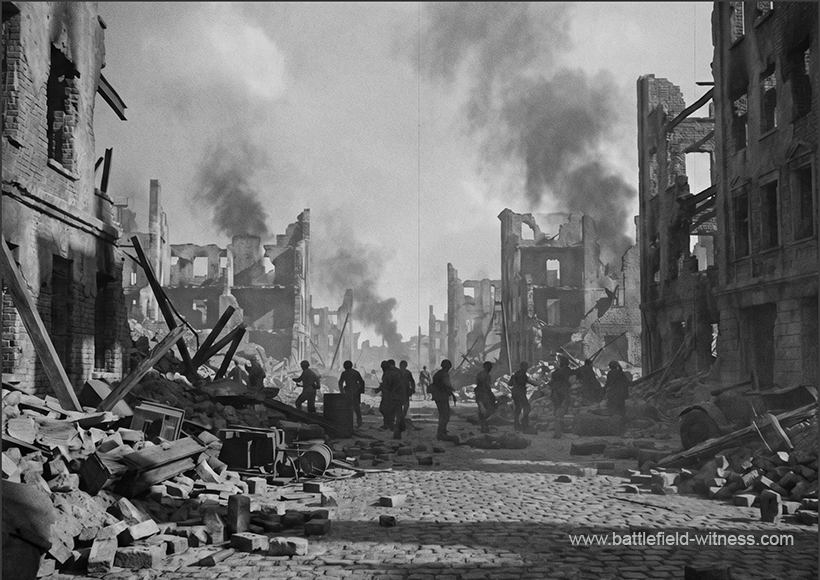
The street fighting that had evolved in Stalingrad bore no resemblance to anything in training manuals or the tactical guides the Red Army had prepared. The city had been bombed so comprehensively that it no longer consisted of streets and buildings in any recognizable sense — it was a terrain of rubble, collapsed floors, shattered walls, and cellars accessible through holes no architect had planned. What remained standing was dangerous to enter because German snipers had every window calibrated. What was rubble was safer, paradoxically, because rubble was cover and masonry debris provided angles of concealment that bullets struggled to navigate.
General Chuikov — their commander, a rough stocky man from the countryside south of Moscow who swore without apparent effort and had been recalled specifically from a posting in China for this battle — had understood the central problem immediately. The Germans had the Luftwaffe and heavy artillery. The Soviet 62nd Army had courage, numbers, and the Volga at its back. But the Luftwaffe could not bomb what was indistinguishable from German positions, and the artillery could not shell what was ten metres from German soldiers without killing those soldiers. Chuikov's order was almost simple: stay close. Stay so close to the German lines that German air support became impossible. This was called "hugging the enemy." The men called it other things.
What it produced was the Rattenkrieg — the Rat War. A conflict conducted room to room, floor to floor, through the labyrinthine sewer systems beneath the streets, across rubble fields where a man could live for a week without once standing fully upright. The physical destruction of the city had, paradoxically, served its defenders: the jagged ruins and massive piles of masonry created by German bombing provided superior cover and concealment, and the debris that had once been apartment buildings now hindered German armour and rendered conventional artillery largely unable to clear positions without endangering the attackers.
The Storm Groups
Viktor's world shrank to approximately two city blocks over the course of October. He learned them the way you learn a body in the dark — the bad step of the collapsed stairwell in what had been a four-storey apartment building, the open wound of the courtyard that German machine guns swept every forty seconds, the deep passage through the basement connecting one building to the next that smelled of sewage and old water and something worse that they did not discuss.
His unit had been reorganised as a Shturmovaya Gruppa — a Storm Group — in the Soviet tactical doctrine that had evolved specifically for this battle. Twenty to fifty soldiers subdivided into fire teams of three to five. Their doctrine emphasised stealth, breach, and surprise. The PPSh-41 submachine gun was the preferred weapon for room clearing, its seventy-one-round drum magazine producing a sustained rate of fire that made it devastatingly effective in confined spaces. Fish-hook grenades — standard grenades fitted with hooks to catch on window mesh — could be thrown into German-held windows that ordinary grenades would simply bounce from. Satchel charges blew holes through interior walls — a technique the Soviet soldiers called mousing, moving through a building like mice in its walls, emerging where the enemy did not expect, from behind, from below.
He learned to move through buildings by going through them. Blast, entry. The moment of pushing through a fresh hole in plaster and lath and finding yourself in a space that had, hours before, been German, and having perhaps four seconds to assess what was alive in there and act before assessment became irrelevant. Viktor became, in October, very precise with the PPSh-41. He did not find this something to be proud of. It was simply what was required.
The flamethrowers were used for the nests — the positions in basements and inaccessible rubble where defenders had fortified themselves so thoroughly that nothing else would dislodge them. Viktor saw a flamethrower used twice in October. The second time he was ten metres away. He did not look directly at what happened. Some things, once seen, could not be unseated from the mind, and the mind needed whatever space remained for the work ahead.
Order No. 227 — Not a Step Back — had been issued in July. It had the force of law and the force of something older than law. NKVD blocking detachments were stationed at the Volga crossing points to intercept any soldier attempting to retreat from the city without orders. In a single forty-eight-hour period in mid-September, the 62nd Army's blocking detachments had stopped one thousand two hundred and eighteen men and executed twenty-one on the spot. The others were returned to the line. Viktor knew about the blocking detachments. Everyone knew. He did not dwell on it. There was no direction to move in except forward.
The other thing required, alongside movement and violence and the management of fear, was not going mad.
Men went mad at Stalingrad. Viktor saw it happen and did not always recognise it when it began — the particular rigidity that came over a man after three weeks of living underground, moving through rubble and cellars, eating cold food in the dark, listening to artillery that never stopped and that left a sound in the inner ear that persisted even after it stopped. Some men simply sat down and would not get up. Some wept without apparent cause or context. Some became very calm and precise and their eyes were the eyes of dolls, and those were the ones Viktor watched most carefully, because calm in that place was not a good sign.
PART III: THE WOMAN ON THE HILL
Mamayev Kurgan, October 1942
Natalya Volkova had been a student of literature at Leningrad State University. She had been reading Anna Karenina for the third time when the city of her birth was enclosed in the German siege ring in September of 1941, and she had set the book down in the middle of a sentence she would not finish until 1947, in a different city, as a different person entirely.
She had enlisted in the summer of 1942, had been assessed by the sniper training unit at Podolsk, and had been designated a first-class sniper. She arrived at Mamayev Kurgan — Height 102.0, the hill that commanded the city and whose ownership was so violently contested that it changed hands dozens of times, sometimes multiple times in a single day — with a Mosin-Nagant Model 91/30 rifle fitted with a PU 3.5×21 telescopic sight, one hundred and forty rounds of ammunition, and a certainty that she was going to die here that was so complete it had become, paradoxically, a source of calm.
The hill was a terrible place. What vegetation had once grown on it was gone. What soil remained was mixed with ash, shell fragments, and the remains of men — the remains were not always distinguishable from the soil after enough time and enough artillery. A crater could be a fighting position or a grave or both simultaneously. The winter was coming; she could feel it in the way the ground hardened at night, in the air that had surrendered its last warmth.
She fired her first confirmed kill on the third day. A German NCO — identifiable by the collar tabs visible in her scope at three hundred and twenty metres — who had been standing at what he believed was a safe distance from the Soviet lines to issue orders to men she could not see. She had been watching him for eighteen minutes, establishing his pattern of movement, the places he stopped, the duration of each pause. When he stopped at what she had identified as his preferred position — a broken wall he clearly found reassuring, incorrectly — she exhaled slowly, let her pulse settle, and let the trigger take itself.
She marked the kill in her notebook. Not with satisfaction. With something more like accounting.
The sniper war at Stalingrad was a war within the war. Both sides deployed them extensively. Both sides understood that snipers changed the physics of the battle — not through mass casualties, but through the particular psychology of not knowing where death was coming from. A unit that believed a sniper was working its area moved differently: more slowly, more carefully, spending cognitive energy on concealment that should have been spent on coordination and attack. Vasily Zaitsev — whose name had by October become known through the Soviet press, a propaganda triumph made of a living man and his two hundred and twenty-five kills — was the most famous. But there were others. There were women among the others, and the German soldiers who discovered this fact found it disorienting in ways they struggled to articulate.
Natalya was not interested in being a story. She was assigned to target German artillery observers — the soldiers who climbed to elevated positions to direct artillery fire onto Soviet positions. Without observers, German guns became approximate. Approximate artillery killed fewer people. She calculated, with the care of a person trained to be precise about things, that her work over three weeks in October had preserved approximately forty Soviet lives. She made this calculation in her notebook.
She also targeted water carriers and provision carriers, which felt like different work — slower, more deliberate, requiring a discipline she had to consciously maintain. She did not look at their faces through the scope. This was a practice she had developed deliberately. A face made a person particular, and a particular person was harder to kill than a category. She was aware this was a psychological trick she was playing on herself, and she played it anyway, because the alternative was worse.
At night, in the cellar that served as her billet, she slept with the rifle against her body. Not for comfort — she was not under any illusion about the rifle as an object of comfort — but because the first time she had set it aside and woken to find it across the room, she had felt a terror disproportionate to the actual danger, and she preferred not to feel that particular terror again. Proportionate fear she could manage. It was the other kind that used up reserves she needed.
She was twenty-four years old and she was the best shot in her section and she had not finished Anna Karenina and she did not know if she ever would.
PART IV: PAVLOV'S HOUSE
Zagorodnaya Street, September – November 1942
Some three hundred metres from the Volga, on what had been Zagorodnaya Street, there stood a four-storey apartment building of the type constructed across Soviet cities in the 1930s — solid construction, deep cellars, the kind of building that could absorb punishment and retain its essential structure. In the third week of September, a reconnaissance group of four soldiers led by Sergeant Yakov Pavlov took the building from a small German garrison and found the cellars still occupied by a handful of civilians who had not left and were not going to leave, being by that point too old or too connected to their former life to do so.
Pavlov held the building. A platoon joined him. They fortified it with minefields on three sides and machine-gun nests at the upper windows with interlocking fields of fire. They installed anti-tank rifles in the basement to cover the street approaches. They breached the basement walls to connect via underground passage to Soviet positions, which meant they could be resupplied without crossing the open ground that German machine guns commanded. They knocked holes between apartments for interior movement without using the stairwells. They transformed a residential building into a fortress without quite ceasing to be a building.
For two months, German forces attempted to take Pavlov's House. The attempts were serious, sustained, and unsuccessful. The garrison at its peak never exceeded approximately thirty men. General Chuikov later observed, with a dry precision that served as the highest possible tribute, that the German losses sustained in attempting to take this single building exceeded their total losses in the fall of Paris.
Viktor's unit passed through Pavlov's House twice in October, using the basement passage as a transit route between positions. The second time, he sat for twenty minutes in the cellar while an artillery barrage worked over the street above, and during those twenty minutes an old Kazakh worker named Khaitkali Toirov — who had been employed at one of the nearby factories and who had organised the basement's domestic arrangements with a practicality that the soldiers found both touching and slightly absurd — offered him tea.
Actual tea. Made from actual tea. On a small stove they had pulled from the rubble of the first floor.
Viktor almost refused out of embarrassment. He drank it. It was very hot and it tasted exactly like tea, which is to say it tasted like something from a world that still existed somewhere beyond this city and this winter and this war. He did not speak to the old man because there was nothing to say that the tea had not already said.
He thought about that tea many times in the months afterward.
PART V: THE CAULDRON
November 19 – 23, 1942
While the street fighting consumed the city, Generals Georgy Zhukov and Alexander Vasilevsky were looking at maps.
The maps showed something that the German High Command had either not noticed or had decided not to address: the flanks. The 6th Army had driven deep into Stalingrad and was consumed there — fighting for factories and apartment blocks and sewers and train stations and a grain elevator on the southern waterfront that a small Soviet garrison had held for three weeks against everything the Germans could bring to bear. But the flanks of that salient were held not by the 6th Army's elite divisions, which were all in the city, but by the Third Romanian Army to the north and the Fourth Romanian Army to the south.
The Third Romanian Army defended one hundred and forty kilometres of the Don river with insufficient anti-tank weapons. The Fourth Romanian Army defended two hundred and seventy kilometres of front — some sectors manned by a single platoon per two kilometres — with equipment that had not been designed for mobile defence against Soviet armour. German liaison officers noted, and this is to their credit, that the Romanian and Italian soldiers fought with spirit and "comparatively good" fighting quality. They were overwhelmed anyway, because spirit and fighting quality were not the variables that mattered.
The variables that mattered were: that they lacked the anti-tank guns to stop T-34 breakthroughs; that there were nine Soviet soldiers for every one of theirs on the sectors chosen for the attack; and that the timing had been chosen with cold precision.
At 05:30 on the morning of November 19th, 1942, the Soviet artillery opened fire on the Third Romanian Army's positions along the Don.
What came next was not a battle. It was a dissolution.
Gefreiter Klaus Brandt was in the supply depot behind the main line when the news arrived, and the news arrived in the usual way such news arrives — confused and partial first, then less confused, then in the form of a T-34 appearing on the road from the north with its hatches closed and no visible markings and a pace that suggested it had somewhere specific to be.
Klaus watched it pass from behind a supply truck. He was twenty-two years old and had been in the Wehrmacht for sixteen months. He had enlisted with something close to enthusiasm — not the frenetic, poster-image enthusiasm of the newsreel footage, but a steady, practical patriotism, the conviction that Germany was fighting a necessary war against genuine enemies and that a man did his part. He was from Munich, the son of a baker, and he was not a sophisticated young man but he was an attentive one, and he had spent the last four months attending carefully to events and forming conclusions he did not share with anyone.
He found his unit. His unit found its officers. The officers found instructions that could be summarised as: hold your position.
The Soviet pincers closed at the town of Kalach on November 23rd, 1942. Klaus Brandt was inside the ring.
The Kessel — the German word means simply cauldron — contained approximately two hundred and sixty thousand men: the 6th Army and elements of the 4th Panzer Army, plus Romanian and Croatian fragments who had not escaped the encirclement. They occupied a rough oval shape approximately fifty kilometres across in the flat, exposed steppe west of Stalingrad. The temperature on the night of November 23rd was minus twenty-two degrees Celsius and falling.
Feldmarshall Erich von Manstein was ordered to relieve the pocket with Operation Winter Storm. His armoured spearhead came close — closer than it had any right to come, reaching within forty-eight kilometres of the Kessel's southern perimeter before Soviet resistance stiffened and the fuel ran short. Hitler refused to allow Paulus to break out to meet Manstein, demanding the 6th Army hold Festung Stalingrad — Fortress Stalingrad — as an anchor for the entire Eastern Front.
Paulus held. Manstein stalled. Operation Winter Storm died in the snow.
The Luftwaffe was ordered to supply the pocket by air.
The minimum daily supply requirement for two hundred and sixty thousand men — food, ammunition, fuel, medicine — was seven hundred and fifty tons. In December, the average daily delivery was one hundred and five tons. On some days it was sixty. On Christmas Day, 1942, forty-two tons were delivered to the Kessel.
Klaus Brandt received, on Christmas Day, one hundred and fifty grams of bread and a ladle of horsemeat soup. The horse had once had a name, and now it was soup. He ate it in a dugout that he shared with seven other men, in a space so small that the collective body heat of eight men was the primary source of warmth. Outside, the temperature was minus thirty-one degrees Celsius.
He wrote in his diary — he had kept one since September, technically against regulations, which no one had enforced since October — with fingers he could not entirely feel:
It is Christmas. I have been inside the pocket for thirty-two days. There was soup today and I am grateful for it. I think about my mother's kitchen. The smell of bread baking. I think about this more than I think about anything else. I am twenty-two years old and I want very much to go home.
He did not know, as he wrote these words, that he would not see Munich for eleven years.
PART VI: THE LONG DYING
January 1943
Cold at minus thirty-five degrees is not primarily felt as cold. It is felt first as a sharpening — the edges of things become very clear, the air seems to crystallise around objects, and there is a brief, almost pleasant clarity for perhaps the first three minutes of exposure. After that, the body begins to redirect warmth to its core organs, and the extremities — fingers, toes, ears, nose — begin to lose sensation in a manner that begins as numbness and progresses toward something simultaneously painful and characterless, like trying to feel through a prosthetic. After an hour without adequate clothing, rational thought becomes difficult. Decisions come slowly and often incorrectly.
The rations in January were cut to one hundred grams of bread per day. The horsemeat was gone. Men ate leather — shoe leather, harness leather, the leather straps of equipment. The rats that infested the dugouts were caught and eaten. The rats were also vectors for the typhus and dysentery that moved through the Kessel like a second army. Lice were universal. Diphtheria. Jaundice. The symptoms of starvation, which had begun in December, became explicit in January: the slowness of thought, the tremor, the progressive failure of the body to protect itself from cold it had previously managed.
At the GUM department store — the grand commercial building that served as Paulus's headquarters — conditions had deteriorated to a point that no military language had terms for. Human waste and accumulated debris reportedly reached chest height in some corridors by January. The wounded who had been brought there lay in what the soldiers called the death basements: dark, freezing spaces where anaesthetic supplies were exhausted, where surgeries were conducted on conscious men by surgeons whose hands shook with cold and exhaustion, where men who arrived wounded died of cold and hunger over the following days. Rats had chewed through the electrical cables of the remaining vehicles. The electricity died. The bunkers went dark.
The Pitomnik airfield — the 6th Army's primary supply terminal — received its last transport aircraft on January 16th. Gumrak, the secondary airfield, closed on January 21st. After that, supplies were parachuted into the pocket, or attempts were made to parachute them; many containers fell outside the perimeter and were recovered by Soviet forces or lost in the snow.
Viktor was part of the force that took Gumrak airfield. The fighting had been brief and light — the defenders were in no condition for sustained resistance. He walked through the terminal building and found, in one of the holding rooms, sixty-three German soldiers who had been brought there as wounded in the preceding weeks and then, when the last aircraft left, not transported. They lay on the floor in their coats and looked at the Soviet soldiers with eyes that expressed something Viktor could not find a name for.
He had brought water. He gave them water.
He could not hate them. He had considered this in October, in the worst of the Rattenkrieg, when hatred would have been useful as fuel. He could make himself hate the idea of them — the army that had come four thousand kilometres to destroy his country, that had bombed Stalingrad until forty thousand civilians were dead in a single day, that had committed atrocities he had seen evidence of and sometimes seen themselves. He could hate that. But the individual soldiers he found at Gumrak were men of his own age who looked cold and hungry and afraid, and he was also cold and hungry and afraid, and he could not sustain the distance that hatred required.
He found instead something less useful and more complicated: a recognition he had not asked for and could not set aside. He gave them water and moved on.
Natalya fired her last confirmed kill on January 28th. A German officer crossing a courtyard near the central station, trying to reach whatever remained of a command structure in that area. She lowered the rifle and looked at the sky, which was pale and empty, the kind of sky that had nothing further to say.
She had been alive in Stalingrad for five months. She was twenty-four years old. She had sixty-seven confirmed kills recorded in her notebook.
She would live to be seventy-one. She would not speak about the notebook.
PART VII: THE END
February 2, 1943
General Friedrich Paulus surrendered on February 2nd, 1943. Hitler had promoted him to Feldmarshall the day before — a promotion unprecedented in its implicit message, since no German Feldmarshall had ever surrendered to an enemy. Whether it was a supreme vote of confidence or an expectation that Paulus would take a different way out was a question that men in the Kessel discussed and could not resolve.
The surrender came in stages, as surrenders do when an army is spread across thirty kilometres of rubble in minus thirty degrees. Units stopped fighting when they ran out of ammunition or will or both, often simultaneously. Men climbed out of cellars and dugouts with their hands raised and found themselves standing in open air for the first time in weeks, and the openness was strange after so long underground. The silence, where there had been no silence, was also strange.
Ninety-one thousand men went into captivity. Most of them were already dying.
Of those ninety-one thousand, approximately seventeen thousand of the first thirty-five thousand transported died during the initial transit alone — in rail cars with no heat, with insufficient food and water, before they reached the labour camps that were their destination. Of the total ninety-one thousand, a mortality rate of ninety-five percent is the figure historians have settled on. Approximately five thousand to six thousand men returned to Germany, the last of them in 1955. Paulus himself survived, eventually joining the Soviet-sponsored National Committee for a Free Germany and testifying at the Nuremberg trials. He died in Dresden in 1957.
Klaus Brandt survived the transit. He survived the camp. He returned to Munich in 1953, a thin man of thirty-three who had spent eleven years building roads and logging timber in the Urals. His father's bakery was gone — bombed in 1944 — but his mother was alive, and he found her in a small flat in Schwabing, and she made him bread on the day he arrived and he sat at her kitchen table and ate it and did not say anything for a very long time.
Viktor Melnyk was demobilised in 1945. He returned to Dnipropetrovsk, worked in a factory again — a different factory, making parts for agricultural machinery — and was married in 1947 to a woman named Halyna who had spent the war years in Tashkent. They had two children and grew old in a country that had been transformed by what had happened at Stalingrad, in ways Viktor could feel but not always name.
He visited Mamayev Kurgan once more, in 1965, when the great memorial was unveiled — the enormous concrete figure of the Motherland Calling, her sword raised over the hill where the dead still lay in the soil at the rate of five hundred to twelve hundred metal fragments per square metre. He stood at the base of the figure and looked up at it and thought about Petrenko, whose name was carved in a cellar wall in the Red October factory district. He thought about the German soldier at Gumrak who had taken water from his hand with shaking fingers. He thought about the old man in Pavlov's House and the tea that had tasted exactly like tea.
He smoked a cigarette and walked back down the hill.
HISTORICAL NOTE
The Battle of Stalingrad was fought between August 23, 1942, and February 2, 1943. It is estimated to have cost between 1.7 and 2 million lives in total: Soviet military dead, German and Axis military dead, and civilian deaths estimated at between 185,000 and 235,000. Post-war census data revealed that between 1,515 and 9,796 civilians survived in the ruins of the city. It was the largest and deadliest single battle in the history of human warfare.
Of the 91,000 German prisoners taken after the surrender, fewer than 6,000 returned to Germany, the last of them in 1955. The overall prisoner mortality rate was approximately 95%.
Operation Uranus, planned by Generals Georgy Zhukov and Alexander Vasilevsky, encircled the German 6th Army by closing pincers at Kalach on November 23, 1942, trapping between 250,000 and 330,000 men in the Kessel.
The Luftwaffe airlift was required to deliver a minimum of 750 tons of supplies daily. The average daily delivery in December 1942 was 105 tons. On Christmas Day, 1942, 42 tons were delivered. The fall of Pitomnik airfield (January 16) and Gumrak (January 21–22) ended all landing capability.
Sergeant Yakov Pavlov held the apartment building on Zagorodnaya Street for approximately two months with a garrison never exceeding thirty men. General Chuikov's observation that German losses attempting to take this single building exceeded their total losses in the capture of Paris is recorded in his memoirs.
Vasily Zaitsev is credited with 225 confirmed kills during the Battle of Stalingrad.
The 1077th Anti-Aircraft Regiment, composed predominantly of female Komsomol volunteers, engaged the 16th Panzer Division on August 23, 1942. The 6th Battery alone destroyed 28 German tanks.
General Vasily Chuikov's "hugging" strategy — keeping Soviet front lines in such close physical proximity to German positions that Luftwaffe support and heavy artillery became impossible to use — was the defining tactical innovation of the urban battle. It forced the Rattenkrieg and levelled the technological disparity between the two forces.
The soil of Mamayev Kurgan contains, by post-war metallurgical analysis, between 500 and 1,250 metal fragments per square metre. The Motherland Calls statue, erected on the site in 1967, stands 85 metres tall.
The dead are still in the soil.
— END —