Thermopylae historical fiction

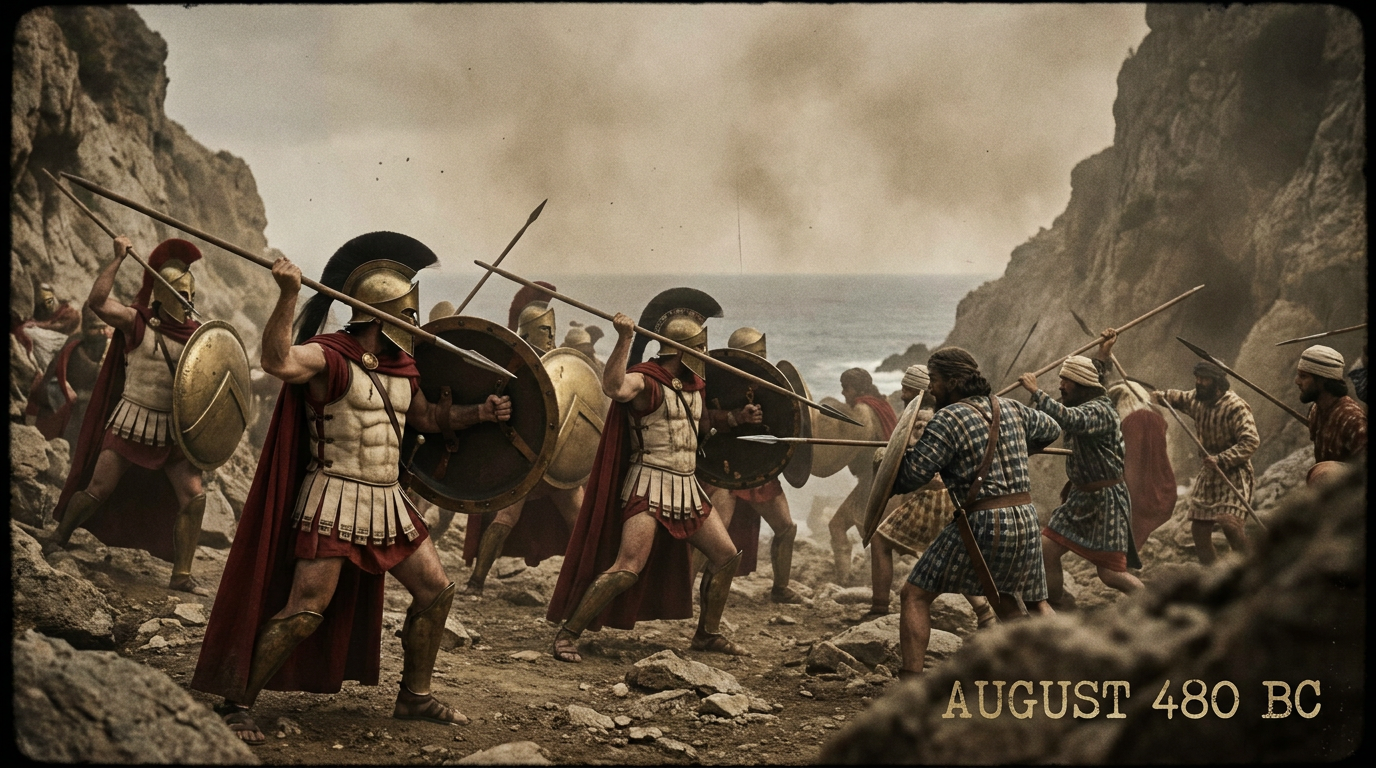
A Spartan at Thermopylae, August 480 BC
Before the Pass
You smell it before you see it.
The road north from Trachis bends around a shelf of limestone, and the wind comes off the Malian Gulf carrying salt and something else — a breath of sulphur, deep and mineral, rising from the earth itself. The springs. They give this place its name. Thermopylae. The Hot Gates. The Spartans ahead of me know the smell and say nothing. We march without speaking, as we always march.
The pass opens before us like a scar. On the left, Mount Kallidromo rises sheer and black, its face too steep for goats. On the right, no more than fifty feet away, the sea — grey this morning, flat as hammered bronze. Between mountain and water, this strip of coast is what we have been sent to hold. In places it narrows further still, to a width where four men cannot stand abreast. The Persians will come down from the north with their ten thousand Immortals, their Medes and their Cissians and their Scythian horsemen and their massed millions, and they will pour against us here, into this needle, this corridor, this trap that geography has made for them.
Three hundred of us. Against the world.
I have trained for this since the age of seven. I know no other life.
Day One
We hear them before dawn.
Not individual sounds — nothing so particular. A sound like weather, low and building, the way a storm comes in off the Aegean. Drums, and beneath the drums something deeper, the massed breath and foot-fall of uncountable men. The sound carries through the stone of the mountain and into the soles of my feet. I feel it before my ears make sense of it.
Leonidas walks the line. He is not a young man — past fifty, leathered from a lifetime of this — and he moves without haste, touching a shoulder here, a forearm there, saying almost nothing. What is there to say that the agoge has not already said? We have been prepared for death since childhood. Not reconciled to it. Prepared. There is a difference.
The sun comes up behind the Persian host and shows them to us.
I had heard the stories. Every Greek had heard the stories. Xerxes' army was so large that rivers ran dry when it drank. His fleet darkened the sea. His soldiers were beyond counting, their weapons beyond numbering, their banners so many that they blotted out the sky. I had heard these stories and dismissed them as the fear-talk of men who had not stood in a phalanx, who did not understand what a wall of shields means to those behind it and to those who must break it.
But they come, and they keep coming, and they keep coming after that.
The far end of the pass fills with colour. Painted shields, bright cloth, bronze and iron catching the morning light. There is no end to them. They bank up against the narrowing of the pass and begin to compress, column after column funnelling into the channel between mountain and sea, and even then they do not slow. Tens of thousands. Hundreds of thousands. More.
Someone beside me makes a sound, a low exhalation, not quite a word.
We lock shields.
The bronze rim of my aspis presses against the shoulder of the man to my left — Dienekes, a man who has stood beside me in a dozen training bouts, whose breathing I know as well as my own. The man to my right is Alpheus, young, still carrying a ridge of scar tissue from his last agoge challenge. Behind me I feel the weight of Nikodromos, his shield pressing into my back, his spear above my left shoulder. The phalanx breathes as one body. This is what they do not understand, the Persians with their individual glory and their personal bravery. We are not men. We are a wall.
They send the Medes first. They come screaming — genuinely screaming, a sound pitched to turn the bowels to water — in their wicker shields and their layered robes, their short spears and their curved swords.
They are brave men. I will say that. They come straight at us, which requires a kind of courage that most men in the world do not possess.
They are also dying before they understand what is happening.
The spears take them at range, before they reach us. Eight feet of ash and iron, the point between the eyes of the first man who approaches, a smooth downward thrust into his throat, and then I am stepping forward with the phalanx into the space his falling body made, my shield's iron rim swinging into the face of the man behind him, my short xiphos driving up and in. The pass is too narrow for their numbers to count. Their width advantage means nothing here. They can only come to us in the width of the corridor, and in the corridor, they meet the wall, and the wall does not move.
The dead begin to pile.
This is something the stories do not tell you. The dead are a tactical reality, not merely a tragedy. They block the advance of the living behind them. They make the ground uneven, treacherous. They bleed, and blood makes stone slippery in the summer heat. The Persians are stumbling over their own fallen men to reach us, and we step back in rotation when a man tires and a fresh warrior takes his place, and the Persians have nowhere to rotate to, nowhere to rest. We are a machine. They are a mob.
The heat is ferocious. Late August on a stone coastline, in bronze armour, fighting without pause. My mouth is the inside of a kiln. The sweat runs into my eyes and I let it run because a man who breaks the line to wipe his face is a man who has cracked the wall. Dehydration is a weapon Xerxes has used without knowing it. We drink at the prescribed intervals. No more.
By midday the bodies in front of us are stacked three deep.
They pull back. We dress the line, replace broken spears, drink. I look at the man beside me — Dienekes — and he looks back. There is nothing to say. We have known, since the first grey light, that there is no way out of this pass except forward or dead. That knowledge does not produce what you might expect. It produces a particular kind of clarity. The clarity of a man who has already made his choice.
In the afternoon they send the Cissians. Then the Immortals themselves — the ten thousand elite, Xerxes' personal guard, in their gold and crimson, men who have never known defeat. They come against us in formation, organized, disciplined, better than the Medes. They kill two of ours before we push them back. The first Spartan dead. We step over them and hold the line.
By evening the pass is ours.
Night Between Days
We sleep in the dirt among the dead.
Not because we are callous — we are not — but because there is nowhere else. The pass is thirty yards wide and the verges of it are bodies. The smell is copper and iron and opened bowel, a smell so dense it has its own weight. The sea to the east is dark and flat. From the north comes, still, the distant noise of the Persian camp: drums, voices, the shifting of a city of men.
Leonidas sits apart, looking at nothing. Or everything. I cannot tell.
I take off my helmet. My hair is wet and there is blood along my jawline from a cut I did not feel when it happened — shallow, nothing — and I press my thumb to it in the dark. Around me men clean their weapons with the same careful attention they give everything. This too is agoge. A rusty spear-point is a dead warrior. A clean one is another morning.
I think of Sparta. Not the city — the stone and shadow of the valley — but the smell of it in spring, the river through the town, the sound of boys training in the dust. The faces of the old men at the gates when we marched north. Those faces said: we know what we are asking. We know.
I sleep three hours. No more is needed.
Day Two
The second day is the same as the first, and it is worse.
The Persians have learned from yesterday. They attack in shorter waves, replace men more quickly, try to find the gaps in our formation, the place where two shields do not quite meet. They are intelligent soldiers adapting. In another context I might admire this.
Alpheus, on my right, takes a spear-point in the shoulder — it skips off the pauldron, grazes the flesh, ugly but not crippling — and he doesn't leave the line. He fights the afternoon with one arm less useful than the other, which slows him, which means I must cover for him at certain angles, which produces in me a particular focused attention that has no name but that every soldier knows.
We take perhaps a dozen wounded that day. Eight dead. The pass is ours again at nightfall. The Persian mound of dead is beyond counting.
A runner comes from the rear at dusk. He speaks to Leonidas, and Leonidas's face shows nothing at all, which is its own kind of message.
I watch him from across the camp as men clean weapons and eat what they have. His face shows nothing. But something is different. Something in his stillness is different from the stillness of the evening before.
I know, then. I don't know how I know. But I know.
The Third Day
Dawn comes grey and cool.
Leonidas speaks to us before the sun is up. His voice is level, that particular Spartan flatness, emotion planed away until only the fact remains. A man named Ephialtes — a Greek, a man of Malis — had gone to Xerxes. Had told him of a mountain path. A path that circles behind us, up through the trees on the face of Kallidromo, around and down to the south. The Immortals had moved through the night. The Phocians sent to guard the path had scattered before them.
They are behind us now.
The allied Greeks — Thespians, Thebans, the others — Leonidas releases them. Some go. The Thespians refuse, to their eternal honour. The Thebans stay, though they will surrender when the end comes, which Leonidas knows, which is why he does not press the point.
Three hundred Spartans. Seven hundred Thespians. They have nowhere to go.
We eat.
This is not absurdity. This is Spartan. If you are to die this morning you eat first, because a dead man is not a warrior and a hungry man is less than he might be. We eat and we clean the weapons again and we look at the pass and the sea and the mountain in the early light, and nothing is said that does not need to be said.
Leonidas puts on his helmet. The great scarlet plume, the mark of a king.
Leonidas. Fifty years old, son of Anaxandridas, king of Sparta. He chose three hundred men for this march knowing what it was. He chose men who had sons, men who had given Sparta its future, men who could die here without ending a line. This is what they will not say about him in later years, when the legend has smoothed all the edges — he did not choose heroes. He chose fathers. He made the mathematics of sacrifice as clean as he could.
We form the phalanx for the last time.
I lock shields with Dienekes. The bronze rim against my shoulder. His arm against my arm. The smell of sweat and leather and the sea behind us. The hot springs somewhere beneath our feet, their sulphurous exhalation rising through the stone.
The Persians come from both directions now, north and south, and we go out to meet them.
We go forward. This is the thing they will not understand, the ones who hear the story later, in the warm houses, in the taverns, in the assemblies where men make speeches about this day. We do not hold. We advance. We push north into the narrowest part of the pass and we kill them there, on their own ground, at a time when we are already dead men and know it, and we make them pay.
My spear breaks against a Cissian's bronze breastplate. I throw the shaft into a man's face and draw the xiphos and keep moving. The noise is something that exists inside the body now, not outside it — the crash of shields, the screaming of men, the percussion of iron on iron, a sound that the training produces in miniature but that here has a weight and scale no training can approximate. I am not afraid. This surprises me, though it should not. The agoge took fear years ago and replaced it with something else. Not courage — courage implies the presence of fear overcome. This is a different thing. A simplicity. A clean forward motion.
Dienekes is beside me. Then he is not.
I don't look.
The sun is fully up and the pass is chaos and they are pressing from both sides and the line is thinning and I am still moving forward, toward the north, toward them, my shield up, my sword arm working, because this is what the three hundred are for.
Not to win. Never to win. To stand here long enough that Athens can prepare. That Greece can breathe. That the other cities can see what is possible when men who have made their choice stop calculating the cost.
The legend will say that Leonidas died with a spear in his chest. The legend will say we fought over his body for hours. The legend will be true.
I know, as the ring closes and the sky narrows to a band of bright August blue between the mountain and the sea, that we have already done what we came to do. The Persians will take the pass. They will take it from our dead hands and march south and burn Athens, yes, and they will think themselves victorious. But something happened here in this narrow place between cliff and water that is not defeat, and I understand this with the same bone-deep clarity with which I understand the weight of my shield and the length of my spear and the face of Dienekes when he looked at me before the line.
The water of the Malian Gulf catches the morning light. It is a beautiful colour. I had not noticed until now.
Forward.
"Go tell the Spartans, stranger passing by, that here, obedient to their laws, we lie." — Simonides of Ceos, epitaph at Thermopylae
Historical note: Of the three hundred Spartans who held the pass, two are known to have survived: one sent home with messages before the final day, and Aristodemos, who was ordered to the rear due to an eye infection. He survived, was called a coward by Sparta, and died the following year at Plataea fighting with such reckless ferocity that his countrymen said he had tried to die there to remove the shame. They did not award him their highest honour, because, they said, a man who wishes to die is not brave — he is merely no longer afraid of the thing all men fear. The three hundred feared it. They advanced anyway.