The Weight of Signals
The Battle of Trafalgar.

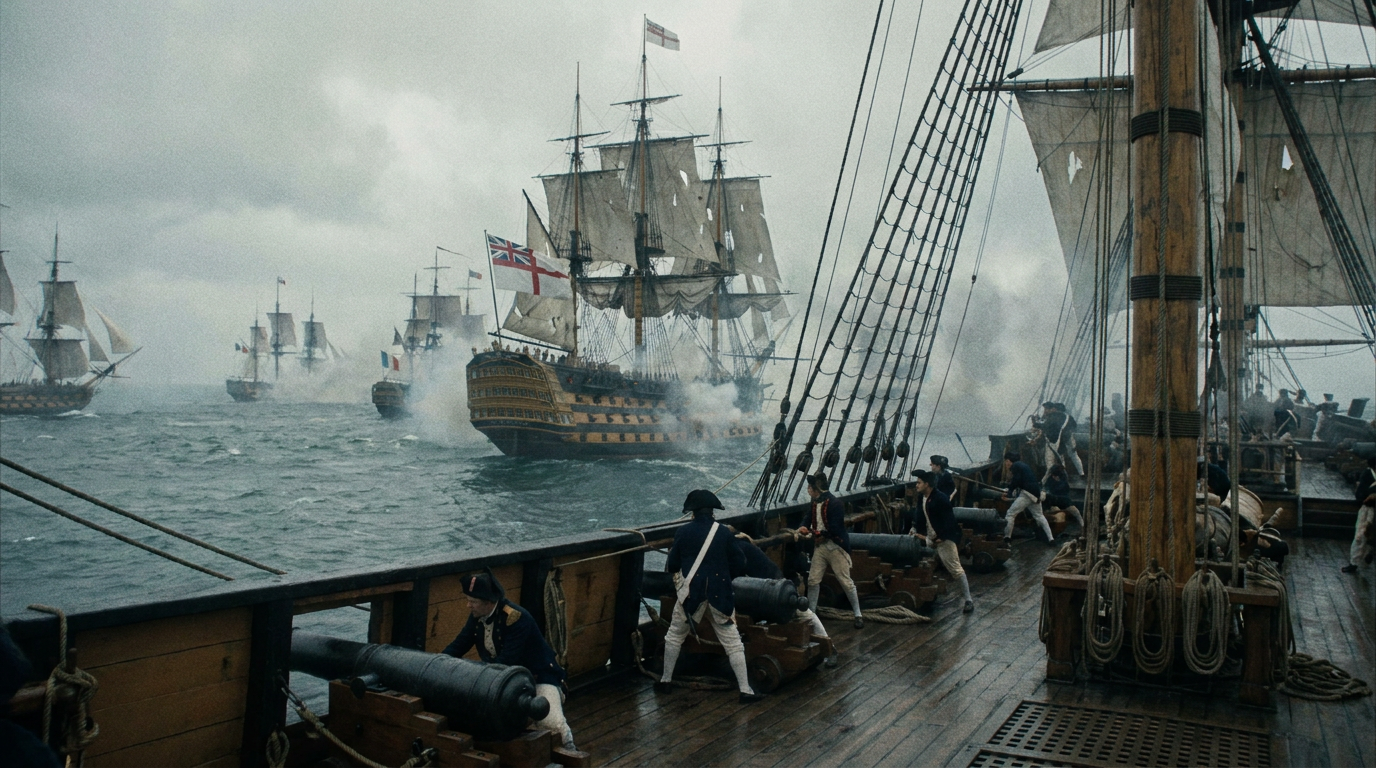
Being an account of the 21st of October, 1805, as experienced by Lieutenant John Pasco, Signal Officer aboard HMS Victory.
I. Dawn
The wind came off the Atlantic in long, exhausted breaths.
Pasco had been awake since four, though sleep had been a performance rather than a fact — he had lain in his cot listening to the ship breathe around him, the groan of timber, the long low conversation of ropes under tension, the sea saying its own name against the hull. At half past five he gave up the pretence and went on deck, and there they were: the combined fleet of France and Spain, stretched across the southern horizon like a city that had been knocked sideways. He counted masts for a while and then stopped counting.
Thirty-three ships.
The sky above them was the colour of pewter, and the rising sun smeared a faint copper stain across the water to the east. There was almost no wind. The great fleet sat on the glassy swell like paper models, too still to be real, and between them and the British column lay perhaps four miles of ocean, and somewhere inside that distance lay the day.
Captain Hardy came to stand beside him without speaking. They watched together.
"He's up," Hardy said finally, meaning Nelson, and Pasco already knew it because the ship had a particular quality of attention when the Admiral was on deck — something stiffening, as though Victory herself was drawing breath.
He found him at the forward rail of the quarterdeck, studying the enemy through his glass. The four orders pinned to his coat — the stars of Bath, the Crescent, St Ferdinand, and St Joachim — caught what little light there was, bright as mirrors. Pasco had heard the captains of other ships mention those decorations with something close to dismay. Too visible, they said. Too easily found by a marksman. And Nelson wore them anyway, every one of them, as if to say: look at me. This is what I am. Come and take it.
He turned and saw Pasco and smiled — that particular smile, the one that suggested he was already thinking three things at once and found all of them faintly amusing.
"Pasco." He gestured him close. "I want to send a signal to the fleet. Have you flags enough for it?"
"I believe so, my lord."
Nelson looked back at the enemy. The swell was lifting Victory's bow in a slow, patient rhythm. "I wish to say — England confides that every man will do his duty."
Pasco checked the book in his head. Confides was not in it; it would have to be spelled flag by flag, which would take an age. "My lord," he said carefully, "if you were to substitute expects for confides, it is already in the vocabulary and the signal will fly much faster."
Nelson turned to look at him with an expression Pasco could not quite name. Then: "Make it so."