THE ROAD TO PONTECORVO

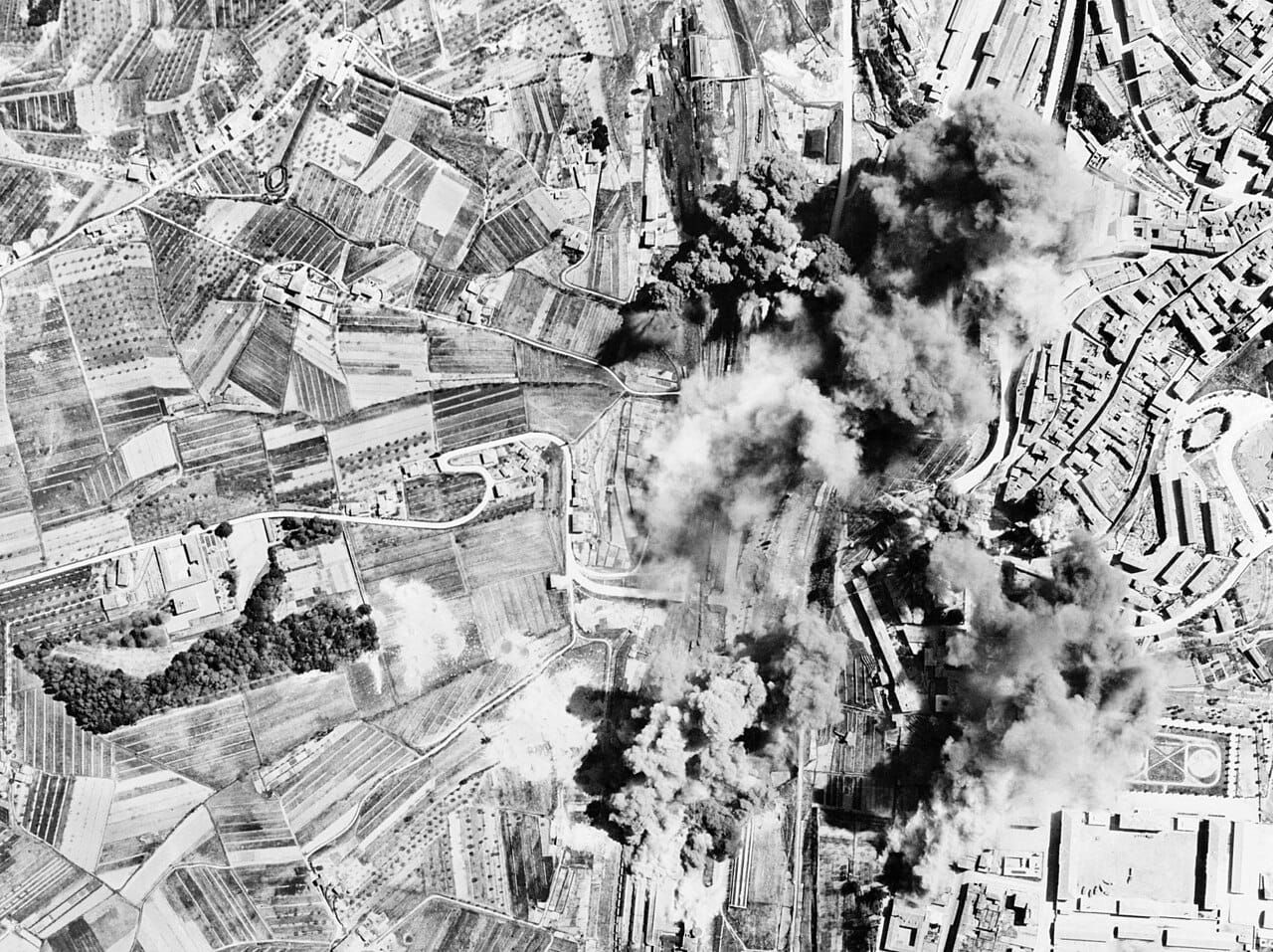
12 May 1944.
A story from Operation Strangle — U.S. Twelfth Air Force, Italy.
The valley was the greenest thing Ray Cafaro had seen in eleven months.
He lay flat in the nose of the Mitchell, his chin maybe two feet above the Plexiglas, and watched Italy roll underneath him like something God had unrolled this morning specifically to spite him. The Liri Valley. He knew the name from the briefing map and from somewhere older than that, a place in the back of his head where his grandfather's voice lived. La Ciociaria, the old man had called it. The land of the sandal-wearers. It didn't look like any particular hardship down there. The spring wheat was coming in. The hills folded into each other soft and dark with olive trees, terraced walls running horizontal across the slopes like ruled lines in a notebook, and from twelve hundred feet you could see the smoke columns.
There were a lot of smoke columns.
"Ercole, fifteen degrees port." Maddox's voice in the interphone, flat and unhurried as a man ordering eggs. He always called Ray by his middle name on missions. Ray had never asked him why. It seemed to matter to Maddox in some way he'd chosen not to explain.
Ray made the correction on the course card and said nothing. The formation — six Mitchells, Straw Dog flight — banked slightly left. The valley tilted under the nose. Somewhere back in the fuselage, the Wright engines changed pitch by a note you felt in your teeth before you heard it in your ears.
He'd been in the nose on twenty-seven previous missions. He knew the geometry of this position: the way it placed him ahead of and below the rest of the aircraft, forward of the wings, so that the Mitchell appeared to him as something trailing behind rather than carrying him. The world was glass and the smell of hydraulic fluid and a coldness at altitude that the flight jacket addressed imperfectly. When flak came close, which it did with regularity, the concussion arrived first and the sound followed, and you felt both in the glass bubble rather than hearing them through it. He'd learned not to focus on individual puffs. You saw the pattern and you decided if the pattern had you.
The Sacco River appeared to the right, running slate-colored between its banks. They were close now. The briefing officer had put his pointer on the blue line and said bridge at map reference S-fourteen, road bridge on the Via Casilina approach to Pontecorvo, intermittent vehicle movement observed, probably nocturnal resupply. The Via Casilina. In Rome it was the Via Appia's younger sister. In Pontecorvo it was just a road, but the road was feeding German 10th Army through the Gustav Line and the Gustav Line was the reason twenty thousand men had spent the winter dying on the approaches to Monte Cassino, and that was the shape of things in the spring of 1944 in the valley his grandfather had described as paradise.
His grandfather had been born in a village eight kilometers from Pontecorvo. His name had been Ercole Cafaro and he had left Italy in 1903 at the age of nineteen with twenty-three dollars sewn into his coat and had never gone back. He had died in Providence in 1941, six months before the declaration of war, and Ray had stood at the grave in the drizzle and thought that at least the old man had missed this particular complication.
✦
"Two minutes," Maddox said.
Ray checked his bombsight. The Norden was warm — he could feel the heat of its motor against his forearm when he leaned over it — and the gyros were running. He made a small adjustment for wind drift and settled his eye into the optics. The town ahead resolved through the sight's lens: red tile rooftops, a campanile, the thread of the Via Casilina, and at the river, the bridge. Stone, maybe thirty meters. Wide enough for a German supply truck with something to spare.
He became aware, vaguely, that there was flak.
It had been there for perhaps twenty seconds before he registered it consciously. This was the thing they couldn't teach you: you learned to keep working while the world came apart outside the glass, not through courage precisely, but through something more like the refusal to be distracted. The puffs were black and they came in clusters of four, the Germans firing in bracketed patterns from their 88s, and the nearest cluster was off to the left and maybe two hundred feet below. The Mitchell rocked once, sharply, as though a giant had reached up and slapped the wing.
"That's close," Driscoll said from the tail.
"Quiet," Maddox said.
Ray kept his eye on the sight. The bridge was walking toward him through the optics, and he felt the strange compressed patience of the bomb run, the way time changed texture on the run-in — expanding slightly, so that each second had more weight than it should. He'd been here before, twenty-seven times. He knew the geometry of his own attention in these moments.
The 88s had them ranged. He could feel it before he could articulate it — the pattern shifting, the bursts rising, walking in from the sides. The Mitchell shuddered again and he heard metal, a brief ripping sound in the upper fuselage, there and gone. He held the sight picture.
Nonno, he thought, incongruously. In the way that you think things under pressure that you would never think in ordinary life.
The bridge walked into the center of the optics.
"Bombs away."
The aircraft lifted — not much, barely perceptibly, but he always felt it, the five-hundred-pound incendiaries leaving the bomb bay, the Mitchell suddenly a few thousand pounds lighter. He was already calling the corrections into the interphone, watching the pattern of smoke from the bombs falling, and then the river disappeared below him and there was open sky and Maddox was banking hard right and the formation was turning and behind them, through the tail position, Driscoll said, "We got the bridge, Lieutenant. One of them got the bridge."
Ray lay in the nose and looked at the sky. Blue. Specific blue, the kind you only got in southern Italy in spring, a blue that sat on top of white cumulus and made the whole upper world look designed rather than accidental. The Wright engines ran their note. The flak was already behind them and the valley was falling away to the east as they headed back for the Adriatic side of the mountains.
"Good work," Maddox said. He said it to nobody in particular, or to all of them.
✦
They flew southeast, back toward the Adriatic coast. The formation came together, tightened slightly, checking in. Two of the six aircraft had taken hits. Piekarz came on the interphone to say the radio antenna was gone from the dorsal position but everything else seemed in order. Ray made a notation in his log. He wrote down the time, the estimated point of impact, the number of bombs expended. He wrote it all down precisely because precision was what you had. The rest of it — the thing he'd seen through the Norden optics, the red rooftops, the campanile, which might have been the church his grandfather had been baptized in or might simply have been a church — this he did not write down.
The Apennines slid under the nose again and he watched them. He'd grown up in a three-story house on Federal Hill in Providence. His grandfather had kept a small garden in the back where he grew eggplants and a particular kind of bean you couldn't buy in any market in Rhode Island and had to have seeds sent from somebody in New York who had gotten them from somebody else who had carried them from the province of Frosinone in 1921. The garden was still there. Ray's mother had kept it going, after. You could see it from the kitchen window, which faced north, toward nothing.
He thought about the bridge. Stone, maybe thirty meters. Old — the river cut had worn the stone piers to an organic smoothness you could see even from the air. Pre-war, certainly. Perhaps pre-century. If you built a bridge that lasted a hundred years in the Sacco Valley it suggested something about the people who built it, something about permanence and intention, a belief that the future would be inhabited by their grandchildren and their grandchildren's grandchildren, who would also need to cross the river. He didn't know what to do with this thought. He wrote the time in his log instead. 09:47.
"Twelve minutes to coast," Maddox said.
The mountains were beautiful from above in a way that Ray found troubling, because things should not be beautiful when you were killing them. He had thought this before and had no resolution for it. The marble quarries north of Carrara had been one of the strangest sights of his flying life — white scars on the mountain face, beautiful and obscene simultaneously, and from the air you could not tell whether what you were seeing was a wound or a natural feature. He'd bombed the rail line north of Florence in February and the snow on the Apennines had been blue in the shadows. He didn't know what to do with any of it, the beauty. He'd given up trying to reconcile it.
The Adriatic appeared. Its color was different from the blue of the sky — more grey-green at this hour, less decisive. The coast came up and behind it the base, the airstrip that was currently home to the 321st Bombardment Group of the United States Twelfth Air Force, somewhere in the mud of eastern Italy. Ray had been here since the previous August. He knew the mud well. He thought about it sometimes with something close to affection, which told you something about his state of mind.
✦
They joined the traffic pattern. Maddox put them down without drama. He was a precise pilot, Maddox, the kind of precision that came from not wasting attention on anything that wasn't the immediate problem. The wheels touched and the Mitchell slowed and the runway ran out under the nose and they turned off and taxied to the hardstand and Maddox cut the engines.
The silence after a flight was always the same — not actually silence, there were still sounds, the ticking of cooling metal, the voices of the ground crew, the distant sound of another formation coming in — but the absence of the engine noise created a negative space that you felt as silence even though it wasn't. Ray had read somewhere that the ear took several minutes to readjust after prolonged exposure to high noise levels. For those first few minutes after shutdown, you lived in a muffled world where everything that wasn't engine noise sounded provisional.
He climbed out through the nose hatch and stood on the hardstand in the Italian morning and for a while nobody said anything. Driscoll was looking at the tail. There was a hole in it, about the size of a fist, with the metal peeled back in petals. Maddox was signing the aircraft log with the crew chief. Piekarz was doing something with the radio antenna position, explaining something technical to a mechanic who was nodding.
Maddox came over and stood next to Ray and looked at the mountains, which were visible on the western horizon.
"Twenty-eight," Ray said.
"What?"
"Twenty-eight missions."
Maddox considered this. "You need twelve more."
"I know."
They stood there. The sun was getting higher and the morning was warming toward what would be a warm day. From the briefing tent, two hundred meters away, Ray could hear voices and the sound of someone rolling a map table across a concrete floor. The next briefing was already in preparation. This was not a criticism. It was simply how things worked.
"Good bridge today," Maddox said.
Ray thought about the stone piers, the smoothed stone, the people who had believed in the future enough to build a thing to last.
"Yeah," he said.
"Driscoll says two hits, maybe three."
"Good."
Maddox looked at him for a moment longer and then turned away toward the debrief tent. He didn't say anything else, which was correct. There wasn't anything to say. The bridge was down or partly down and Operation Strangle was running its course and in a few days or a few weeks the ground forces would move — there was a rumor that it was starting already, that the Poles had taken Hill 593 overnight, that the Gustav Line was finally breaking — and eventually the Germans would retreat north and the roads would be used by Allied trucks instead of German ones and the Via Casilina would once again be just a road rather than a target.
Ray stood on the hardstand and looked at the mountains for a while after Maddox had gone. They were still beautiful. He thought about his grandfather's garden, the beans nobody in Providence could identify by name, the small patch of specific soil that was not quite Italian and not quite American and was consequently both. He thought about a bridge that had been there long enough that the stone had forgotten it was cut.
Then he picked up his flight bag and walked toward the debrief tent, where someone had made coffee and where he would answer the intelligence officer's questions precisely and completely and would not mention any of the other things.
A Note on the History
Operation Strangle ran from 19 March to 11 May 1944. Its aim was to destroy the Axis supply network — roads, bridges, rail lines, rolling stock — feeding the Gustav Line north of Cassino. The U.S. Twelfth Air Force flew B-25 Mitchell medium bombers and A-20 Havocs in low- and medium-level interdiction strikes across central Italy throughout this period. The 321st Bombardment Group, flying from Vincenzo on the Adriatic coast, participated in these operations.
The Norden bombsight — standard equipment for American bombardiers — used an analogue computer and gyroscopic stabilizer to calculate the ideal bomb release point. It required the bombardier to fly the aircraft on the final run-in through a small control handle, holding a precise course regardless of flak or evasive action.
On the night of 11–12 May 1944 — the eve of this story — the Allied armies launched Operation Diadem, the final offensive to break the Gustav Line. Polish II Corps attacked Monte Cassino from the north. By 18 May, the abbey fell. The Germans began withdrawing northward the following week. The Via Casilina, which the story's crew worked to interdict, became one of the primary routes of the Allied advance.
The province of Frosinone — from which Ray's fictional grandfather emigrated — was one of the most heavily bombed regions of central Italy during this campaign. Many of the road bridges in the Sacco and Liri valleys were destroyed and rebuilt multiple times between 1943 and 1944.