The Golden Age of Piracy

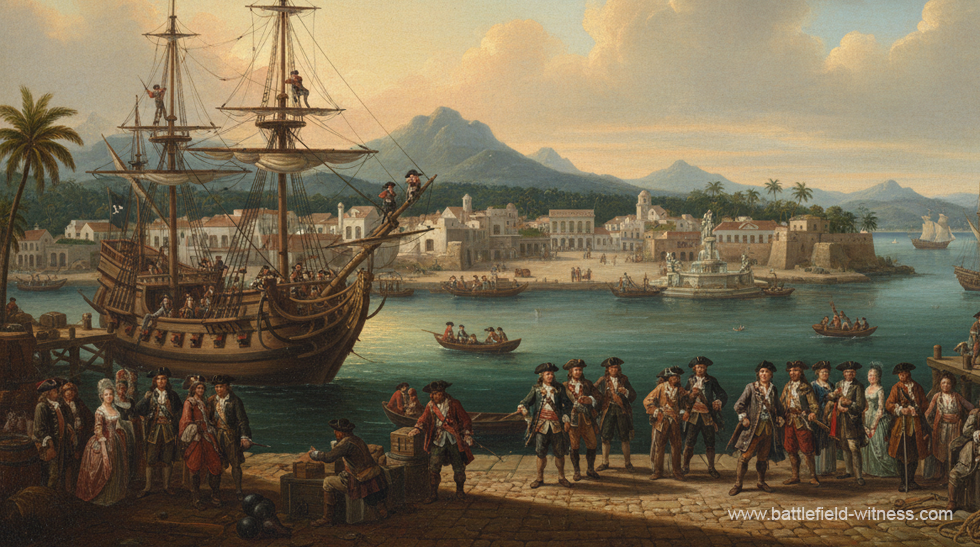
Articles of Agreement
A story of the Golden Age of Piracy, 1716–1718
I. HMS Seaflower, the Bahama Channel — March 1716
The cat came down nine times, and Thomas Rooke counted every one, because counting was the only thing left him. One. The rope bit through the wet shirt they'd left on him for the first stroke, which the bosun's mate always did, out of a mercy so small it was its own kind of cruelty. Two. Salt in it now, salt and something warmer. Three. Somewhere past the mainmast a gull was screaming, and he fixed on that sound and rode it the way his father had once told him to ride a fever — not fighting it, just staying on top of it until it passed underneath.
Four boys before the mast had watched. That was the point of it. Captain Josiah Wrenfield stood with his hands behind his back and his hat square and his face doing nothing at all, and read from the Articles of War in a voice pitched for the quarterdeck rail, though there was no one aboard the Seaflower who didn't already know what came after insolence to a superior officer.
Rooke was nineteen. He had been rated midshipman for two years, which meant he was expected to be an officer and treated like a dog, both at once, and the confusion of that had never once resolved itself in his favour. His crime, that morning, had been to say — quietly, to the master's mate, not even to the captain — that a man three days without water in this heat would not live to see Nassau. The master's mate had said it louder. Wrenfield had heard insolence where Rooke had meant only arithmetic.
Five. Six.
He did not cry out. He had promised himself that much on the walk to the gratings, the one promise a man could still keep when everything else about his body had been signed over to the King.
Afterwards they cut him down and a Portsmouth boy named Diggory poured vinegar into the ribbons of his back, which was meant as medicine and felt like the ninth stroke all over again, slower. Rooke lay on his belly in the cable tier where the air came thick with tar and bilge and the sweetish rot of ship's biscuit gone to weevil, and he listened to the Seaflower work herself south through the Florida Strait, timbers groaning against each swell like something being slowly, deliberately broken.
Brutal and short, his uncle had called the life, the one time Rooke had confessed, home on leave, that he hated it. His uncle had said this as though it were a comfort — as though short were the mercy in the sentence. Rooke, face down in the dark with salt drying stiff across his back, thought that a life could be brutal and long, too, if a man simply refused to end it. He did not yet know which kind he wanted.
He did know, with the specific clarity that only comes an hour after a flogging, that he would not do nine more years of this to make post captain. Whatever came instead — he did not have a name for it yet. He only knew the shape of the hole where the future used to be.
II. The Same Waters, Two Days Later
The sail came up out of the haze a little after four bells in the forenoon watch, and for a quarter hour nobody aboard the Seaflower thought anything of it, because sloops worked those waters by the dozen — turtlers, wreckers, island traders running rum and hides between Providence and the Carolina coast. It was the second sail, low and fast off her larboard quarter, that made the lookout call down twice.
By the time Wrenfield came up in his shirtsleeves the first sloop had already run out her guns, and there was no mistaking her then — the black flag climbing her halyard unhurried, almost lazy, as if her crew knew exactly how much time they had and meant to spend it in full view of everyone who'd rather not see it.
Rooke, three days off the gratings and still moving like a man in a body he didn't quite own, was sent to the guns. His hands did what hands trained into a body will do without being asked — swab, load, prick the cartridge, prime — and some far-off unoccupied part of his mind noted, almost with wonder, that his back had stopped hurting the moment the first ball took the Seaflower's fore topmast and brought forty feet of spar and canvas down across her waist like the closing of a hand.
It was not a battle in the way the word promised. It was twenty minutes of noise and smoke thick enough to eat, men screaming for reasons that made no sense until you traced the blood to find them, and then it was over, because the Seaflower was a King's sloop of eight guns crewed by boys and pressed men under a captain who had, in the one moment that mattered, nothing left in the magazine of his own courage. Wrenfield struck his colours with the smoke still hanging in the rigging like a fog that refused to lift.
The men who came over the side did not look like devils. That surprised Rooke more than anything else that day. They looked like sailors — sunburned, missing teeth, dressed in a magpie assortment of good captured cloth and rags, one of them incongruously splendid in a blue velvet coat gone white at the seams with salt. Their captain was a broad, sun-cured man of perhaps forty who introduced himself, with what Rooke would later understand was characteristic and deliberate courtesy, as Benjamin Hornigold, and who asked — asked, not demanded — whether any man aboard the Seaflower wished to volunteer before the matter of the prize was settled.
"Wrenfield's a flogging captain," said one of Hornigold's men, a lean fellow with a quartermaster's easy authority who'd already found the log and was reading Rooke's name off the punishment entries with something between contempt and recognition. "Nine lashes for arithmetic, it says here." He looked up. "That you, boy?"
Rooke said that it was.
"You've a choice," the quartermaster said. His name, Rooke would learn within the hour, was Davey Coombes, and he said the words the way a man reads out weather — flatly, because the weather did not care how you felt about it. "Sign the Articles and you're one of the Brethren, with a full share and a vote same as any man aboard, captain included. Refuse it, and we'll set you off in a boat with water and a chart, because Captain Hornigold don't force a man to turn account against his own conscience, whatever you may have heard of us. But there's a third road some men choose without meaning to, which is neither, and that one generally ends with a rope or a reef, so I'd think fast."
Rooke thought of the gratings. He thought of nine years to post captain, and the particular sound Wrenfield's voice had made reading out insolence, entirely without anger, as though cruelty were simply a clause in a contract he was executing on someone else's behalf. He thought, too — and this surprised him, arriving as it did in the middle of terror — of his mother's kitchen in Portsmouth, the smell of it, and how far away that now seemed from every direction at once.
"I'll sign," he said.
Coombes nodded, unimpressed, already turning to the next man. "Most do."
III. Nassau, New Providence — April to October, 1716
25°02′ N, 77°21′ W — a harbour formed by a long cay lying just off New Providence, its water so shallow and reef-toothed that no Royal Navy frigate of any real draft could come at the anchorage without a local pilot, which was, as Coombes explained it over the first meal Rooke ate as a free account man, rather the entire point of the place.
He had expected — he was ashamed, later, of how much he had expected — something like a town. Wooden houses, a proper wharf, the trappings of the little kingdom the stories back in England already whispered it was. What he found instead, coming ashore past the wrecks scuttled in the harbour mouth to keep the deep-draft warships out, was a long crescent of white sand crowded with tents and lean-tos of salvaged sailcloth, cook-fires smoking between them, and beyond the tents the hulls of perhaps twenty vessels careened over on their sides at low tide like beached whales, their bottoms black with the shipworm that ate a wooden hull to lace in these waters if a crew went a season without scraping it clean. Men swarmed the exposed timbers with fire-pots and iron scrapers, cursing the heat, and the whole crescent smelled of tar and woodsmoke and the low-tide reek of turtle grass, and under all of it, everywhere, rum.
It was, Coombes told him without apparent embarrassment, mostly this: men living in canvas, or aboard their ships, because nobody had troubled to build anything more permanent in a republic that every man there half-expected to end within the year.
The Articles, when Coombes finally sat him down with them properly inked out on a chart-back gone soft with handling, were plainer than Rooke had imagined and stranger for their plainness. A full share to every man before the mast, a share and a half to the quartermaster, two shares to the captain and no more — and the captain elected, and the captain deposable, by vote, for cowardice or cheating the company or plain bad luck too often repeated. No man to be punished by whipping. Disputes settled ashore by sword or pistol, not aboard where a grudge could fester the whole crew's temper. A man who lost a limb in the taking of a prize was owed out of the common fund before ever the shares were reckoned — eight hundred pieces of eight for an arm or a leg gone, four hundred for a finger or an eye, paid the same to a captain as to a boy, which struck Rooke, raised on a service where an admiral's wound bought him a pension and a topman's bought him a begging bowl, as the single most radical sentence he had ever heard spoken aloud.
"Who pays it?" he asked. "If a man's crippled and there's no prize taken after — who pays him then?"
"The fund," said Coombes. "Taken off the top of every prize before any man sees his share, captain included. Ain't romantic. It's arithmetic, same as your flogging was, only this time it comes out even." He watched Rooke turn that over. "You're thinking it's a strange thing, thieves running an insurance company."
"I'm thinking," Rooke said slowly, "that I have never once in the King's service seen a system built on the assumption that the men mean to survive each other."
Coombes laughed at that, short and without much humour in it, and said that was because the King's service was built by men who did not expect to sail in it themselves.
He signed with the whole crew watching, as the custom required — a unanimous oath, hand on the Articles, because a code enforced by only half a crew's consent was worth exactly nothing at the first hard weather. Someone had a fiddle going within the hour, and someone else had a woman with him — there were women in the camp, wives and companions of the free-trading sort, ashore for the careening season the way sailors' families the world over gathered wherever the ships came in — and Rooke sat by a fire eating turtle stewed in its own shell and felt, for the first time since Portsmouth, entirely and strangely his own.
He learned the camp's small geography the way any new man does, by bumping into its corners. There was a Bristol man, Josiah Newgate, three years a pirate and touchy about it, who'd been passed over for quartermaster on the last cruise and took it out in small ways on anyone new enough not to know better — a foot put out at the wrong moment, a share of grog gone missing from Rooke's tent. Rooke did not report it, because there was no one to report it to who wouldn't laugh, and instead did the thing Coombes told him actually worked in a camp like this, which was to be visibly, boringly reliable at the things that mattered — first up for the careening work, steady with a needle mending sail, quick with a rope — until Newgate's needling cost him more looks of contempt from the older hands than it earned him satisfaction, and he let it drop of his own accord, the way camp grudges generally did when they weren't fed.
By high summer Rooke had a share and a half's worth of a taken sloop's cargo behind him — French claret, mostly, and bolts of good linen — and had spent some of it, as every man did the moment he had two coins to rub together, on the small vanities that marked a man's rise in that world the way rank once had in the other one. He had a coat now, dove-grey wool with silver-thread buttons, lifted off a Spanish factor's trunk and taken in at the shoulders by a Nassau tailor who did a brisk trade in exactly this. He had a good Toledo hanger to replace the King's-issue cutlass he'd come ashore with, and a brace of Dutch pistols with worked silver mounts that he oiled every evening with a care he had once reserved for nothing at all. He caught himself, one evening, admiring the fall of the coat's cuff in a shard of captured looking-glass propped against a water cask, and felt a small, unfamiliar warmth that took him a moment to identify as pride, and a further moment after that to feel uneasy about, because pride was a thing the Navy had spent two years training carefully out of him.
IV. Aboard the Queen Anne's Revenge — December 1717
He went to Edward Teach's ship the way most men did in that year, which was sideways — Hornigold growing too cautious for the harder spirits under him, Teach breaking off with the fiercer of the two consorts to make his own account, and Rooke, restless after eighteen months of small prizes and short commons, asking Coombes for a letter of introduction he didn't strictly need, because reputation in that world travelled faster than any letter could.
The Queen Anne's Revenge had been a French Guinea-man, La Concorde, taken off Martinique and rebuilt with forty guns run out where she'd carried a slaver's holds, and she was the largest thing Rooke had ever served in that flew no king's commission. Teach himself he did not see for two days, which he came to understand was itself a kind of theatre — the captain letting the ship's scale and the crew's stories do the introducing before he troubled to appear in person.
When he did appear, on the third day, at the quarterdeck rail in the grey hour before a landfall off the Carolina banks, Rooke understood at once why men who had fought him described the fear as something closer to superstition than to ordinary dread. Teach was a tall man made taller by design — a great black beard braided in ribbons and tucked under a wide hat, and beneath the hat brim, unlit that morning but plainly kept ready, several lengths of slow-match, the hemp cord that gunners used to fire cannon, twisted in among the plaits so that when he chose to light them a man looked, from any distance and in any light but full noon, like something that had climbed up out of a woodcut of Hell to take your ship personally. The smoke of it, Rooke was told, hung sulfurous around his face and shoulders in a battle, and more than one crew had struck their colours to that smell alone before a single gun had fired.
"He don't do it for cruelty," said Israel Hands, who had Coombes's old office aboard this ship and none of his warmth, a lean, watchful man who Rooke would come to understand held the crew's whole safety in a temper he could not always govern. "He does it so as the fighting's over before it starts. A ship that strikes without a broadside is a ship that keeps her hull, her cargo, and her crew unkilled, ours and theirs both. Every man that surrenders to a fright is a man Ned didn't have to bury." He looked at Rooke with the flat appraisal of a man pricing new stock. "You'll do the same, time comes. Fear's cheaper than powder."
Rooke found, over the following months, that this was more or less the whole of Teach's method, and that it worked more often than not — that the man's genius, if genius was the word, lay less in violence than in the careful management of other men's imagination of violence, a fact that unsettled Rooke slightly more than honest bloodshed would have, because it meant the terror was a tool consciously chosen, sharpened, and put away again, the way another man might keep a good knife.
He rose, in that crew, faster than he had any right to expect — quartermaster's mate within four months, on the strength of a study Hands took to him for reasons Rooke never fully understood, unless it was simply that Rooke did his work and kept his own counsel and never once, in that whole crew of hard and frightening men, gave Hands cause to doubt him. He wore, by the spring of 1718, a coat of good black broadcloth with brass buttons re-cast from a captured escutcheon, and carried three pistols on a baldric of tooled Spanish leather, and had stopped, without quite noticing the day it happened, thinking of himself as a man who had once been flogged for arithmetic.
V. Charleston Harbour, South Carolina — May 1718
32°46′ N, 79°55′ W — the bar off Charleston is a shifting thing, sand moved and remade by every storm, and Teach's squadron sat outside it for the better part of a week that May, four vessels riding easy at anchor across the harbour's only channel, so that nothing came in or went out of the town's trade without the Queen Anne's Revenge's guns bearing on it first.
Rooke stood the anchor watch on the third night and understood, in a way the paper Articles had never quite taught him, what a blockade actually was: not a battle at all, but a slow strangling done in full view, the town's own lookouts able to count their masts by daylight and knowing exactly what those masts meant, and nothing to be done about it but wait. Ships taken and held — among them a fat merchantman with half of Charleston's prominent families' relations aboard, bound out for London — and no shot fired past the ones needed to make the point, because the point was never the killing. The point was the waiting.
The demand, when Richards rowed it ashore under a flag, was almost domestic in its modesty measured against the terror the squadron's silhouette had already done the work of establishing: not gold, not the ransom of the passengers for coin, but a chest of medicines — for men aboard the pirate ships sick, some said, with the pox, and others with simple scurvy and the low fevers that ran through any crew kept too long at sea on salt meat and rum. Rooke, watching from the Revenge's deck as the town's boat crawled back and forth across two full days of silence while Charleston's council argued and Teach's hostages sweated in their own fear, thought there was something almost obscene in it — that the fate of a governor's brother-in-law could hang on whether a colonial assembly could be made to move as fast as its own dread demanded, and that the currency being spent on both sides was not silver at all, but time, and the town's imagination of what the waiting cost.
The chest came out on the fourth day. Teach let the hostages go unharmed, as he had told them all along he would, and Rooke understood, watching the whole slow theatre resolve itself without a single life spent, that this too was the method — that a captain who kept his word about mercy, once demonstrated, made every future threat of violence worth double, because men believed him on both counts equally.
He did not sleep well that night, riding at anchor with the medicine chest stowed below and the town's lights small and helpless across the water. He told himself it was the closeness of the season's heat. He did not, that night, examine too closely what else it might have been — that he had watched a man's family held at gunpoint for a week over a box of physic, and felt, underneath the professional satisfaction of a plan well executed, something that had once, a long time ago in Portsmouth, been called conscience, and that he had not entirely succeeded in leaving behind with his King's-issue coat.
VI. Topsail Inlet, North Carolina — June 1718
34°42′ N, 76°40′ W — a low, shifting bar of sand off a coast so flat and treeless from seaward that a ship's masts were often the tallest thing visible for miles, and it was here, three weeks north of Charleston, that Teach ran the Queen Anne's Revenge hard aground.
Rooke would spend a long time afterward turning over whether it was truly an accident, the way it was made to look at the time — a misjudged channel, a falling tide, the ordinary bad luck of a coast that shifted its sandbars every season. He came, in the end, to believe what Hands believed and would not quite say aloud: that a captain who could read that coast as well as Teach could had run his own ship aground on purpose, and had let a smaller sloop, the Adventure, run aground trying to haul her free, and that between the two wrecks a crew of near two hundred men had been reduced, with a neatness that could not have been accident, to the small company Teach actually meant to keep.
The plunder went into the sloop that survived — not the Adventure, which was left, but a captured trading vessel Teach kept clean of the wreck and loaded personally, with Hands and a chosen dozen and no vote taken on any of it, no Articles read, no company muster to check the tally against. Rooke stood on the sand with better than a hundred and fifty other men in the ebbing light and watched Teach's boat pull away toward Bath Town and the promise of Governor Eden's pardon, and understood, with a clarity that arrived like cold water, that the quartermaster's whole office — the checks, the balances, the vote in affairs of moment that had seemed to him, eighteen months before at Nassau, the most radical sentence he had ever heard — held only as long as the captain found it convenient to let it hold, and that Edward Teach, the most feared man on that coast, had simply decided, on a falling tide, that it no longer was.
"He'll take the pardon," Hands had told him quietly the night before, in the strange half-confidence of a man who has decided to say one true thing before a great many lies. "And half of us he'll leave to find our own road to it, or none. That's the whole trick of a pardon, boy — it forgives the man who signs it, and not one soul he sailed with unless the Governor's feeling generous, which Governors mostly ain't past the signing." He had looked out at the flat black coast a long while. "Articles are a fair-weather law. Same as any other."
Rooke did not sail on to Bath with the chosen dozen. He was not offered it, and understood, standing on the sand with the tide already working at his boots, that he would not have taken it if he had been. He stood instead with the abandoned company — men robbed twice now, first by the Crown of an honest wage and then by their own captain of an honest share — while the sun went down flat and red over marsh grass that ran on forever in every direction, and felt something in him that was not quite grief and not quite relief settle into a shape he did not yet have a word for.
VII. Bath Town, North Carolina — Summer 1718
He took the pardon in the end, when the Governor's proclamation reached the stranded men a fortnight later and a sloop was sent to carry off any who'd sign it — signed it in a room that smelled of pine tar and ink, under a clerk who did not once look up from his ledger to see what kind of man he was writing free.
He did not become, as some of the old company did, a river pilot or a small trader working the sound with the same easy competence he'd once brought to a gun crew. He took work instead at a chandler's in Bath, coiling rope and keeping accounts, because he found, to his own mild surprise, that he wanted quiet the way he had once wanted a coat with silver buttons — badly, and without being entirely able to explain the want to anyone who asked. He kept the pistols. He sold the coat.
Word came in November, carried up the sound by a fisherman who'd had it from a Bath man who'd had it from a sailor off a Navy sloop, that Teach was dead — taken at anchor in Ocracoke Inlet by a lieutenant named Maynard, his head struck off and hung from a bowsprit as a caution to the coast, the rest of him, the story went, thrown to the water. Rooke heard it standing at the chandler's counter with a coil of half-inch line in his hands, and found that he felt neither the grief he might once have predicted nor the satisfaction the Crown plainly intended a loyal subject to feel, but only a kind of tired recognition — that the man who had taught him fear was cheaper than powder had, in the end, been unable to purchase his own life with either.
He thought sometimes, in the years after, of the Articles he had signed on Hornigold's deck with the whole crew watching — the vote in affairs of moment, the common fund, the eight hundred pieces of eight for a lost arm, paid the same to a captain as to a boy — and of how briefly, and how imperfectly, and how much more fairly than anything the King's service had ever offered him, that promise had once been kept. He did not tell the story often. When he did, in later years, to a nephew who asked what a boy did before he became a man who kept a chandler's books, he left out the parts that did not reflect well on him, as most men do, and kept the part about the fair share, because it was the one part he still, after everything, believed.
A Note on the History
Thomas Rooke, Josiah Wrenfield, Davey Coombes, and Josiah Newgate are invented, built to move through documented history rather than to alter it. Benjamin Hornigold, Edward "Blackbeard" Teach, Israel Hands, and Governor Charles Eden are historical figures; the Articles of Agreement, the common fund and its disability payouts, the Nassau careening camp, Teach's use of lit slow-match as psychological theatre, and the 1718 Charleston blockade ransomed for a chest of medicine are all drawn from the historical record. The grounding at Topsail Inlet that stranded roughly two hundred men while Teach sailed on with a chosen few is likewise documented, though whether it was accident or deliberate cheat is something historians still argue over — the novel takes Israel Hands's side of that argument, as many historians have, but it is interpretation, not settled fact. Teach's death at Ocracoke came that November at the hands of Lieutenant Robert Maynard, several months after the events of this story's close.