The Battle of Waterloo

The Last Ground
Waterloo, 18 June 1815
Part One: Before the Guns — Dawn to Eleven O'Clock
The rain had stopped sometime before three in the morning, but nobody who was lying in the rye fields south of Mont-Saint-Jean had slept through it long enough to notice. The ground remembered. Every hollow had become a pool, every furrow a trench of black water, and the Belgian clay — that heavy, adhesive clay particular to this part of the Brabant plateau — had achieved a consistency somewhere between wet bread dough and cold porridge. It sucked at boots. It held wheels. It had its own intentions about the day.
Sergeant Thomas Hewitt of His Majesty's 27th Regiment of Foot became aware of the morning as a bruise-coloured lightening at the edge of the sky to the east. He was thirty-one years old. He had been at Badajoz and Salamanca, and once, at Vitoria, a French hussar had raked a sabre along his left forearm in a moment of confusion that he had never fully been able to reconstruct afterward, and the scar had gone white and slightly raised in cold weather for three years now. He was not afraid of today, exactly. He had moved past the kind of fear that trembles. What he felt, lying on his back in the sodden rye with his shako propped against his pack, was a blunt, watchful attention — the same alertness a man develops for livestock when something in the field is not right.
Around him the regiment lay or sat in the dark, three hundred and ninety-eight men. Some slept in the way exhausted soldiers sleep, which is not restful sleep but a kind of suspended collapse. Others were doing the things men do before battles: checking flints, drying touchholes with corners of their coats, eating cold biscuit and saying nothing to one another. Private Donnelly from County Fermanagh was conducting a low-voiced, entirely one-sided conversation with his firelock that seemed to constitute prayer. Hewitt had heard it before. It was not a thing he would interrupt.
The ridge behind them — Mont-Saint-Jean, the line of the Brussels road, the reverse slope where Wellington had placed them — was already lousy with men and horses. The Allied army had spent the night arriving in pieces, regiments straggling up from Quatre Bras in the dark and the rain, and the whole ridge had acquired the quality of a vast encampment that had grown without plan. Fires had been prohibited. What warmth existed came from the bodies of eighty thousand men pressed close together on a stretch of ground less than four kilometres wide.
Somewhere to the south — perhaps a mile, perhaps less — a French picket fired once and was not answered. Then silence again.
Hewitt sat up and looked at the man beside him. Corporal Walsh, twenty-two, a big-shouldered young man from Enniskillen who had the unfortunate habit of smiling at moments of difficulty, smiled now.
"Day's coming," Walsh said.
"It is," Hewitt agreed.
That was the whole of it.
Three miles to the south, at the farm complex called Le Caillou on the road to Charleroi, Sergeant-Major Henri Dumont of the 3rd Grenadiers à Pied, Middle Guard, ate his breakfast standing up in the doorway of a barn and watched the sky change colour. He was forty-three years old. He had joined the army of the Republic as a drummer boy in 1789, served through the Egyptian campaign, been at Austerlitz and Wagram and Moscow, and had acquired in twenty-six years of continuous service a bearing so habitually correct that subordinates found it difficult to distinguish between his at ease and his attention. His moustache was extravagant. This was not vanity; it was the uniform's final statement, the thing that told every conscript in the battalions around him what a French soldier looked like when he had been perfected by time.
He was eating bread and drinking a half-cup of cold coffee. Around him the Old Guard's encampment was stirring — a particular kind of stirring, unhurried and methodical, that differed from the nervous activity in the conscript regiments further along the road. These were men who had done this before. Many of them had done it a dozen times. The difference showed in small things: the way they packed their packs, the economy of their movements, the absence of the wide-eyed quality that the young ones had, that brightness that was not excitement but a kind of unsettlement, the way a horse shows the whites of its eyes before a jump.
Dumont finished his coffee and looked south toward Charleroi. The road back was quiet. The road forward was mud.
He had not slept well. The Emperor had not ordered the march until midday yesterday, and the night's rain had turned the roads into something between a cattle track and a river, and by the time the battalions reached this ground the men were wet through and the caissons — the ammunition wagons — had needed teams of men heaving at the wheels from behind. He had heard, without participating in it, the late-night meeting at Le Caillou farmhouse where the marshals had spoken their various opinions about the day. He had not been invited to that meeting. He had not needed to be. He knew what the morning would bring. He could smell it the way he could always smell it — that particular quality of morning air on a day when history is being made, which is not a mystical quality but simply the smell of sixty thousand horses and two hundred thousand men and several thousand tons of gunpowder compressed into four square miles of Belgian countryside.
He turned from the doorway and went to check on his grenadiers.
At half past nine, with the sun three hours up and the ground still unreasonably, stubbornly wet, Wellington received a message at his headquarters in the village of Waterloo. He was on horseback — Copenhagen, the chestnut he had ridden since Salamanca — and he read the dispatch in the saddle with the expression of a man reviewing an already-familiar account. The Prussians, under Blücher, were moving. They had been beaten at Ligny two days before, beaten badly enough that every French officer south of the ridge seemed to believe them finished, broken, incapable of further action. They were not broken. They were marching. Bülow's IV Corps was already on the roads toward this battlefield. In four or five hours, if the roads held, they would arrive on the French right flank.
Wellington folded the dispatch.
"Very well," he said, to no one in particular.
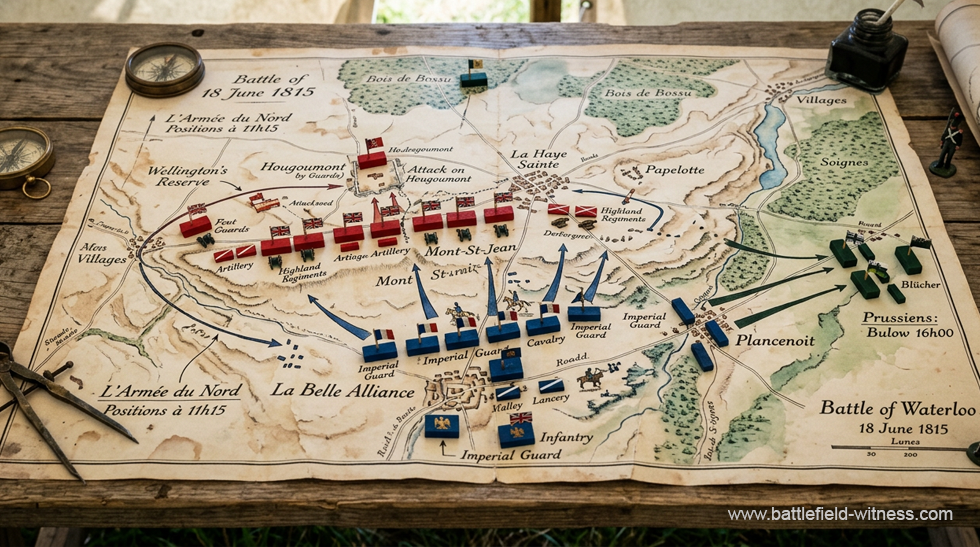
His army was arranged in the configuration he had chosen on this ground the previous afternoon — not chosen randomly, not chosen in response to Napoleon's position, but chosen because Wellington had ridden this road two years earlier and filed the topography away with the same instinct a carpenter files the grain of a particular wood. The ridge at Mont-Saint-Jean. The reverse slope, where infantry could lie down behind the crest and be invisible to artillery until the moment they were needed. Three forward strongpoints: the walled chateau complex at Hougoumont on the right flank, the farm of La Haye Sainte astride the Brussels road at the centre, the cluster of buildings at Papelotte on the left. He had not invented this technique. He had used it before. What he understood that Napoleon apparently did not was that the ground itself could fight — that mud, and walls, and a reverse slope were forces of the same order as cavalry and guns.
Below, to the south, on the ridge called La Belle Alliance, the French artillery — eighty pieces in the Grande Batterie — was being dragged laboriously into position. The guns were sinking into the clay. Napoleon, watching from the front of his telescope, had ordered the battle delayed until the ground dried sufficiently for ricochet fire. In any previous campaign this would have been sound artillery doctrine. The solid iron balls of a twelve-pounder, fired at a low trajectory across dry, firm ground, bounced and tumbled through infantry formations like thrown stones skimming a lake, multiplying the damage of each shot fourfold. On ground this wet, the balls buried themselves after the first impact. They died in the mud.
Napoleon understood all of this. He waited anyway. And the Prussians marched.
By eleven o'clock the sun had done what it could with the clay, which was less than Napoleon had hoped for and rather more than nothing. The order went out. The guns began to speak.
Part Two: Hougoumont — Eleven O'Clock to Two
Hewitt heard it before he felt it — a low, sustained concussion that seemed to come from beneath the ground rather than across it, as though the earth itself were clearing its throat. Then the individual shots became distinct, arriving in a continuous overlapping sequence that made the whole thing sound like a single protracted detonation. The ridge trembled. The rye around him shook in the absence of wind.
"Here we go then," said Private Donnelly, without apparent surprise, and tucked his prayer away.
The regiment was ordered to its feet. They formed at the ready, standing on the reverse slope of Mont-Saint-Jean ridge with the crest fifty yards in front of them, and the guns fired over them and into them and the soil of Belgium pattered down on their shakos like dirty rain. The cannonballs did not all find the soft clay. Some struck the road behind them, or the hard ridge itself, and the ricochet was a sound quite unlike the impact — a sudden high shriek, the ball spinning end-over-end in an unpredictable arc before it struck something or someone and the sound stopped.
You learned not to watch for them. There was no profit in watching for them.
To the right and below, no more than six hundred yards away along the valley floor, the shooting had changed character. It was no longer the periodic regularity of artillery but a dense, overlapping crackle — thousands of muskets firing as fast as hands could manage — and under it was a different sound, more irregular, that Hewitt had learned at Badajoz was the sound of fighting at a wall. Thumping. Breaking. Human voices producing noises that human voices should not produce.
That was Hougoumont.
He could not see it from here. The slight fold of the land and the thickness of the orchard's outer trees obscured the buildings entirely. What he could see, after perhaps twenty minutes, was smoke — not the white gunpowder smoke that had already begun thickening over the whole field, but a different colour, orange at its base and brown at its top, the smoke of a building burning rather than a gun firing. The chateau was alight. He watched a column of it rise into the morning sky and then flatten and blow north, toward Brussels, toward safety, toward a city full of people who had gone to a ball three nights ago.
Inside the burning compound, the Guards held.
This was not metaphor. The Guards held the courtyard, the stables, the chapel, the garden walls, the orchard hedges. They held them against the better part of four French infantry divisions — fourteen thousand men committed to what Napoleon had intended as a diversion, a side-blow designed to draw Wellington's attention and resources away from the main effort in the centre. What he had not calculated was that the Guards would hold, and that Wellington, perceiving correctly that Hougoumont was the hinge of his entire right flank, would match each French commitment with his own, feeding battalions down the sunken lane to the compound's northern gate in an unending relay that consumed the morning. The diversion became a separate battle. The battle became a furnace.
Hewitt did not know any of this. He knew the fire was burning. He knew the firing had not stopped. He knew what that meant.
Walsh, beside him, had stopped smiling. Not with fear — with something more complex, a settling of the face into a kind of deliberate blankness that Hewitt had seen on men before and recognised as the expression of someone who has decided that the thinking portion of the day is finished. There was a useful stoicism in certain men that came not from stupidity but from a clear-eyed understanding that in a square mile of gunpowder and iron the only variable you could influence was yourself, and that influencing yourself was a full-time occupation.
"Steady," Hewitt said, to no one and everyone.
It needed saying. It always needed saying.
Part Three: The Squares — Two O'Clock to Six
The first cavalry came at half past three.
Hewitt heard them before the order was given — that particular vibration through the soles of his boots that has no other cause in nature, the footfall of several thousand horses moving together in the same direction at increasing speed. It built from a trembling to a thudding to something you felt in your chest, and by the time the trumpets on the ridge called form square there were men in the battalion who had gone white and there were men who had gone blank and there was Donnelly, still and apparently calm, who had begun his prayer again.
The infantry square of 1815 was approximately eighteen metres on a side. Each face was four ranks deep — the first rank kneeling with fixed bayonets pointing outward at horse-chest height, the second rank presenting over their heads, the third rank loaded and ready, the fourth rank reloading. The interior was a compressed, dark space of sweat and leather and the particular smell — sour, organic, unmistakable — of men who are frightened. The battalion's colour party stood in the centre, the King's Colours and the Regimental Colours held upright on their poles, because these were the things you stood around and that told you what you were, and a battalion that lost its colours in a square had lost the point of being a square.
The 27th Inniskillings formed their square on a slight rise of ground roughly two hundred yards south of the crest of the ridge, between La Haye Sainte to their left and Hougoumont smoke to their right. They were not alone. The Allied infantry along the ridge had collapsed into a checkerboard of squares — perhaps thirty of them visible, arranged in staggered rows so that each one could fire without hitting the one in front, a pattern that Wellington had apparently designed with the same deliberateness that a chessboard is laid out, each piece defending the others.
The French cavalry that came were cuirassiers — the heavy armoured cavalry of Napoleon's Imperial Guard, men on large horses wearing polished steel breastplates and backplates that enclosed their torsos and steel helmets with horsehair crests that made them look, in the smoke and the afternoon light, like something out of a different century. The breastplates were not decoration. A smooth-bore Brown Bess musket ball at fifty yards would not penetrate them. You had to aim for the horses, the legs, the faces, or wait until the range was ten yards and hope the ball found a gap at the throat.
They came in masse — eight, nine, ten thousand riders in the repeated charges of that long afternoon, wave after wave sent forward by Marshal Ney, who had already had three horses killed beneath him and was conducting the battle from borrowed mounts, his hat gone, his coat blackened, his face the colour of a man who has moved past reason into something that might once have been courage but had become by now a kind of furious bewilderment at why the squares would not break.
The horses would not charge home. This was the thing Ney had not accounted for and could not repair. A horse is not a weapon in the way a cannon is a weapon; it is an animal, and animals have preserved themselves for fifty million years by not throwing themselves onto things that will kill them. A wall of bayonets, four ranks deep, presenting points at chest height — no horse born ever walked willingly into that. They shied, swerved, milled. The riders wheeled around the squares, pistols and sabres finding what angles they could, and the square fired into them from all four sides at distances of twenty and thirty yards, and the ground around each square acquired its own deposit of dead horses and dead men in polished steel, and the charges came again.
The guns on the ridge had stopped. The Royal Artillery crews had fired until the last possible moment — canister at sixty yards, which is not a single ball but a tin case full of musket balls that opens in the barrel and spreads like a shotgun charge through a formation, and at sixty yards against cavalry it is catastrophic — and then, when the horses were on top of them, they had abandoned their pieces and run for the nearest square. They were admitted through a gap in the rear rank, the gap closed behind them, and they stood inside in the choking dark waiting for the charge to pass. When the cavalry drew back, they ran to their guns again.
The French cavalry had not spiked the guns. This was a failing so elementary that no one, afterward, could explain it adequately. Spiking a gun — driving an iron nail into the touchhole through which the powder was ignited — rendered it inoperable until a blacksmith could drill it clear, a process requiring tools and time no battlefield afforded. The French troopers had the nails. They were standard equipment. In the chaos of the charges, with squares firing from three sides and dead horses piling up underfoot, no one had stopped long enough to do it. Each time the cavalry withdrew, the British gunners were back at their pieces within minutes.
Inside the 27th's square, the world had contracted to what could be seen through the faces of the men on three sides of you. Hewitt was in the second rank of the east face. He was firing, reloading, firing, by a set of physical movements so deeply grooved by training that they did not require thought — bite the cartridge, prime the pan, charge the barrel, ball down, ram down, present, fire — and this sequence repeated perhaps three times a minute, in smoke so thick that you fired into grey blindness and heard the ball strike something out in the grey and did not know whether it had struck a horse or a man or the air.
Walsh was on his left. Someone else, a private whose name Hewitt did not know, was on his right, and after the fourth charge this private sank to his knees and sat down in the interior of the square in the way men sit when something in them has simply stopped, and two of the men behind pulled him backward and closed the gap, and Hewitt never saw him again.
The guns landed in the square at irregular intervals throughout the afternoon. The artillery south of the ridge had continued firing through the cavalry charges, relying on the precision of French gunners to clear the heads of their own horsemen — and the precision was not always equal to the task. A twelve-pounder ball struck the east face of the square at quarter past four and took three men off their feet simultaneously, one dead and two screaming in a way that was hard not to hear, and the ranks closed over the gap as they had been trained to, and the square was the same size it had been a moment before, only smaller.
The 27th Inniskillings held their square for six hours. By the end of it, nearly two hundred and sixty men were casualties. They had begun the day three hundred and ninety-eight strong. They held their square through twelve major cavalry charges. They did not break.
Donnelly survived. Walsh survived, with a pistol ball through the flesh of his left arm that he did not mention for two hours. Hewitt survived without a mark on him, which he found, in later years, impossible to fully explain to people who had not been there — the way survival was not earned but simply allocated, the way you stood in a particular spot and the ball went a foot to the left and the man a foot to the left was dead, and you were the one who went home.
Part Four: The Farm Falls — Six O'Clock
He heard it when La Haye Sainte fell — not the falling itself, which was not a single event but a degradation, a slow collapse — but the change in the quality of the battle noise that announced it. The sustained, precise, lethal crackle of Baker rifles being fired by the King's German Legion's 2nd Light Battalion — a sound Hewitt had learned to distinguish over six hours of battle, a higher, sharper report than the standard musket, the sound of men who had been fighting all day with the controlled economy of trained marksmen — that sound stopped. And what replaced it was a different kind of firing, closer, more disordered, and then a roar from the French lines that had the quality of a crowd sound, the particular communal sound of men who have collectively crossed a threshold.
Major Baring's men had fought all day. They had held that stone farmhouse on the Brussels road for nine hours against the weight of repeated infantry assaults, firing their Baker rifles through loopholed walls with an accuracy that carved holes in the French columns approaching across the open ground. The Baker was not a standard-issue weapon; it was a rifled firearm — the barrel cut with spiral grooves that spun the ball and gave it range and precision that the smooth-bore musket could not approach. A trained rifleman with a Baker could hit a man at two hundred yards with consistency. At one hundred yards it was nearly certain. The French had learned to hate the sound of it.
What finished them was not French valour but arithmetic. The 2nd Light Battalion had expended their ammunition.
The appeals for resupply had been sent and repeated and apparently lost in the chaos of the afternoon, and at six o'clock the magazine at La Haye Sainte was essentially empty, and when the next French assault came there was nothing to meet it but bayonets, and bayonets are magnificent things but they require you to be alive and upright and in sufficient numbers to present a credible wall, and the battalion had been fighting since before dawn and were perhaps two hundred men by now, and the French infantry came over the walls and through the gates and the farm fell.
Its fall changed everything.
Napoleon moved his skirmishers and a battery of horse artillery to within sixty metres of the Allied centre. Sixty metres. In the language of musketry, this is almost no distance at all. At sixty metres, a smooth-bore musket ball fired at the Allied centre could reasonably expect to find flesh. The canister from the horse artillery at sixty metres was not destructive; it was annihilatory. The Allied centre — the 27th and the regiments around them, the whole thin line on the ridge — bent under the new fire like something bending before wind.
Wellington, watching from the ridge, said nothing that was recorded. He was observed to look, once, toward the east — toward the direction from which, if the information from Müffling was accurate, the Prussians were already arriving — and then to look back at the centre.
He held.
Part Five: La Garde — Half Past Seven in the Evening
When the order came, Henri Dumont had been waiting for it for six hours.
He had waited in the prescribed manner: standing, or sitting on a pack, or inspecting equipment that did not require inspection, in the space behind the low ridge at La Belle Alliance where the Guard's reserve had been placed at the start of the battle and where it had remained through the whole disintegrating afternoon. He had watched the cavalry charges from a distance. He had watched the smoke over Hougoumont thicken and darken and change colour as the hours passed. He had watched the messengers going to and from the Emperor's position at the inn, and he had read their faces — not for information, which was not his to be given, but for tone, the way you read a room before you enter it.
By late afternoon the tone was wrong. He had known it in the way men who have been at many battles know things — not from a single source but from the accumulated evidence of small signs: the fact that the first cavalry charge had not produced the general infantry advance that should have followed it; the fact that Ney's subsequent charges, without infantry support, were throwing horses and riders against walls of bayonets with no exploitation; the fact that the columns of smoke from the eastern edge of the battlefield, beyond Papelotte, had a different quality from French smoke and were arriving from a direction that French forces were not supposed to be.
The Prussians had come. Bülow's IV Corps, arriving at half past four on the French right flank, had driven into the village of Plancenoit and the Emperor had been forced to divert the Young Guard — the youngest and least experienced formation of the Imperial Guard — to hold them off. The Guard was being used for defensive fire-fighting, which was not what Guards were for. This was not how winning armies used their final reserve.
Dumont did not say any of this. He was a sergeant-major, not a general, and he understood the distinction absolutely. His function was not to win the battle with his understanding of it but to make his grenadiers do what they were told when the order came.
The order came at half past seven.
Marshal Ney delivered it himself — or what was left of the Marshal who had begun the day, because the figure who rode down the line of the Guard's reserve was not the polished, magnificent presence of Ney in his full dress but something that the battle had processed through itself and returned, coat blackened and torn, face the colour of quarried stone, on his fifth horse of the day. His fifth horse. There are moments in history that read as symbols even as they happen, and a marshal of France on his fifth borrowed horse, riding down the line of the last reserve, is one of them.
"En avant, grenadiers," Ney said. "Pour la France."
Dumont gave the order. The battalions of the Middle Guard began to move.
What struck him first was the ground. After a day of sitting back in relative shelter, the first hundred metres of the advance showed him what the afternoon had built in this valley: a landscape that no longer resembled the farmland it had been six hours ago, a terrain of craters and spoil where the artillery had worked the earth over, of dead horses lying in the attitudes of creatures that had been running and then simply stopped, of men from both sides arranged in patterns that defied geography, face-down and face-up and curled and sprawled, with the particular stillness that belongs only to people who have stopped caring about comfort.
He put it to the side. He had seen this before. What he had not seen — or not seen in such concentration — was the smoke. By late evening on this field, the black powder smoke from sixty thousand muskets and three hundred cannon firing all day had created something that was not quite fog and not quite cloud but a compound of both, a drifting, sulphurous obscurity that reduced visibility to eighty or a hundred metres and gave the whole field the quality of something seen through gauze. The setting sun behind them to the west came through it orange and then red and lit the smoke in layers, amber near the ground, brown above, and it was beautiful in the way that things lit by fire at dusk are beautiful, which is a beauty you feel while also wishing it away.
They crossed the valley in column, the Middle Guard, five battalions of five hundred men each moving in the old manner — men shoulder to shoulder, sixteen across and fifty deep, the columns that the Emperor had used to break enemy lines from Madrid to Moscow, the mass and momentum of which was intended to absorb casualties and still arrive. They were moving uphill. The Brussels road was to their left. La Haye Sainte, taken two hours ago, lay on their right, its walls still smoking. Ahead was the crest of Mont-Saint-Jean ridge, and beyond the crest were the British lines, and when the British saw the bearskin caps of the Imperial Guard coming up the slope every voice on the ridge that was still capable of producing sound produced it.
Dumont could hear it above the artillery. He had been hearing British infantry shouting for twenty years and he knew what it was. It was not fear. It was aggression — the particular compressed aggression of men who have been standing in squares and taking fire for six hours and had, until this moment, been denied the simple physical relief of movement.
The battery opened on them at two hundred metres. Canister, and then canister again, and then canister a third time, and the front of the first column acquired gaps the way cloth acquires tears, and the men behind closed up as they had been trained and the column moved forward and acquired more gaps and closed them again, and this was how you did it, this was the arithmetic of massed assault, you fed men into the calculation faster than the guns could remove them and eventually you arrived at the guns and then you were past them.
Dumont was in the column's left file, second rank from the front. The man ahead of him went down — not dramatically, not thrown backward by the impact, but simply down, as though he had decided to lie down, and Dumont stepped over him and moved forward and the man behind him moved into Dumont's place and the man behind that moved into the place after that, and the column was the same size it had been a moment before, only smaller.
Then something happened.
From above and to the right, from a position that should have been empty — that the French intelligence had noted as empty, that the smoke had been hiding — a fresh voice came into the battle. Not artillery. Musketry, but delivered in a single simultaneous crash that in a day of individual shots and ragged volleys hit the ear with the force of something new, something that had been saving itself. It came from the left flank of the column, from the side, and it moved down the column's length in a traversing wave of fire, not into the faces of the grenadiers but into their sides, where there was no protection, where the density of the column offered nothing but more targets, where a single ball fired at ninety degrees to the line of march had four or five bodies to find before it exhausted itself.
The 52nd Light Infantry — Colonel John Colborne had swung them out, a full battalion on the French flank, without waiting for orders and without checking whether the orders were coming. He had seen the angle and taken it, and the angle was lethal.
At almost the same moment, above them on the crest, a voice gave an order in English that Dumont could not hear clearly but whose effect he saw: from behind the ridge, from beneath the crest where they had been lying invisible to artillery for the entire afternoon, a line of red coats rose. Fifteen hundred men. They had been lying in the rye, invisible, for two hours. They stood and fired at thirty metres.
The column stopped moving forward.
This was not, at first, a retreat. The column simply ceased to advance, which is a different thing and a worse one — an army that retreats has made a decision; an army that stops has lost the mechanism of decision. The grenadiers of the Middle Guard stood on the slope and were fired into from two sides at distances of between thirty and one hundred metres and did what they had always done, which was stand and fire back, and they continued to do this as the column's front eroded and the column's sides eroded and from somewhere behind them — from the French lines to the south, from the watching infantry and the watching cavalry and the watching remnants of the afternoon's disasters — a sound arose that was not artillery and not musketry but something worse.
La Garde recule.
The Guard is retreating.
It was not a factual observation. The Guard had not yet retreated. But the words moved south through the French army the way fire moves through dry grass, and what they ignited was not orderly withdrawal but disintegration. The units that had held all afternoon — d'Erlon's survivors, the remnants of the cavalry, the conscript regiments who had stood in the valley under the Prussian fire — simply came apart. Not in the organised, tactical sense. In the human sense. Men threw down their muskets and turned and ran, and their running infected the men beside them, and those men infected the men behind them, and in ten minutes the French army ceased to be an army and became fifty thousand individuals all moving south, all moving away from the ridge where, at this moment, the Duke of Wellington was standing in his stirrups on a grey horse and raising his hat and the entire Allied line was advancing.
Dumont did not run. This was not heroism; it was the accumulated habit of forty-three years and twenty-six campaigns and the complete inability, by this point in his life, to imagine the movement of running away from an enemy. He walked. He formed the rearmost handful of grenadiers who were still functional into something like a line, and they walked south through the growing dark and through the debris of an army and through the first arrivals of the Prussian cavalry that Gneisenau had unleashed in pursuit, and several times he was obliged to present bayonets to the horsemen and several times the horsemen found easier prey and rode past, and by midnight he was on the road to Charleroi with perhaps forty men in a nation of sixty thousand that had all gone the same direction.
He did not know, then, what he had lost. He knew the battle. He did not yet know the rest of it — the Emperor's abdication, the island of Saint Helena, the twenty-three years of peace in Europe that would follow this day's work, the absolute finality of it. He knew only the dark road south, and his feet in the clay, and the distant fires behind him still burning on the ridge.
Part Six: After — Night, and the Field
Hewitt found Walsh at a quarter past nine, sitting on an overturned French caisson a hundred yards from where the square had been, attending to the ball in his arm with the focus of a man who has been putting something off all day.
"You should have said," Hewitt told him.
"We were occupied," Walsh said.
The field around them was extraordinary in the way that the aftermath of battle is always extraordinary: the noise had gone, or nearly gone — there was still distant firing to the south as the Prussians drove their pursuit into the fleeing French columns — and what remained was the particular quality of silence that a very noisy place achieves after the noise stops, which is not silence exactly but its opposite, an expressive quiet that is defined by the contrast with what preceded it. Under it, and through it, were other sounds: voices calling, horses still moving in the dark, and under all of that a continuous sound that Hewitt did not let himself listen to clearly because it was the sound of ten thousand wounded men.
The fires at Hougoumont were still burning. The chateau was gone — only the stone walls remained, and the chapel where, inexplicably, a wooden painting of Christ above the door had survived intact while everything around it had been consumed. The defenders of Hougoumont were still there, some of them, sitting in the ruins and saying very little. They had been in that burning compound for ten hours.
Hewitt sat beside Walsh and helped with the arm, which was not as bad as it could have been, and they watched the fires and said nothing for a while. The moon was rising. It showed the field as something pale and irregular, as though the ground itself had been rearranged, which in a sense it had — thirty thousand men lay on it who had not lain there in the morning.
"We won, then," Walsh said, eventually.
"We did," Hewitt said.
Walsh considered this. "It doesn't feel like much," he said, and this was not complaint but honest observation, the kind of thing a man says when the gap between what a thing means in history and what it feels like from inside it has become temporarily visible.
"No," Hewitt agreed. "It doesn't."
Donnelly appeared from somewhere in the dark, sat down on the ground beside them, produced a bottle of something he didn't explain, and offered it around. They drank in silence for a while. The fires burned. The Prussians were somewhere to the south in the dark, following the road to Charleroi, pursuing. The night would be long and the road behind the French would be merciless, and by morning there would be nothing left of the army that had come north three days ago with a plan to destroy two nations' armies before they could combine.
In the east, the sky was still dark.
Somewhere between this ridge and the sea, couriers were already riding north with the news. By morning it would be in Brussels. By evening in London. By the end of the week the word would have reached the capitals of Europe, and the chancelleries would reconfigure, and the maps would be redrawn, and a certain quality of possibility — the possibility that Napoleon Bonaparte might once again remake the continent according to his own logic — would pass out of the world entirely.
None of this was available to the men sitting on the overturned caisson watching Hougoumont burn.
They had a bottle. They were alive. For now, that was the whole of it.
The 27th Regiment of Foot (Inniskillings) suffered 105 men killed and 373 wounded at Waterloo — a casualty rate of over sixty-nine percent, the highest of any regiment in the Allied army. The Regimental Colours were carried by Ensign Thomas Crawford, who had already been wounded twice. They did not fall.
Henri Dumont is a fictional character. The grenadiers of the Middle Guard's 3rd Battalion, who led the final assault, were real men. Approximately forty percent of them became casualties on the slope of Mont-Saint-Jean. Their sergeant-majors' names are recorded in the French archives at Vincennes.
Wellington, asked later to name the day's critical moment, did not mention the cavalry charges, or the Prussian arrival, or the final advance. "The success of the battle," he said, "turned upon the closing of the gates at Hougoumont." The gates were closed by a lieutenant colonel and six guardsmen, against thirty-one Frenchmen who had already entered the courtyard. All thirty-one died.
18 June 1815. Mont-Saint-Jean, Belgium.