The Battle of the Catalaunian Fields

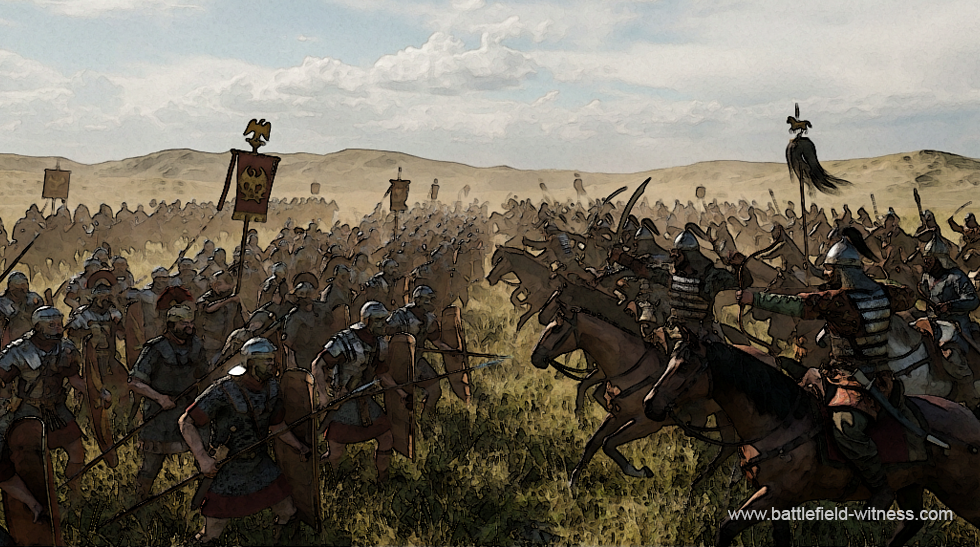
The Hostage's Debt
A story of the Battle of the Catalaunian Fields, June 451 AD — told from within Aetius's own household
I. Two Hostages
Optila had been given away twice in his life, and both times it had made him, in the end, more valuable than the men who gave him.
The first time he had been nine years old, a nephew of a minor Hunnish chieftain, handed over as a guarantee of some treaty his uncle had no real intention of keeping — the way steppe lords traded sons the way Roman senators traded promissory notes, each one worth exactly as much as the danger of breaking it. He had grown up half in a Roman garrison town on the middle Danube, learning Latin from a chaplain who beat the declensions into him and learning the sword from men who assumed, correctly, that a Hunnish boy would need it. By the time anyone thought to send him home, home had stopped meaning anything in particular, and he had gone instead into the bucellarii — the personal retinue, sworn not to the Roman state but to a single Roman man, fed at that man's table and paid from that man's purse — of a rising officer named Flavius Aetius.
It did not escape Optila, and it had certainly not escaped Aetius, that the general had once been a hostage too — sent as a young man to the court of the Huns themselves, in the years before Attila's uncle Rugila had died and the boy-king had inherited an empire built entirely on personal terror. Aetius had learned Hunnish the way Optila had learned Latin: by necessity, among people who could have killed him for a whim and mostly chose not to, because a live hostage is a lever and a dead one is only a grievance. The two men never spoke of it directly — a Roman general and his Hunnish bodyguard did not sit trading childhood stories like old campaigners — but Optila had seen, more than once, a particular stillness cross his general's face at the sound of Hunnish being spoken nearby, the stillness of a man translating not just words but an entire vanished stretch of his own life, and he understood that stillness perfectly, because he felt its twin every time a psalm was sung in a dialect close enough to the Danube garrison chaplain's Latin to catch him off guard.
Now, in the fourth week of a campaign that had already burned half the cities between the Rhine and the Loire, Optila rode two horses back from Aetius's own position in the column, close enough to reach him in a dozen strides, far enough not to overhear every word — which was, in any case, precisely what a bucellarius was for.
II. The Tent Before Orléans
He had heard the Honoria business explained three separate times by three separate officers before Orléans, each version slightly different, each one delivered with the particular confidence of men repeating court gossip as strategic analysis. A princess — the Emperor's own sister — had sent her ring across the world to Attila, whether as a genuine plea for rescue from an unwanted marriage or a reckless private fantasy no one in the tent claimed to know for certain, and Attila had chosen, with the deliberate opportunism of a man who had spent his whole life turning other people's weaknesses into levers, to hear in that ring a formal proposal of marriage and a dowry of half an empire. Rome had refused him. Attila had come to collect the debt in the only currency he had ever fully trusted: an army large enough that refusal stopped being an option.
Optila had stood at the tent-pole the night the final dispositions were argued before Orléans, close enough to see Aetius's face by the single oil lamp and far enough that no one troubled to lower their voice on his account — a bodyguard, in a general's household, was furniture with a sword, present at conversations no clerk would have been trusted to hear. He listened to Aetius and his officers debate the placement of King Sangiban's Alans with a bluntness that would have startled the Alan king himself, had he been present. Word had reached the command tent, more than once and from more than one source, that Sangiban had opened secret correspondence with Attila — a private assurance, perhaps, that the gates of Orléans might be found unaccountably unguarded, should the Hunnish host arrive in force. Whether it was true, no one in that tent could say with certainty. What mattered, one grizzled tribune said flatly, was that the army believed it, and an army that believes its own center cannot be trusted will break at the center whether or not the belief was ever earned.
"Then put them where they cannot run," Aetius said, in the tone of a man solving an engineering problem rather than a question of honor. "Romans on one side. Goths on the other. Let them fight the Huns because the alternative is dying on their own allies' spears." It was not trust. Optila, listening, understood it for what it was: a leash woven out of legions, tied around a king whose loyalty no one in that tent was willing to wager on outright.
They reached Orléans with days, perhaps hours, to spare. Optila rode in the column that crested the last rise above the city and heard — before anyone saw a single standard — the unmistakable sound of a siege already in its final, desperate hour, a low continuous grinding of ram against gate audible even over hoofbeats. And then, astonishingly, they watched the Hunnish lines dissolve at the mere sight of the relief column's dust, an entire army abandoning a siege it had very nearly won rather than be caught between a broken wall and Aetius's arriving spears. Attila pulled back east. Every officer in the command tent understood, within the hour, exactly what that meant: the Hunnish king was not retreating from the campaign. He was withdrawing to ground of his own choosing.
III. The Race, Seen From Beside the General
A man riding at a commander's shoulder sees more than the soldier in the line and understands, in the moment, almost as little. He sees messengers arrive. He sees the general's face change before the general says why. He rarely learns the reason until it is already history.
The plain the Huns chose, some days later, was flat chalk country cut by a thin summer river, dominated by a single long ridge that any competent officer could see mattered before a spear had been thrown. Optila watched Aetius read that ground the way another man might read a letter — a long look, a shorter one at the sun, and then the order, given without visible urgency though every man who received it moved as if the building were on fire: take the high ground, now, before the Huns reach it.
He rode in that charge — part of the general's own household troops, mounted men sworn personally to Aetius rather than to the wider army, riding alongside the young Visigothic prince Thorismund and his own guard in a race that felt, from inside it, considerably less dignified than it would sound afterward in anyone's account of the battle. Optila's horse labored up a slope that had looked gentle from a distance and felt, at the canter with armor on, like the side of a real mountain; he heard, over his own horse's breathing, the first exchange of missiles rattling off shields ahead as the allied skirmishers who had won the race by minutes flung javelins and sling-stones down into a Hunnish vanguard trying to climb the same slope from the wrong direction. He saw the charge falter — not break, these were Attila's own household men and they did not break easily, but falter, horses turning broadside on ground that punished them for it — and he understood, with the particular clarity of a man who had grown up among Huns and knew exactly how much they hated fighting uphill on tired horses, that the first exchange of the day had already gone against his own blood.
He did not examine that feeling too closely. There was no time, and besides, he had made his choice of blood a long time ago, at nine years old, without being asked.
IV. What Reached the General's Ear
The main lines closed within the hour, and from that point Optila's task narrowed to the one thing a bucellarius exists to do in the middle of a battle: stay between his general and anything sharp, while the battle itself became, for him as for everyone else on that field, a matter of fragments rather than a whole picture.
He heard the reports arrive before Aetius did, because he stood between the messengers and the general's person, and every rider who came pounding up out of the dust had to pass close enough to Optila's blade for Optila to judge, in the half-second before recognition, whether the man reaching for something at his belt meant a dispatch or a knife. Most meant dispatches. He heard a rider from the center report that Sangiban's Alans were holding, bloodied but holding, exactly as squeezed as the leash had been designed to make them. He heard, within the same hour, two contradictory accounts of the Visigothic king's death arrive within minutes of each other — one rider swearing Theoderic had been thrown from his horse and trampled by his own advancing warriors, a second insisting a spear thrown by a young Ostrogothic noble of the Amal house, fighting for Attila, had found the old king first. Optila watched Aetius's face receive both reports with exactly the same expression, and understood that a good commander could not afford to prefer the version that pleased him, because command decisions made from a preferred story rather than an uncertain one were how battles were lost by men who had already won them.
What was certain — because the sound of it reached even Aetius's position, a swelling, changed note in the general roar from the direction of the Visigothic line — was that the news, however it had traveled, had turned Visigothic grief into something with no brake on it. Optila had heard that particular pitch of noise only twice before in his life, both times from Hunnish warbands who had just lost a chieftain, and both times it had meant that whatever the enemy did next, restraint would not be part of it.
Aetius, receiving this, did something Optila had not expected and would turn over in his mind for years afterward: he did not send men to calm the Visigothic line. He let the fury run. A grieving, furious ally driving hard at your enemy's flank was, in the arithmetic Aetius practiced, simply a resource, and resources were not to be gentled when they could be aimed.
V. The Night at the Tent-Flap
Dusk brought the second piece of news that mattered: the new King Thorismund — no one on that field yet called him king, though within hours he would be one — had led his own household guard in the near-dark straight into the wagon-fort where Attila's shattered host had taken refuge, and had been dragged back out again, wounded, bareheaded, cursing the men who had refused to let him go back in for a second attempt. Optila, standing his post outside the command tent that night while the fighting dissolved into isolated struggles by starlight, heard the prince half-carried past, still furious, still bleeding from a gash above the ear, and understood that a boy had become a king that night in the worst possible way, all at once, with no time allowed to grieve his father before he had to decide what kind of king the grief would make him.
What Optila overheard afterward, standing where a bucellarius always stands — close enough to be useful, far enough to seem invisible — he did not fully understand until years later, though he carried every word of it with him from that night onward.
Aetius went to Thorismund himself, past midnight, and Optila, posted just outside the tent-flap with his hand loose on his sword-hilt, heard the shape of the conversation if not every word of it: the general's voice, level and almost gentle, laying out for the new king exactly what waited for him if he lingered on this field to finish what his father's death demanded. Brothers in Toulouse. An empty throne. Every day spent besieging Attila's wagon-fort was a day closer to losing, at home, everything his father had spent a reign building. Optila could not have said, standing there, how much of what Aetius told the young king was true and how much was the precise, surgical placement of a fear that happened to serve Rome's purposes rather than the Visigoths'. He suspected, even then, that his general did not entirely know the answer to that question himself, and had stopped needing to know it, the way a good physician stops needing to enjoy the taste of the medicine he prescribes.
What Optila understood without needing anyone to explain it to him — because he had grown up among Huns and knew exactly what an intact Hunnish threat was worth to a Roman general surrounded by barbarian allies he did not fully control — was the shape of the calculation itself, once he'd had time to turn it over. Destroy Attila utterly on this field, and there was nothing left in Gaul to make the Visigoths, now larger and angrier and led by a furious young king, remember why they still needed Rome at all. A dead Hunnish empire solved one problem and handed his general a worse one within the season. Optila had spent his whole life as a lever in other men's calculations. He recognized the shape of one being built in front of him, this time with an entire people's future king as the lever's fulcrum.
Past the command tent, out toward the dark bulk of the wagon-fort, a light began to rise and steady — a great pyre, built, Optila learned only the next day, from stacked horse-saddles, because Attila had believed himself beaten and had chosen to burn rather than be taken. Optila stood at his post and watched that glow all night, feeling something he did not have a clean word for in either of his two languages: not quite grief, not quite relief, something closer to the specific loneliness of a man watching his own childhood be allowed, deliberately, to survive one more year by the calculation of the man he had sworn his sword to.
VI. What Was Allowed to Live
Dawn came up grey over a field Optila would not describe in detail to anyone for years, and the allied host, to the visible fury of half the men who had fought the day before, did not storm the wagon-fort. Optila rode close enough to his general's shoulder that morning to see the exact moment the order to hold position was given, and to see that Aetius gave it without any particular satisfaction, the way a man signs a necessary document he does not enjoy signing.
Within days the Visigothic host — grieving, victorious, and now the largest single army left standing on that plain — turned south for Toulouse exactly as Aetius had calculated it would, and the rest of the coalition drifted apart behind it the way an army does when the men in it have stopped believing there is more to be won by staying together. Attila gathered what remained of his shattered host and rode east, back toward the Rhine, alive, carrying with him — though no one on that field could have known it yet — perhaps two more years of life and one final catastrophic wedding night waiting for him at the end of it.
Optila served his general four more years after that field. He was at Aetius's shoulder, or near enough to it, through the slow unraveling that followed the victory nobody quite knew how to celebrate: Attila's death in 453, drowned in his own blood on his wedding night, an empire that had been held together by nothing but one man's terror consequently tearing itself apart within a season; the crushing of Attila's sons by their own former Gepid and Ostrogothic vassals at Nedao the year after, a battle that finished, at last, the work Aetius had chosen not to finish on the Catalaunian plain.
And he was in Ravenna in 454, though not in the room, when the Emperor Valentinian III — who had never once in his reign faced Attila's army but had spent a great deal of his reign fearing the general who had — summoned Aetius to a private audience and killed him there with his own hand. A contemporary wit, hearing of it, remarked that the Emperor had cut off his own right hand with his left, and the phrase traveled through every barracks and bathhouse in Italy within the month, as such phrases do, admired by men who had never had to decide what a hand owed the arm it had served.
Optila had been given away twice as a boy and had made of both gifts a kind of value nobody who gave him away had intended. He made a third choice himself, the following year, needing no one's permission for it: in 455, on the Campus Martius, he put a blade into Valentinian III with his own hand, in the plainest possible payment of the plainest possible debt, for the plainest possible reason — that a man who had spent his whole life as somebody else's lever had decided, once, to be the hand instead.
He did not, so far as anyone recorded, explain himself further. He did not need to. Every soldier who had stood a night watch outside that command tent above the Catalaunian Fields would have understood exactly why, and exactly what it had cost him to wait four years to do it.
A Simple Timeline
Youth, before 430s AD — Optila, a Hunnish-born hostage, is raised in a Roman frontier garrison and enters the bucellarii — the personal armed household — of the rising officer Flavius Aetius, who had himself once been a hostage among the Huns.
449–450 AD — Justa Grata Honoria sends her ring to Attila, seeking rescue from an unwanted marriage; Attila reinterprets it as a marriage proposal and a claim to half the Western Empire.
Spring 451 AD — Attila leads a coalition of Huns and allied tribes across the Rhine into Gaul, burning cities on his advance toward the Loire.
Early June 451 AD — Attila besieges Orléans. Aetius, with King Theoderic I of the Visigoths, force-marches the allied army to the city and breaks the siege in its final hours. Attila withdraws east into open country suited to his cavalry.
Mid-June 451 AD — Both hosts converge on the plain near Durocatalaunum. Aetius orders a race for the dominant ridge; his household troops, alongside Prince Thorismund's guard, secure the high ground first and repel the Hunnish vanguard's uphill assault.
Afternoon — The full battle lines engage. King Sangiban's Alans, distrusted for suspected dealings with Attila, hold the center under close watch from both flanks.
Late afternoon — King Theoderic I falls in the fighting, in circumstances even eyewitnesses could not agree upon at the time.
Dusk — Thorismund, learning of his father's death, leads a reckless charge into the Hunnish wagon-fort and is pulled back, wounded, by his own guard.
Night — Attila's host withdraws behind its wagons. Believing defeat certain, Attila orders a pyre of saddles built rather than face capture. Aetius privately persuades the newly-crowned Thorismund that his throne in Toulouse is under threat.
Dawn, the following day — The allied army does not storm the wagon-fort. The Visigothic army departs for Toulouse; the coalition disperses. Attila withdraws east across the Rhine, alive.
453 AD — Attila dies on his wedding night; his empire fractures among his sons.
454 AD — The Huns are broken by their former vassals at the Battle of Nedao. In the same year, Emperor Valentinian III murders Aetius with his own hand in Ravenna.
455 AD — Optila, a Hunnish member of Aetius's former bucellarii, assassinates Valentinian III on the Campus Martius in revenge for his master's murder.
Historical note: Optila is a genuine historical figure, named by ancient sources as the Hunnish guardsman who killed Valentinian III in 455 in revenge for the murder of Aetius — one of the few named members of Aetius's personal retinue to survive in the record at all. Everything about his early life, his presence on the ridge, and his thoughts in this account is invented, built around that one attested fact and the documented behavior of bucellarii as personal, barbarian-recruited retinues in the late Roman army. Aetius, Theoderic I, Thorismund, Attila, and the political and tactical framework of the battle follow the ancient tradition — chiefly Jordanes' Getica, drawing on the lost history of Priscus — as closely as its own internal contradictions allow.