Stockholm WW2 spy center story

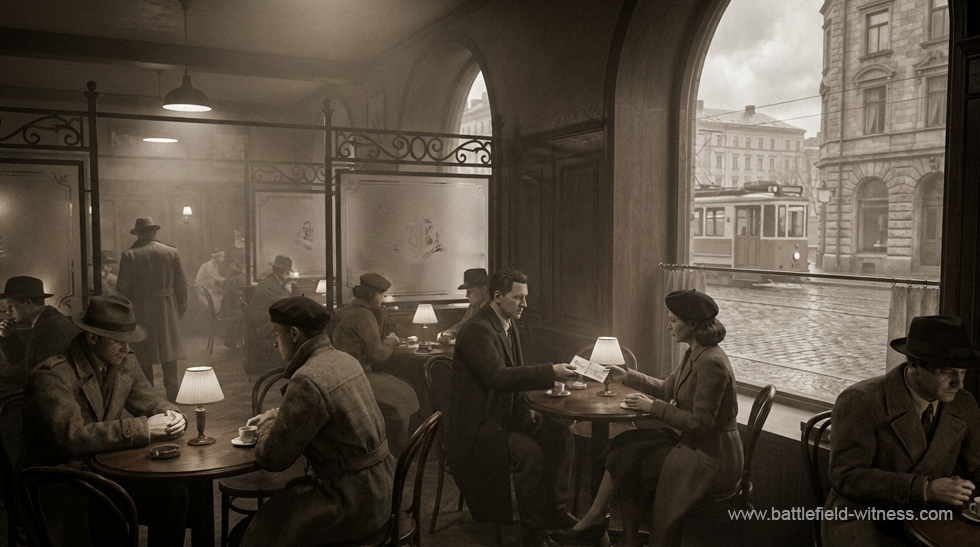
Tjuvlyssnade, (eavesdropped)
Stockholm, Autumn 1943
I.
The trick was to look like you were waiting for someone who was late.
Ingrid Sundqvist had learned this from Ternberg himself, in the flat above the tobacconist on Sibyllegatan, over coffee that had gone cold before either of them touched it. Nobody watches a woman who is annoyed. He'd said it lightly, the way he said most things, as if espionage were a kind of manners. Give them irritation instead of purpose, and they'll look straight through you.
So she sat at Café Anglais with her wristwatch turned face-up on the tablecloth, checking it every few minutes, sighing at the door each time it opened, and let herself become furniture.
At the next table, two men in good coats were speaking German in the unhurried register of people who believed the room belonged to them. One she recognized — Dr. Brenner, commercial attaché, a soft face gone permanently pink from the cold he'd never adjusted to. The other was new. Younger, a colonel's bearing without a colonel's uniform, and he kept glancing toward Strandvägen as though the street itself might report him.
She did not turn her head. She had practised not turning her head in the mirror of her rented room until her neck ached with the discipline of it, and now the discipline had become a kind of peace — a place inside herself where she went to listen, flat and wide as still water, and let the words fall onto her the way rain falls onto a lake without disturbing what's underneath.
Die Lieferung geht über Norwegen — the shipment goes via Norway. Wenn Falkenhorst sein Wort hält — if Falkenhorst keeps his word.
Nothing that would win a war. But a name, a route, a general's word given or withheld — these were the coins of the realm here, and she was meant to gather them the way a woman gathers stray buttons, without appearing to notice she was doing it at all.
Brenner laughed at something and the sound of it — wet, satisfied — nearly made her look up. She caught herself. Sighed instead, theatrically, at her watch. The waiter, passing, gave her a small sympathetic smile, a man's smile for a woman stood up, and she let him have it, because it cost her nothing and bought her the whole room.
Outside, the light over Stureplan was doing the thing October light did here, going thin and pewter-colored by four in the afternoon, so that the awning stripes and the wet cobblestones and the fur collars of the women hurrying toward NK all seemed to exist one register duller than they should have. Ingrid had been in this city three years and she still hadn't gotten used to how early the dark arrived, how it came down like something lowered rather than something that fell.
She gave it eleven more minutes — long enough — before gathering her gloves and leaving three kronor under the saucer for a waiter who would remember only a woman who'd been left waiting.
II.
Erik Falk read the report twice before he burned the notes he'd made reading it the first time.
The flat at Sibyllegatan 49 was arranged, deliberately, to look like nothing. A dentist's waiting room without the dentist. Two rooms of unremarkable furniture, a coat stand that held three overcoats belonging to three different fictional tenants, a kitchen where the kettle was kept permanently full so that anyone arriving unannounced would find the makings of an ordinary domestic scene rather than a listening post. Petersén had chosen the building for exactly this reason — its genius was its total failure to be interesting.
Falkenhorst. Erik turned the name over. General Nikolaus von Falkenhorst commanded the German forces in Norway, and if there was a shipment moving under his personal word rather than through the usual channel, someone above Erik's pay grade would want to know why the usual channel had been judged unsafe.
He was thirty-one years old and had been, before all this, an unremarkable lieutenant in the Defense Staff's cartography section, a man who drew coastlines for a living and had never fired a weapon outside of training. Ternberg had found him at a dinner party — of course he had, everyone in this business seemed to have been found at a dinner party — and had asked him, apropos of nothing, whether he thought Sweden's neutrality was a fact or a performance.
Both, Erik had said, not thinking about it, and Ternberg had looked at him the way a man looks at a horse he's decided to buy.
Now he ran four people, of whom Ingrid Sundqvist was the best and the one he worried about most, in that order, though he had never told her either fact.
He locked the report in the drawer that wasn't the real drawer — the real one was behind it, accessed by a catch no dentist's waiting room would ever have needed — and went to make the tea nobody was fictional enough not to actually drink.
III.
They did not meet at Sibyllegatan. They never met at Sibyllegatan; Ingrid had been there exactly once, for the recruitment, and had understood without being told that she would not return.
Instead they met the way two people who knew each other slightly might meet by accident — on a bench in Humlegården, or, this particular Tuesday, walking the same stretch of Strandvägen at the same unremarkable hour, two acquaintances who happened to fall into step.
"Falkenhorst," she said, to the middle distance, not to him. "A shipment through Norway. Brenner and a man I didn't know — young, wanted rank badly, the kind who corrects his own tie in shop windows."
"Kluge's replacement, probably. There's been a reshuffling." Erik kept his eyes on the water, on the boats moored along the quay with their flags gone slack in the still air. Across the street, Strandvägen 7 stood in its handsome row — American flag at one door, Italian tricolor two doors along, and past that the black eagle of the German legation, the three of them close enough that a man could, in theory, borrow a light from an enemy's cigarette on his way between appointments. Everyone in Stockholm found this funny in a way that had stopped, some time ago, being actually funny.
"There was something else." Ingrid slowed, adjusting her glove, buying half a second. "A woman looked at me. In the café. Not at me — through me, the way you look at furniture. But she looked twice."
Erik's pace did not change. This was the discipline; whatever moved in you, the feet kept their rhythm. "Describe her."
"Forty, perhaps. Good coat, better than her face suggested she could afford honestly. She was with the man I didn't know. She left when he left, but not with him — a few minutes behind, different door."
"Secretarial." Erik said it flatly, an observation rather than a comfort. Everyone knew what a woman like that, attached loosely to a man like that, tended to be. "If she looked twice, she's paid to look twice at everyone. It may be nothing."
"It may be nothing," Ingrid agreed, in the tone of a woman who did not believe it and would carry the not-believing home with her, fold it into the lining of her coat, take it out at three in the morning to look at again.
They reached the end of the quay, where by unspoken agreement one of them would turn back and the other would continue, two acquaintances whose paths had simply diverged the way paths do.
"Ingrid." He said her name — her real one, which he was not, strictly, supposed to use even here, even now, but the false name felt obscene applied to a warning. "If it's not nothing. If someone is watching you specifically. You come to me. Not the drop, not the signal. You come to Sibyllegatan and you knock, and it doesn't matter what hour it is."
"That would be conspicuous."
"So would being dead."
She looked at him then — the first time either of them had properly looked at the other during the whole conversation — and something passed between them that had no place in the report he would not write about this meeting, and that she would carry, folded, into the same lining as the woman's second glance.
IV.
The woman's name, it turned out three days later, was Frau Albrecht, and she was not secretarial at all.
Ingrid learned this the way she learned most things — sideways, at an oblique angle, in a conversation not meant for her. She had taken a position, six weeks prior, at a small translation bureau off Birger Jarlsgatan that did commercial correspondence for German firms wanting Swedish partners, the kind of dull, necessary work that put German business letters through her hands three times a day and had, twice now, put German business letters from the Abwehr's commercial cover through her hands as well. It was Ternberg's genius, this placement — not glamorous, barely noticed, a woman correcting the grammar of men who had no idea what she was correcting it for.
The bureau's owner, Herr Falck — no relation, an irony Erik had found sourly amusing — kept a bottle of aquavit in his desk and grew talkative after his fourth glass on a slow Friday, and it was in this condition that he mentioned, to nobody in particular, that Frau Albrecht from the legation had been asking after "the new girl," whether she was reliable, whether she'd worked for German firms before Falck's bureau, whether — and here Falck had laughed, not understanding what he was saying — she had family still in Germany.
Ingrid kept typing. Her fingers did not slow. This, too, was discipline: the body performing competence while something colder moved underneath it, the specific fear of the person who has no leverage against her, no cousin in Munich, no husband's brother in a camp, nothing to be threatened with except the plain fact of exposure itself, which was, she was beginning to understand, entirely enough.
That night she did not go to Sibyllegatan. She told herself it was because nothing had actually happened — a drunk man's gossip, a woman's idle question — and this was true, and it was also a lie she was telling herself because going meant admitting how frightened she'd been sitting at that typewriter, and Ingrid had built the whole architecture of her usefulness on not admitting that, to Erik least of all.
She went instead to the Grand Hôtel, because it was a Friday and going to the Grand Hôtel on a Friday was itself a kind of camouflage, and she sat at the bar with a Cinzano she didn't finish and let the room's low gold light do what it always did, which was make everyone in it look like they were keeping a secret, so that hers dissolved into the general texture of the evening. A British attaché she recognized by sight bought a round for a table of Swedish businessmen who would report the conversation to three different intelligence services by Monday, each believing themselves the only one listening. A young couple by the window were having, with great seriousness, the argument that precedes an engagement or ends one — she couldn't tell which, and found she wanted, badly and uselessly, to know.
At the far end of the bar, alone, a man in a good coat drank slowly and watched the door with the specific patience of someone waiting for a person who was not, in fact, late, but who simply hadn't been told the meeting was tonight.
She recognized the patience because it was her own, worn on someone else, and understood, with a small cold drop of feeling, that C-byrån was not the only service that used this room.
V.
Erik heard about Frau Albrecht on the Monday, four days later than he should have, and the delay told him more than the content did.
"She should have come Friday," he said, to Ternberg, in the flat above the tobacconist, both of them standing because sitting felt, in that conversation, like an indulgence neither had earned.
"She should have," Ternberg agreed. "She didn't, because she's good at this, and being good at this means learning to carry weight without setting it down at the first opportunity. You want her to come running at every sideways glance, you'll have an agent who runs at shadows within a year and gives herself away by running. You want her steady, this is what steady costs. She sits on it. Sometimes too long."
"And if Albrecht is Gestapo liaison, not legation."
"Then she's already been made, and coming to you Friday or Monday changes nothing about what's already happened, and changes everything about whether she can still function afterward." Ternberg said this the way he said most hard things, without softening it, because softening it would have been its own kind of lie. "Your job isn't to make her safe, Falk. There is no safe. Your job is to make her useful for as long as possible and get her out the day before it isn't."
The day before it isn't. Erik turned this over on the walk back through Humlegården, past the statue of Linnaeus going pale and severe in the last of the light, past a nursemaid wheeling a pram at the specific unhurried pace of a woman with nowhere else she needed to be, past two old men arguing amiably over a chessboard set on a bench, the pieces balanced against the autumn wind with little stones. Ordinary Stockholm continuing its ordinary Monday around a fact that would have altered, if it were known, every one of those small unremarkable lives — the nursemaid's, the chess players', his own.
He thought of Jane. Everyone in this small trade thought of Jane, sooner or later, whether or not they'd known her — the courier who'd trusted the wrong resistance cell to read her correctly, who'd been cleared by the police and condemned anyway by men who needed someone to be guilty of something, taken out onto the water and not brought back. Nobody said her name aloud anymore in the flat above the tobacconist. It didn't need saying. It sat in the room the way the extra overcoats sat on the stand, a fact of furniture.
He was not going to let that happen to Ingrid Sundqvist. He understood, turning the thought over, that this was not entirely a professional conviction, and put the understanding away in the same drawer as the report, behind the catch a dentist would never have needed.
VI.
The dead drop was a loose stone in the wall along Karlaplan, third from the corner nearest Erik's crypto colleagues at number 4 — a location Ternberg had chosen for its perfect audacity: nobody surveils a wall a hundred meters from five hundred Swedish cryptographers working around the clock on German traffic, because nobody imagines anyone would be foolish enough to run a human network in the shadow of that particular fire.
Ingrid reached it on a Thursday evening with the film canister sewn into the hem lining of her coat — three photographed pages of shipping correspondence, Falkenhorst's name appearing twice more, a bill of lading that named a Norwegian port Erik would recognize and she did not need to — and found, twenty meters short of the stone, that she was not alone on the pavement.
A man was walking a dog along the same stretch, an ordinary evening ritual, the kind of thing Layer One of a life a hundred people were performing within sight of her at that moment: someone's supper cooking two floors up, someone's radio tuned low to dance music from a station that pretended the war wasn't happening, a boy on a bicycle delivering something to somebody, late, standing on his pedals. The man with the dog was Herr Falck. Her employer. Off his usual streets, on his usual hour, walking an animal she had not known he owned.
She did not break stride. This was the whole of the training, distilled to a single unbroken rhythm of feet on cobblestone: you do not break stride, you do not check your watch a second time in the same minute, you become, again, a woman irritated by someone's lateness, and she manufactured the irritation now with her whole body, checking the wristwatch, sighing at the empty street the way she'd sighed at the café door, walking past the loose stone without so much as a glance at it, past Falck and his dog, offering him the small surprised nod of a coincidental employee encountering her employer on an evening street, nothing more.
"Fröken Sundqvist." He touched his hat. The dog — an elderly dachshund, entirely uninterested in espionage — strained toward a lamppost.
"Herr Falck. I didn't know you had a dog."
"My wife's. She's visiting her sister, so the animal's fallen to me." He said it with the specific rue of a man performing a chore he resented, and something in Ingrid's chest, which had gone tight and small at the sight of him, loosened by careful degrees. A dog. A wife's sister. The ordinary furniture of an ordinary life, and she had nearly mistaken it for the machinery closing around her.
They exchanged three more sentences of no consequence and parted. She walked another two blocks before turning back by a different route, waiting until a delivery van obscured the sightline from the nearest windows, and returned to the stone to do, at last, what she'd come to do.
Her hands, sliding the canister into the cavity behind the loose stone, were not steady. She noted this the way she noted everything now, from the outside, a clinician cataloguing a specimen: hands unsteady, four seconds longer than usual to seat the stone flush, breath held without deciding to hold it. The fear had not been real that time. But it would be, someday, and she understood, replacing the stone with exaggerated care, that the difference between tonight and that day might be nothing more than which ordinary man on which ordinary street turned out, after all, not to be walking his wife's dog.
VII.
Erik retrieved the canister himself two hours later, at the hour Ternberg's schedule called the safest, which was to say the hour when the fewest people were doing anything at all — not late enough for the last theatre crowds, not early enough for the first bakers. Karlaplan at that hour belonged to cats and one drunk singing to himself with more tenderness than tune, and to Erik, crouched at a wall with the unhurried economy of a man tying his shoe.
He developed the film himself in the bureau's darkroom rather than sending it up the ordinary channel, because Falkenhorst's name, twice repeated, felt like something that wanted his own eyes on it before anyone else's. The chemical smell, the red safelight, the specific patience of watching an image surface out of nothing — he had always found something in this that steadied him, a process with a beginning, middle, and reliable end, a rarity in this line of work.
The third frame showed the bill of lading clearly. Narvik. Iron ore route, ostensibly, though the tonnage listed didn't match ore at all — too light, the manifest category wrong for a mineral cargo. He sat back from the tray and felt the specific cold clarity that came, rarely, when a piece of information arranged itself into a shape you hadn't been looking for and didn't want.
He would take this to Petersén in the morning. Tonight he allowed himself the luxury, small and stolen, of sitting a moment longer in the red light, thinking not about Narvik or Falkenhorst but about a woman's unsteady hands on a stone wall, which he had not seen and could not have known about, and yet felt, with the specific unreasonable certainty of a man beginning to care about someone he had no right to, exactly as if he had.
VIII.
The message came eleven days later, not through the stone at Karlaplan but through the far cruder channel of a note left with the tobacconist below Sibyllegatan 49, addressed to a name that existed for exactly this purpose. Come tonight. Not the usual hour.
Erik read it standing at the counter, paid for cigarettes he didn't smoke to justify having been there, and was at the flat when Ingrid arrived forty minutes later, still in her work coat, her face arranged into the specific calm of someone who has spent the entire tram ride convincing herself not to look calm would be worse.
"Albrecht spoke to me today." She said it before he'd closed the door. "Not through Falck. Directly. She came into the bureau on a pretext — a letter needing translation, which was nonsense, any of the German staff could have read it — and while I was at the desk she said, very quietly, in Swedish rather than German, that it would be a shame if my brother's situation in Hamburg became known to the wrong people."
"You don't have a brother in Hamburg."
"I don't have a brother at all. That's rather the point, Erik." Her voice had a thinness in it he hadn't heard before, not fear exactly, something adjacent to fear and worse for being harder to name. "She's not testing whether I have a brother. She's testing whether I'll correct her. Whether the correction reveals that I know exactly who I am and exactly what I'm not admitting to."
"Did you correct her?"
"I said I didn't know what she meant, and that if she needed the letter translated by end of day I could have it to her by four." A short, humorless breath, not quite a laugh. "I gave her nothing. I don't think I gave her nothing. I don't know anymore what my face does when I'm not watching it from outside."
Erik did not, this time, reach for the professional register — steady, this is what steady costs — because he understood, watching her stand in the middle of the room still wearing her coat as though she hadn't yet decided whether she was staying, that the professional register was a coat of its own and both of them had been wearing borrowed clothes for so long that the line between the wearing and the person underneath had gone thin as paper.
"Ternberg will want to pull you," he said instead, "out of the bureau at minimum. Possibly out of the country."
"And go where. Do what. I have been three years becoming a woman who reads other people's letters for a living and passes what she learns to a man who burns his notes twice. I don't know how to be anyone else anymore, Erik, and I am not sure that's a complaint."
It was, he understood, as close as she would come to telling him she was afraid, and as close as he would come to telling her what Ternberg's the day before it isn't had cost him to hear applied, in his own private ledger, to her specifically. He crossed the small distance of the room — a distance that had, over eleven days and one unsteady-handed drop and a red darkroom light he'd sat in longer than necessary, stopped being merely professional — and did not touch her, because touching her here, now, in the flat that was supposed to be nothing, would have been one indulgence too many for people who had already spent every allowance the work permitted them.
"You come out Thursday," he said. "Not through Falck's bureau, not through the usual channel. There's a fishing boat runs supplies to Åland twice a month that Petersén has an arrangement with. You take that route, and from there overland, and it looks like nothing more than a woman going home to see family, because that's exactly what the manifest will say."
"And Albrecht."
"Albrecht gets a girl who quietly hands in her notice on Wednesday because her mother's ill in Södertälje, which is dull and explicable and closes the file without opening a more dangerous one." He said it steadily, though the plan had assembled itself only in the last thirty seconds, built out of the same cold clarity the darkroom had given him over Falkenhorst's manifest, applied now to a problem he found he could not hold at the same clinical distance. "It isn't clean. Nothing here is clean. But it gets you out a day earlier than the day it stops being enough."
IX.
She left on the Thursday morning boat with a small case containing nothing incriminating and everything she owned that mattered, which amounted to almost nothing, three years distilled to a change of clothes and a photograph of a mother she would not, in fact, be visiting.
Erik did not go to the harbor. This, too, was the discipline — the handler does not see the agent off, does not stand on a dock being the last known association anyone could photograph, does not get the ending a film would have given him. He learned she'd gotten clear the same way he learned everything, sideways: a coded line in the shipping manifest Petersén showed him three days later, a girl's name among the cargo of an entirely unremarkable vessel, no photograph, no wave from a departing rail, nothing.
He kept working. Falkenhorst's manifest turned out to matter more than anyone had first understood, and there would be, eventually, a small unglamorous commendation that named neither Ingrid nor the wall at Karlaplan nor the eleven days between a woman's unsteady hands and a fishing boat's manifest, because that was not how any of this was ever going to be written down.
Some evenings, walking the same stretch of Strandvägen where a woman had once told him a name in the middle distance, not looking at him, he found the war's whole machinery reduced to a size he could almost hold: not armies, not fronts, not the abstractions in the newspapers Falck's clients used to disguise what they actually shipped through Narvik, but a single specific fact, carried alone through a city that mistook her for nobody in particular, and a debt he had not been able to pay her except by getting her onto a boat before the day it stopped being enough.
The Germans, it was said around the flat above the tobacconist, had finally worked out — some time back, in a different theater of this same quiet war — that their own wire had been read for years, and had sent, in the end, not rage but a kind of grim professional courtesy: a message addressed plainly to the Swedes, acknowledging what both sides had known and neither had said. Erik thought of that message often in the weeks after Ingrid's boat cleared the harbor. There was a mercy in confession, even a hostile one. It closed something. Gave a shape to what had otherwise gone on being merely felt, unspoken, underneath the ordinary traffic of an ordinary neutral city, where a woman with a stopped watch could sit in a café for twenty minutes and take home, folded into the lining of her coat, the exact weight of a war she was never permitted to admit she was fighting.
fin
Author's note: This story is a work of fiction inspired by the real history of Swedish intelligence during the Second World War — C-byrån, the "Svalorna" network, Arne Beurling's cryptographic breakthrough, and Stockholm's documented role as neutral ground for Allied, Axis, and Soviet operations. Ingrid Sundqvist and Erik Falk are invented characters. Named historical figures, agencies, and locations (Teddy Ternberg, Carl Petersén, Sibyllegatan 49, Strandvägen 7, Karlaplan 4, the Grand Hôtel, and the wartime fates of agents referenced only obliquely here) are drawn from the historical record, though all dialogue and specific events involving the fictional protagonists are imagined.