Operation Desert Storm

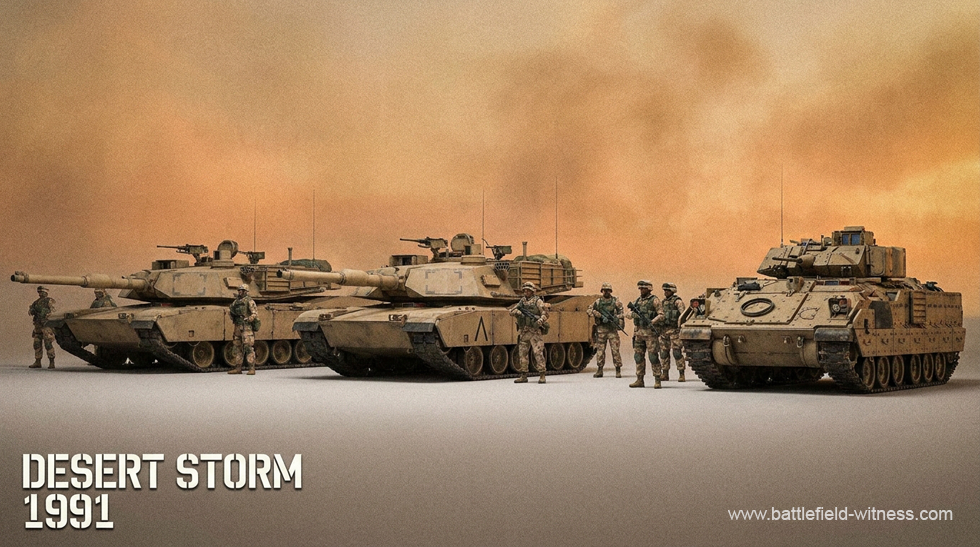
Left Hook
A story of Operation Desert Storm
I. Riyadh — 6 August 1990
The map wasn't finished yet. That was the first thing Captain Diane Kessler noticed when she was walked into the annex behind the Ministry of Defense and Aviation building in Riyadh — a room still smelling of fresh paint and cut plywood, acoustic tile stacked in the corner because no one had gotten around to hanging it. Someone had taped a wall map of the Arabian Peninsula to a sheet of plywood and was still filling in unit symbols in grease pencil. Kuwait sat at the top of it, a small country shaped like a fist, and someone had already drawn a red arrow through it and out the other side, toward Dhahran, toward the oil.
She had landed nine hours earlier. Her orders said "attached, CENTCOM forward, intelligence directorate," which meant nothing until a full colonel with a voice like a diesel engine idling told her she'd be working order-of-battle analysis on the Iraqi formations sitting on the Saudi border, formations that — as far as anyone in this room could prove on 6 August — might keep coming.
"You ever seen a T-72 up close?" the colonel asked her, not looking up from the folder he was signing.
"Only in photographs, sir."
"You will." He slid the folder across. "Get comfortable. This is going to take a while."
Four days earlier, at two in the morning Kuwait time, three Republican Guard armored divisions had crossed the border and taken the country in under twelve hours. Kessler had heard about it on the radio in the car on the way to Bragg, the way most of the Army had heard about it — a small, strange war on the other side of the planet, the kind that usually stayed small. It had not stayed small. The 82nd Airborne's first paratroopers were already on the ground at Dhahran, dug into positions that everyone privately understood would not stop a determined Iraqi tank column, because there was nothing yet in-theater that could. It was a tripwire, not a wall. Kessler understood that the moment she saw how thin the line was on the map, how much empty desert sat between the units and the border, and how calmly the officers around her spoke about it anyway, as if calm were simply a habit they'd trained into their voices along with everything else.
She didn't meet the commanding general that first week, though she saw him twice — once from the back of a briefing room, a broad-shouldered man with a voice that filled the space without being raised, and once in a hallway, where he stopped to ask a sergeant carrying a box of radio components whether his family had made it out of Kuwait City. The sergeant's wife was Kuwaiti. General H. Norman Schwarzkopf remembered that detail without being told twice. Kessler filed it away the way she filed everything that week — not because it was actionable intelligence, but because it told her something about the man whose staff she now worked for, and she had learned a long time ago that the second kind of information mattered too.
II. Riyadh — October 1990
By October the annex had air conditioning that worked half the time and a corkboard covered in overhead imagery, and Kessler had stopped flinching at the sound of C-141s taking off two miles away, which came now at a rate of one every eight minutes, day and night, a river of steel pouring into the Kingdom.
The plan on the table that autumn — the plan everyone above her pay grade had been chewing over since September — was called, without much imagination, the "one corps" concept. It called for VII Corps to punch north into Kuwait directly, straight into the belt of sand berms, minefields, and interlocking fire the Iraqis had spent five months building along the border. Kessler had read the engineering estimates on those defenses. Double-apron wire. Fire trenches that could be flooded with oil and lit. Dug-in armor, artillery pre-registered on every approach. It was, on paper, a war of attrition against a fortified line, and everyone in the room doing the arithmetic knew what that kind of war had cost the last time American soldiers walked into one.
She was in the room — at the back, holding a folder she'd been told to bring and not to open unless asked — when Schwarzkopf killed it.
He didn't raise his voice. That surprised her; she'd expected the temper the staff joked about in low voices, the one that had earned him the nickname "the Bear." Instead he stood at the map with his hands loose at his sides and talked through exactly what the one-corps plan would cost in bodies, in days, in the thing he kept coming back to — the world's patience, the coalition's patience, twenty-eight nations' worth of patience for a war that CNN would carry live into their living rooms.
"We are not doing this the way Saddam wants us to do it," he said. "He wants a straight fight through his kill zones because he thinks Americans quit when the casualty count gets ugly. He watched Vietnam on television same as everybody else. I am not giving him Vietnam."
Kessler watched the planners exchange a look she'd come to recognize — not disagreement, but the particular tension of men recalculating in real time. Someone mentioned the western flank, the open desert past Wadi al-Batin where the Iraqi defenses simply stopped, because no one on the Iraqi side of the border believed an army could cross two hundred miles of trackless sand fast enough to matter.
"Then that's where we go," Schwarzkopf said.
It was, Kessler would think much later, the entire war in one sentence, though she didn't know it yet. She only knew that the plan on the plywood map changed that week from a single arrow punching north into two — one small, aggressive, and loud along the coast, and one enormous, silent, and five hundred kilometers to the west, and that her job, whatever else it involved, was now going to be about making sure the Iraqis kept believing in the small one.
III. Somewhere in the Eastern Province, Saudi Arabia — November 1990
Staff Sergeant Tomás Reyes had learned three things about the Saudi desert by the middle of November, and none of them were in the field manual.
The first was that cold existed here. Nobody back at Campbell had briefed him on that — everyone talked about Arabia like it was one long furnace, and by day it mostly was, but at four in the morning, waiting in a hole with a poncho liner wrapped around his shoulders while the rest of his pathfinder team slept in shifts, the cold came up out of the sand itself and got into a man's teeth. The second thing was that sand was not sand, not the way the word suggested — it came in a hundred consistencies from powder fine enough to work its way into a rifle's bolt carrier to a crust hard enough to twist an ankle on, and learning to read it under boot and under a vehicle's tires was its own kind of training nobody had given him. The third thing, and the one that mattered most for a pathfinder, was that the desert erased you. No trees. No hills worth the name. No rivers except the one everyone talked about and nobody had seen, far to the north. A man could walk in a dead straight line by the stars and still not know, without help, whether he'd gone four miles or fourteen.
That was what the little box did. Reyes still didn't entirely trust it — a soldier's habit, distrusting anything that hadn't failed on him yet — but the AN/PSN-8 SLGR, the handheld GPS receiver his team had been issued two months back, told him his position to within a hundred meters anywhere on the featureless plain, day or night, weather or not. The infantry had taken to calling it "God's own map," half in jest, and Reyes used the phrase without irony, because the alternative was dead reckoning across a desert the size of Nebraska with nothing but a compass and hope, and he had done that kind of navigating in training and did not care to repeat it for real.
His team's job, when it came, would be simple to say and hard to do: get in first, mark the ground, tell the birds where to put two thousand soldiers in the dark without stacking helicopters into each other. He'd done it in daylight, on ranges, a hundred times. He had not yet done it a hundred and fifty miles inside a country that wanted him dead, at night, with artillery somewhere on the other side of a ridgeline he couldn't see.
They trained anyway. Every night that November his team rehearsed the drill under chemical light — set the strobes, mark the axis, call the birds in — until his hands could do it without his eyes, which was the whole point, because eyes lied in the dark and hands didn't. Between rehearsals he wrote letters he mostly didn't send and thought, with the particular boredom-shaped clarity that comes to soldiers waiting for a war that keeps not starting, about how strange it was to be this frightened of something that hadn't happened yet.
IV. Riyadh — December 1990 to mid-January 1991
The thing Kessler's section began calling the ghost army, in the dry way intelligence officers named things so they wouldn't have to feel what the names implied, took shape through December.
It rested on a piece of reasoning so old it had a name from another war: Magruder's Principle, which said, in essence, that it is far easier to confirm a fear a man already holds than to plant a new one in him. Saddam Hussein believed the Americans would come the way armies had always come into Kuwait — straight up the coast road, with a Marine landing on the beaches to seal it. He had said as much, publicly, more than once. So the coalition set out, methodically, to prove him right.
Kessler's part of it was modest and almost administrative: she cross-referenced the deception cell's signal plan against what Iraqi SIGINT was actually likely to hear, flagging gaps. But she sat close enough to the machinery to watch it work. A detachment of barely three hundred soldiers — signal and engineer specialists, no more — ran communications emulators that reproduced, on the airwaves, the radio traffic pattern of an entire corps, tens of thousands of men who did not exist in that place, transmitting orders and log requests and idle chatter until, as one of the EW warrant officers put it to her over bad coffee, "the whole eastern net just sounds like a corps getting ready to jump off." Along the coast, engineers inflated tank and vehicle decoys and set heat-signature generators beside them, so that an Iraqi thermal scope looking south at dawn saw exactly the armored buildup its owner expected to see. Marines rehearsed amphibious landings in full view of the cameras that every network in the world had pointed at the Gulf, because a rehearsal broadcast on CNN was, in this war, a weapon.
And overhead, almost continuously now, flew the E-8 JSTARS aircraft, its radar sweeping the desert floor and rendering Iraqi vehicle positions onto a screen in near-real time — not a photograph of the battlefield but something closer to a pulse, a heartbeat monitor for eleven Iraqi divisions. Kessler watched a live feed of it one night in December, in a room that had gone quiet except for the hum of the equipment, and watched the Iraqi units along the coast do exactly what they were supposed to do: nothing. They sat in place, reinforcing a threat that was mostly cardboard and static, while five hundred kilometers to the west, past a fold in the earth that hid them from anyone watching the border crossings, two entire American corps had begun, in fits and convoys, at night, to move.
She asked one of the majors, once, whether it would hold — whether three hundred men and some inflatable tanks could really keep an army of half a million looking the wrong direction. He said something she wrote down afterward because it sounded true in a way she wanted to remember: "We're not lying to them. We're just agreeing with what they already believe. People will forgive you almost anything except telling them they're wrong."
On the seventeenth of January, at 2:38 in the morning local time, she was in the room when the first strike package crossed into Iraqi airspace, and Task Force Normandy's Apaches fired the war's opening shots into two early-warning radar sites, punching a blind hole in the Iraqi air-defense net for the strike aircraft to pour through. F-117s that no radar screen in Baghdad had registered were, at that same hour, laying precision munitions on command bunkers and communications exchanges the Iraqi high command would need in the next hundred hours and would not have. Kessler did not sleep that night, and neither, as far as she could tell, did anyone else in the building.
V. West of Wadi al-Batin — Late January 1991
Reyes's team moved west in the last week of January, part of a river of vehicles that flowed for three nights along a route someone had christened, with the Army's usual flair, "Tapline Road," though half of it wasn't a road at all, just hard-packed desert marked with chemlights and MP checkpoints spaced out over a distance that made a man's sense of scale collapse. Two entire corps — better than two hundred thousand soldiers, thousands of vehicles — were making the same move he was, in the dark, headlights blacked out, navigating by GPS and the taillights of the truck ahead, and the sheer scale of it was the thing that stayed with him afterward: how a movement that size could happen at all without the enemy seeing it, how something so enormous could be made to disappear.
They halted twice for sandstorms, the second one bad enough that Reyes lost sight of his own hand at arm's length, grit working into his eyes and mouth and the inside of his weapon no matter how he wrapped it, and he thought, not for the first time, that the desert didn't care which side it was on. His squad leader, a sergeant first class named Okonkwo who'd done a tour in Panama and talked about it the way some men talked about a bad marriage, kept the team moving on compass bearing during the worst of it because the GPS receivers, for all their magic, occasionally lost their satellite lock in the storm, and a pathfinder who couldn't navigate without a machine wasn't much of a pathfinder.
By the last days of January they were staged in the deep desert north of the tactical assembly areas, close enough now that the war stopped being something on the radio and became a smell — diesel, cordite carried faint on the wind from strikes farther north, the ammonia reek of a few thousand men and vehicles packed into positions with no plumbing. Reyes slept when he could, cleaned his weapon obsessively, and ran the LZ drill in his head so many times he began dreaming it: the strobe pattern, the radio call, the rotor wash coming up out of the dark like something alive.
The word came down on the twenty-third of February that G-Day was the next morning. Nobody slept that night either.
VI. Highway 8, near An Nasiriyah — 24 February 1991
They went in before first light, in the open door of a Black Hawk with the cold coming through his gloves and the desert below him lit green and grainless through his night vision, a country he had never seen turning underneath him at a hundred and forty knots. Two hundred and eighty miles of Iraq slid past below in the dark, and then it wasn't sliding anymore; it was rising to meet the skids, and Reyes was out the door before the aircraft had fully settled, running to set his strobe on the axis they'd rehearsed a hundred times on a range that hadn't tried to kill him.
The scale of what followed was not something training had prepared him to feel, only to survive. Over four hundred helicopters — Black Hawks, Chinooks slung with artillery pieces and fuel bladders, Apaches stitching the perimeter — poured two brigades of the 101st Airborne a hundred and fifty-five miles into Iraq in a single day, the largest air assault the Army had ever mounted, and Reyes stood at the center of it with a radio in one hand and a strobe light in the other, talking the next wave of aircraft down out of a sky gone the color of a healing bruise, calling corrections in a voice he kept flat by main force because a pathfinder's voice on the radio had to sound like nothing at all was wrong, whatever was actually happening around him.
What was actually happening, mostly, was noise — rotor wash that could knock a man flat if he didn't brace for it, the flat crack of outgoing artillery from the guns the Chinooks had just delivered, somewhere off to the north the abrupt bark of an Apache's cannon finding a target he never saw. He smelled JP-8 exhaust and hot hydraulic fluid and, underneath it, the mineral smell of turned desert earth, and he understood, in the disconnected way a man understands things while his hands are still doing the job, that he was standing in the middle of something that would be a paragraph in a textbook someday, and that right now it was only this: noise, and the strobe, and the next aircraft on approach, and the next.
By afternoon the division had what it came for — a forward operating base with a name, Cobra, sitting astride the ground it needed, and elements pushing on to close the last hard part of the trap: Highway 8, the paved artery running along the Euphrates that connected Baghdad to every Iraqi soldier still south of it. Cut that road and the army occupying Kuwait had no way home. Reyes's team moved with the lead elements toward it in the hours after, riding on a Humvee with two other soaked-through, deafened soldiers, watching a country he had trained a year to memorize on paper turn into mud-brick villages and palm groves and the wide brown ribbon of a river he'd only ever seen labeled on a map, and he thought, absurdly, that it was almost beautiful, and then didn't let himself think about it again because there wasn't time.
VII. Riyadh — 24–26 February 1991
Kessler tracked all of it from a room two hundred and eighty miles south, on screens fed by JSTARS and situation reports relayed faster than she could fully read them, and the strange vertigo of that — watching a war in something close to real time while sitting in air conditioning — never entirely left her, not that week and not for years after.
VII Corps had come across the border west of the fortified line exactly as planned, into open desert the Iraqis had never bothered to defend, and now it was doing what it had trained a decade to do: closing on the Republican Guard's armored divisions in some of the largest tank engagements since the Second World War. She watched the shorthand of it scroll past on a screen — grid coordinates, unit designations, kill counts that climbed through the day at a rate that felt, even to someone trained to read them coldly, unreal. Coalition sensors could find and kill an Iraqi tank crew in the dark, in a sandstorm, before the crew inside it knew it was being watched. Iraqi doctrine had been built around daylight fighting and night resupply; the coalition had simply taken the night away from them, and what was left, division by division, came apart.
At the coast, the deception that had occupied Kessler's autumn paid its bill in full: on G-Day, a brigade of the 1st Cavalry ran hard feints at Wadi al-Batin, and Navy SEALs put demolition charges on the beaches south of Kuwait City to simulate a landing force coming ashore, and it worked well enough that Iraqi divisions that could have reinforced the line VII Corps was tearing through instead sat facing a beach nothing ever came across. Kessler read the intercept summaries confirming it — Iraqi commanders reporting an amphibious assault building, requesting reinforcement against a landing that was never going to happen — and felt something she didn't have a clean word for, satisfaction tangled up with something closer to guilt, the particular discomfort of watching a lie work exactly as well as you'd hoped it would, against men who were about to die believing it.
She was in the room on the twenty-sixth when the argument happened, though "argument" overstated what she actually witnessed — Schwarzkopf on a secure line, jaw tight, one hand flat on the map table, listening more than talking, while somewhere on the other end of it Washington and the Chairman of the Joint Chiefs weighed how much longer the war needed to run. She heard only Schwarzkopf's half of it, but she understood the shape of the argument well enough from what got repeated around the building afterward: how many more hours to grant the retreating army, whether the world's stomach for television footage of a beaten enemy fleeing up a highway could survive one more day of coverage, how a war fought in a hundred hours would read in history against a war fought in a hundred and twenty. She thought, listening to him afterward on the phone, about a man who had spent his whole career being told to take charge and had built two entire corps' worth of deception and maneuver on his own judgment, now finding that the machinery of that judgment ran only as far as Washington allowed it to.
VIII. Kuwait City and the Highway of Death — 27 February 1991
By the twenty-seventh, Kuwait City was free, and the retreating remnants of the Iraqi occupation force were strung out along the highway north toward Basra in a column that coalition air power caught in the open and savaged from end to end — a sight that, replayed on television that evening, would do more to end the war than any single tank battle had. Reyes's unit heard about the liberation over the radio net, secondhand and clipped, the way soldiers hear almost everything that matters: a few words, a lot left unsaid, and no time to sit with any of it because the mission north of Highway 8 hadn't stopped.
What Reyes remembered most from those two days wasn't a battle at all. It was the road itself — the burned-out hulks, the abandoned equipment stretching further than he could see in either direction, and here and there the ordinary human debris of an army that had broken and run: boots, a child's shoe someone had apparently been carrying home as loot, ration tins, a photograph face-down in the sand that he didn't turn over. He had trained for two years to fight this army and had spent, in the end, perhaps six hours of his life doing it directly; what was left afterward was cleanup, and grief he hadn't expected to feel for men who'd occupied a country at gunpoint, and didn't know what to do with.
IX. Riyadh — 27–28 February 1991
The Republican Guard, by every measure Kessler's section could gather that final day, had stopped existing as an effective force. VII Corps had closed on what remained of it and finished the fight the strategy had been built around from the beginning — not merely pushing Iraq's army out of Kuwait, but destroying the reserve that could have rebuilt it. The armor exchange, when the analysts finally tallied it in the days that followed, would run to something close to a hundred Iraqi tanks lost for every coalition tank destroyed, a ratio so lopsided that Kessler, checking the figures twice before she'd let herself believe them, thought of the word her father had used for numbers that seemed to defy the physical world: unreal.
The cease-fire came into effect at eight in the morning on the twenty-eighth, exactly one hundred hours after the ground war began, and Kessler stood in a room that had gone from tension to something quieter and stranger — not celebration, not yet, more like men and women remembering how to stand down after months of not being allowed to. Schwarzkopf gave what the reporters would later call the Mother of All Briefings that day, walking a room full of press through the whole shape of the campaign on a map not so different from the plywood one Kessler had watched being filled in six months earlier, except that now every arrow on it had already happened.
She heard him say, weeks later, in a smaller room, something that stayed with her longer than the briefing had — a warning, not a boast, about what would happen if anyone in Washington got the idea that the job wasn't finished, that the army should have pushed on to Baghdad and occupied the country outright. He called it becoming an asphalt pit dinosaur: an occupying force with no way out, stuck in someone else's country with no plan for leaving it. She thought about that phrase for a long time afterward, turning it over the way she'd once turned over the sergeant's question about his wife in Kuwait City — another small thing that told her more about the man than the briefings ever had. He had built his career on Rule Thirteen: when you're given command, take it, fully, and answer for what you do with it. But the rule underneath that one, the one he talked about less often and seemed to mean more, was that command existed to protect the people under it, not to spend them on a headline. Do what's right. She had watched him apply the first rule for six months. She understood, only at the end, that the second one was the reason the first one mattered.
Historical Note
This story is built directly on the documented record of Operation Desert Storm: the "One Corps" plan and Schwarzkopf's shift to the western envelopment; the Digital Ghost Army deception (the roughly 300-strong electronic warfare and engineer detachment, the inflatable decoys, the amphibious feints, and JSTARS' role in confirming the deception's success); the air campaign's opening strikes by Task Force Normandy's Apaches and the F-117s on 17 January 1991; the 101st Airborne's 155-mile air assault to establish Forward Operating Base Cobra and cut Highway 8; VII Corps' armor battles against the Republican Guard; the roughly 100-to-1 tank kill ratio; the liberation of Kuwait City and the 100-hour ground war ending in cease-fire on 28 February 1991; and Schwarzkopf's own leadership language — Rule 13 ("When placed in command, take charge"), Rule 14 ("Do what's right"), his Vietnam-era Silver Star action, and his later "asphalt pit dinosaur" warning against occupying Iraq.
One claim from the source briefing was deliberately not dramatized as stated: that Powell "intentionally withheld" a Schwarzkopf truce proposal to force the war's continuation. Cross-checking against the historical record shows a more complicated — and better corroborated — picture: it was Powell who pushed for ending the ground war at the 100-hour mark, while Schwarzkopf, in a widely reported interview at the time, expressed a wish to "continue the march" before publicly aligning with the White House decision to stop. The story above reflects that tension instead: real friction over the timing and terms of the cease-fire, without asserting a specific, disputed claim about who withheld what from whom.
Captain Diane Kessler and Staff Sergeant Tomás Reyes are fictional composite characters, invented to carry the reader through the intelligence and ground-combat perspectives of the campaign. They did not exist as depicted. General Schwarzkopf and the broad shape of events around him are drawn from the historical record; his private conversations and interior thoughts in this story, where not directly documented, are dramatized reconstructions consistent with his public statements and well-documented character. This piece is best classified as inspired by actual events: the historical scaffolding is real and verified, but the scenes, dialogue, and personal experience are fiction built on that scaffolding, not a claim to know what was said in rooms where only real people stood.