Johnny Cakes and Journey Cake

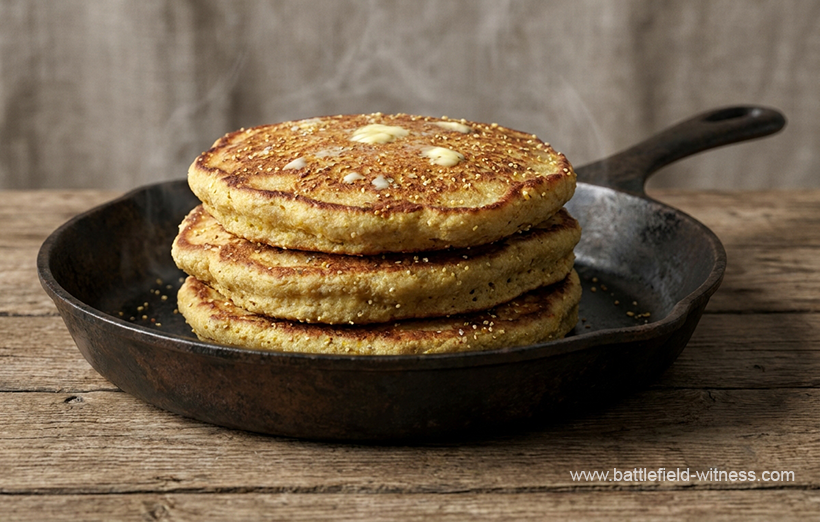
The Historical Significance of Johnny Cakes / johnnycakes:
For early settlers and Revolutionary War soldiers, johnnycakes were a vital survival food. The Pilgrims at Plymouth learned to use cornmeal from the Pawtuxet and Narragansett peoples after their own wheat supplies spoiled during the voyage from England. During the Revolutionary War, these cakes provided a reliable and portable alternative to scarce wheat flour when supply lines were disrupted .
- The "Journey Cake" (Soldier & Frontier Field Recipe)
This version is the most basic form of the dish, often called a "journey cake" because it could be carried in saddlebags on long expeditions and cooked quickly over a campfire. - Ingredients:
- 1 cup stone-ground cornmeal (traditionally white cap flint corn)
- 1 cup boiling water
- 3/4 teaspoon salt
- Fat for frying (traditionally bacon drippings or lard)
- Instructions:
- Mix the cornmeal and salt in a bowl.
- Scald the mixture by pouring the boiling water over the cornmeal while stirring vigorously to form a thick, spoonable batter.
- Heat a cast-iron skillet (or a flat stone) with bacon fat.
- Drop the batter by spoonfuls and flatten them to about 1/4 inch thickness.
- Fry until golden brown and crispy on both sides.
- Amelia Simmons' "Johny Cake" (The 1796 Classic)
This recipe comes from American Cookery (1796), the first cookbook authored by an American. This version was common in colonial households and was even served by George Washington at Mount Vernon. - Ingredients:
- 3 cups cornmeal
- 2 cups milk (often scalded)
- 1/2 cup flour
- Salt (to taste)
- Instructions:
- Combine all ingredients in a bowl until the mixture reaches a "pancake consistency".
- Fry the batter in a well-oiled frying pan or on a hot, greased griddle.
- Cook until the centers are firm and the edges are crisp.
Traditional Frontier Cooking Methods
Soldiers and laborers often had to be creative with their cooking tools, leading to several regional names for the dish:
● Hoecakes: In the Southern colonies, workers cooked the batter directly on the iron blade of a garden hoe held over an open fire.
● Ashcakes: The dough was sometimes placed directly into hot embers or ashes to bake.
● Barrel Staves: During the Civil War, soldiers were known to bake the cakes on wooden barrel staves tilted toward the heat of a fire.
Whether eaten plain or with a bit of butter, honey, or syrup, these cakes provided the necessary energy for long marches and hard labor.