Jane Horney, documentary-drama

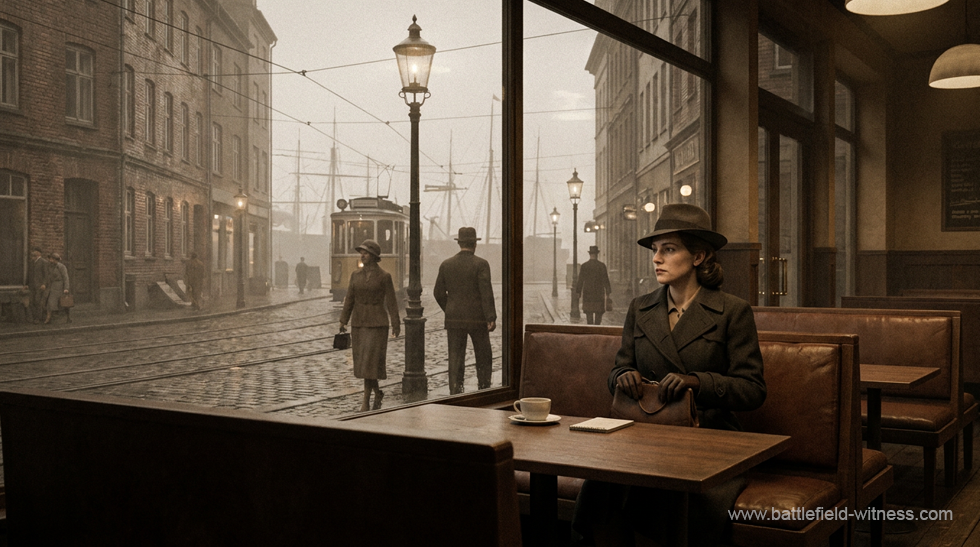
Eskimå
A documentary-drama chapter on the life and death of Jane Horney (1918–1945)
Prologue — Skåne, the Present
The archive box is smaller than she expected boxes like this to be — a single grey folder-file, the security police's stamp faded to the colour of weak tea, a hundred and forty pages that took a typist in October 1944 the better part of two weeks to produce and take a reader now perhaps forty minutes to get through. The reporter has read it three times already this year. She will read it again before she's done, because the file has a way of making you feel, each time, that you missed something on the previous pass — a margin note, a phrase the interrogator chose and then didn't choose again, some seam in the fabric of the thing where if you pressed hard enough with a fingernail, the whole shape of what actually happened might finally give.
It never gives. That is the file's only real secret, and it has kept it now for more than eighty years: that it was thorough, and honest, and entirely correct in what it concluded, and that being correct did nothing whatsoever to save the woman it was written about.
Out past the window, the strait is doing what it always does at this hour, going the colour of hammered tin under a sky that can't commit to rain. Somewhere out there — the exact point is one of the small, stubborn disagreements the sources have never resolved, whether it was the Öresund proper or already the wider water of the Kattegat — a woman named Jane Horney went into the sea on the night of 20 January 1945, weighted with chain, and has not, in eighty years of divers and dredging and the ordinary slow surrender of the sea, been given back.
The reporter closes the folder. She has an article to write about a woman she will never be able to fully explain, and she has made her peace, mostly, with the fact that this is the only honest kind of article this particular life will ever permit. What follows is what the record will support, laid out in the order it happened, with every seam left visible rather than sewn shut for the reader's comfort. It begins four years before the file, in a country not yet at war with anyone, in a room where nobody but Jane Horney herself could have said, with any confidence, which side of the coming conflict she imagined she was standing on.
I. Berlin, Autumn 1941
The press club on Fasanenstraße kept its curtains half-drawn even in daylight, as though the room itself weren't certain what hour it wanted to be. Cigarette smoke pooled at the ceiling in a slow, unbothered weather system of its own, and somewhere beneath it a string quartet was doing its diligent best with something by Strauss that nobody in the room was actually listening to.
Jane Horney had been in Berlin four months and had already learned to read a room the way she'd once read a stage direction — quickly, for blocking, for who stood near the door and who stood near the drinks, for which conversation was real and which was theatre being performed for the benefit of a third party neither speaker would admit to watching for.
The theatre training had not gone to waste, in other words. It had simply changed venues.
She was twenty-three. She had taken the name Jane at sixteen, discarding Ebba Charlotta the way some girls discard a coat that no longer fits, and had spent the seven years since finding out how many rooms a woman with a borrowed name and an unclaimed face could talk her way into — small stages first, then smaller newsrooms, a scattering of bylines under names that weren't quite hers either. Marriage, to Herje Granberg, newly posted to Berlin as Aftonbladet's correspondent, was, she was beginning to suspect this particular evening, not going to be the last identity she outgrew.
Herje was by the piano, laughing at something a Foreign Ministry man had said — the particular laugh he used when he needed the Ministry man to like him, pitched a half-tone too high, held a half-second too long. She had learned to recognise the sound of her husband managing a room the way she recognised her own handwriting: instantly, and with a faint, unexamined embarrassment. She let him have the room's attention and took the window instead, where the blackout tape made a crosshatch over the glass and the city outside existed only as a rumour of light — a searchlight sweeping somewhere south, the huddled shapes of buildings that had not yet learned they would one day be rubble.
The club drew an odd congregation. Ministry officials with their wives. Foreign correspondents filing dispatches that passed through three censors before they reached anyone's breakfast table. The occasional regime critic, bold or foolish enough to say so quietly in a corner, believing the room too loud for anyone to hear him over it. Jane had come to understand, faster than Herje had, that the room was never too loud. The room was, if anything, built for exactly this — for men who believed themselves unheard to be heard very precisely indeed, by someone whose job it was to remember, and pass along, whatever they said.
"You're not drinking," a voice said beside her. Swedish, unhurried, a civilian suit worn like a uniform he'd chosen rather than been issued.
"I'm listening instead." She hadn't meant it to sound like an offer. It came out like one anyway.
"That's a rarer talent in this room than you'd think." He didn't introduce himself immediately, which she noticed, filed, the way she filed most things now without deciding to. "Most people here are waiting for their turn to talk."
"And you?"
"I'm listening to who's listening." He smiled at his own joke before she could decide whether to. "Helmuth Ternberg. I do something dull for the legation."
She knew, within the half-minute that followed, that he did nothing dull at all — the questions arrived too precisely for that, wrapped in enough charm that answering them felt like conversation rather than interview. Was she happy in Berlin. Did she find the Ministry men interesting, or merely necessary. Whether she ever tired of being the wife in the room rather than the woman in it.
That last question she did not have a ready answer for, and he watched her not have one with the patient satisfaction of a man who had asked it precisely because he suspected there wasn't one. She had met men like this before — the theatre was full of them, directors who asked a question not to learn the answer but to watch what your face did while you searched for it. Ternberg did it better than any of them had. He did it as though he weren't doing it at all, which she understood, even then, was the entire craft.
"You have access," he said, quieter now, the charm folded away to make room for the actual proposal underneath it, "to rooms most of Stockholm would give a great deal to hear inside. I'm not asking you to do anything you're not already doing. I'm asking you to remember it afterward, for someone who'd find it useful."
Across the room, Herje's laugh rose again, obliging, a half-beat too eager. She thought, standing at the taped-over window, that she should have been more surprised by the proposal than she was. She thought, with the specific clarity that comes to a person only once or twice in a life and is usually mistaken afterward for something smaller than it was, that this — whatever it turned out to be — was at least a role with lines she would get to choose herself, in a marriage and a war in which almost nothing else currently was.
"What would you call me," she asked, "if I said yes."
He considered her — not her face, she understood later, but something behind it, the specific quality of nerve required for what he was proposing. "Eskimå," he said finally, and laughed at some private joke that sat behind the word and that he never fully explained to her. She would hear, years on and secondhand, that the office had chosen it because she was anything but cold.
She said yes before the quartet had finished the piece nobody was listening to, in a room full of men who believed they were the ones doing the watching.
II. Copenhagen, Winter 1943–1944
The marriage did not survive Berlin, and by February of 1943 she had left it behind along with the name Granberg, though she kept using it when it was useful, the way she kept most things that turned out to be useful. Copenhagen took her in the way occupied cities take in anyone with a plausible reason to be interesting: cautiously, and then all at once.
She met Horst Gilbert at a dinner she would later have trouble placing precisely — one of the countless receptions the occupation generated to prove to itself, and to Denmark, that ordinary civilised life continued regardless of the soldiers on the corners. He arrived late, which she noticed, and apologised for it in a way that suggested he was not a man who apologised often and had not entirely worked out the mechanics of it.
"You're the Swede," he said, taking the chair beside her before it had been offered to him. "The one who used to be married to a journalist."
"I still am married to a journalist. We've simply stopped living in the same country as each other, which some people would say is the more sensible arrangement."
He laughed — properly, not the room-laugh she'd spent three years learning to distinguish from the real kind. He was older than Ternberg had been, heavier through the shoulders, an SS-Standartenführer by rank though he ran his actual days as editor of the Scandinavian Telegram Bureau on Sortedamsdosseringen, filing the sort of dispatches that made the occupation sound orderly, inevitable, almost kind — a service he performed, she would come to suspect, with a precision that had less to do with belief than with survival, and possibly not even that, since survival was, in the end, the one thing his own choices did not buy him.
"You disapprove of my work," he said, some weeks and several dinners later, when the pretence of formality between them had worn thin enough to see through.
"I don't know your work well enough to disapprove of it."
"That's a diplomat's answer."
"I was married to a journalist for two years. I learned to give diplomats' answers the way other women learn to sew."
He was married himself, to a Danish woman he spoke of with a carefulness Jane recognised — not affection exactly, or not only affection, but the specific tenderness of a man protecting something he knew he had already put at risk simply by being who he'd chosen to become. There were people in Copenhagen, she would learn much later, who swore Gilbert privately despised the Party as much as anyone in the resistance did. There were others who swore the opposite. Both groups had their reasons for believing what they needed to believe about a dead man who could no longer answer for himself, and Jane, who had known him as well as anyone still living would ever admit to, found she could not fully settle the question either — not because the evidence was absent, but because she suspected, uncomfortably, that Gilbert himself might not have settled it, and that this unsettledness was the actual truth of him, more than either version people preferred.
What passed between them beyond the dinners — whether it was intelligence, or affection, or the particular currency occupied cities trade in when the two have become impossible to separate — is a question no surviving account answers with any confidence, and this chapter will not pretend otherwise on her behalf. What can be said is only what agrees across the record: that she was seen with him often enough for it to be noted, that the noting reached people whose job was to notice such things, and that by the autumn of 1944 her name had begun appearing on lists she did not know existed until the lists came looking for her.
Copenhagen by then was not a city that forgave ambiguity. Three years of occupation had taught its resistance networks to read a woman's German contacts the way a field surgeon reads a wound — fast, without the luxury of a second opinion, because the cost of hesitation fell on people who could not afford to extend it. Jane moved through the city with the same fluency she'd carried out of Berlin, the same instinct for which door led where, and did not seem — by the accounts of those who knew her in this period — to fully register how differently a city under direct occupation reads a woman who dines with German officers than a neutral one does. Stockholm had, so far, forgiven her this, or at least suspended judgment on it. Copenhagen, in the last months of 1944, was already deciding it would not.
She carried messages, some of them for Ternberg's people, a fact that would have surprised precisely no one in that room and saved her precisely nobody. She carried, more dangerously, the reputation of carrying them, which travelled faster and less accurately than anything she actually did. Somewhere in the gap between what she was doing in Ternberg's service and what she appeared, from the outside, to be doing in Gilbert's, a portrait of her began assembling itself in rooms she never entered — built less from evidence than from the sheer difficulty of imagining a woman moving that freely between both worlds without belonging, in some final accounting, to one of them.
III. Stockholm, 28 September – 14 October 1944
They gave her the same chair each day at the security police offices, which she decided must be deliberate — something about repetition meant to wear a person's story down to its true shape, the way water finds the grain in wood.
The accusations, when the interrogator finally laid them out flatly instead of circling them, were Danish, not Swedish, which struck her as its own kind of answer: her own country had not decided, on its own initiative, that she was dangerous. Someone else's had decided it for them, and Sweden, dutifully neutral, was obliged to find out whether the verdict held water before it let the matter rest.
"You're aware," the interrogator said, on the fourth day, not unkindly, "that people in Copenhagen believe you report to the Germans."
"I'm aware of what people believe." She had learned, three years into this, exactly how much of herself to give a question like that — enough to seem forthcoming, nothing that could be used against the parts of her life the room wasn't asking about. "I don't control what a frightened city decides about a woman who talks to German officers at dinner."
"You dined with a Standartenführer."
"I dined with a great many people whose ranks I did not always ask after. It seemed, at the time, the less alarming question to leave unasked."
The interrogator did not smile, but something in the set of his shoulders eased a fraction, the way a man's does when he suspects, against his professional instincts, that he might actually believe the woman across the table. "And do you? Report to them?"
She let the pause sit exactly as long as an innocent woman's pause would sit — offended rather than caught. "No."
"To anyone."
"I would ask you the same question, and expect the same answer you're about to ask of me."
He wrote something down. She would spend a good portion of the next decade — what remained of hers — wondering what.
The sessions ran on through the first weeks of October, thorough in the particular Swedish way that mistook thoroughness for kindness, or perhaps understood, correctly, that thoroughness was the only kindness available to a case like hers. There were days the questions circled the same three facts from four different angles, as though the interrogator hoped that entering the same room by a different door might reveal furniture he'd missed the first time. There were days he seemed almost apologetic about the whole procedure, a bureaucrat performing a diligence he no longer fully believed was necessary but could not, professionally, abandon halfway.
By the fourteenth, the security police had assembled a hundred and forty pages that found nothing — no evidence that she had ever passed anything of value to the Germans, no confirmation of the fears that had crossed the strait ahead of her. A copy went to Nils Bjarke Schou, a Danish intelligence officer living in Stockholm exile, in the apparent hope that the clearance, once seen by Danish eyes, might travel back the way the accusation had come and undo some of the damage it had already done.
It was, she thought afterward, turning it over in the narrow bed of the room she'd been given for the duration, the passport already surrendered on the table by the door — the city outside going about its blacked-out neutral evening as though nothing in it were at stake — the first fully true thing she had said to anyone in Sweden in over a year. And she had said it in a way designed to sound like every other thing she'd ever said, which was itself, she understood, its own kind of answer to the question of who she had actually become.
They released her with a warning about foreign associations she had no real intention of keeping and a passport she would not get back, on the theory that a woman who could not leave the country could not make its neutrality more complicated than it already was.
The hundred and forty pages that cleared her name did not reach Copenhagen before the city there made up its mind regardless.
IV. Copenhagen, October–November 1944
Horst Gilbert was shot that October, while Jane's own interrogation in Stockholm was still fresh enough that the questions from it were probably still arriving in her sleep. He did not die at once. He lingered a month, into November, in the specific unhurried cruelty of a wound that takes its time — long enough for the news to cross the strait twice: once as rumour, garbled by the time it reached her, and once, weeks later, as confirmed fact, delivered by someone who had the decency, or perhaps simply the caution, not to watch her face too closely while she absorbed it.
She did not, by any account that survives her, weep in front of the person who told her. What she did afterward, alone, in whatever room she was occupying that week, no one recorded, because no one was there to record it, and this is one of the places in her story where the honest thing to do is admit the silence rather than fill it with a scene that flatters the reader's need for one.
The Danish resistance that shot Gilbert did not distinguish, in the arithmetic that mattered to them, between an SS officer's collaborators and an SS officer's associates. His death did not close the file the resistance had opened on Jane Horney. If anything, it confirmed for them the shape of a story they had already decided to believe — a story in which she had stood, throughout, on the wrong side of a line that Copenhagen, unlike Stockholm, was no longer in any position to draw carefully, or slowly, or with the particular luxury of a hundred and forty pages and two weeks in which to be wrong.
She had been cleared in Stockholm. She had lost, in the space of a single autumn, both the man some accounts describe as her protector in Copenhagen and any remaining possibility that his death would read, to the people who mattered, as anything other than proof.
V. The Öresund, Night of 19–20 January 1945
The crossing was cold in the way January made everything cold, a cold with weight to it, settling into the boat's boards the way it settles into a body that has stopped moving. She had been told — by whom, and how convincingly, no surviving account can say — that they were taking her across to people who could finally hear her side without a Swedish transcript standing between her and them. She believed this, or told herself she believed it, or had simply run out of other doors to walk through by then; the record does not say which, and perhaps by that night she could not have told you herself.
The fishing boat was called the Tärnan — the tern, a bird that spends most of its life at sea and returns to land only to breed, which no one aboard that night would have thought to remark on, though it is difficult, telling this story afterward, not to.
Three men had come for her, unremarkable in the way men doing something they have rehearsed always try to appear unremarkable. They spoke Danish low over the engine noise, in the clipped shorthand of people who had done difficult things together before and expected to again. One of them was very young — nineteen, by every account that survives him, though not one of those accounts reliably preserves his name, and this chapter, having found no source willing to stand behind one, will not invent it for him now. She would have noticed him getting aboard, the particular unfinished quality some faces keep until thirty, the way he avoided her eyes at the harbour the way a boy avoids the eyes of someone he has already decided something terrible about, because looking at her as a person would make the decision harder to keep.
For a while there was only the engine, and the black water, and the particular silence of people who have agreed, without saying so, not to make conversation with a woman they may or may not be about to kill.
Somewhere past Ven, past the point where the lights of the Swedish coast thinned into a rumour behind them, the quality of the silence changed. She would have felt it before she understood it — the specific human instinct, older than language, that registers a shift in the room before the mind has caught up to name it. Whether she asked anything in that last stretch of water — whether there was a question, a plea, a demand to know where precisely they imagined they were taking her — no record kept, because no one aboard that boat ever gave a full account of it afterward, and the one witness who might have corrected every guess this chapter has made about her final hour went into the water with the two shots that ended it.
What is known is only the shape of the ending. Somewhere in the water the sources call, variously, the Öresund and the Kattegat — the disagreement itself a small honest admission that even geography could not settle where, precisely, this happened — the crossing stopped being a crossing to anywhere. Two shots were fired into her back in the dark above the strait, by a nineteen-year-old who had convinced himself, on evidence that a hundred and forty Swedish pages had already, weeks earlier and a country's width away, found insufficient, that this was necessary. Her body was weighted with chain and given to the water. No trial preceded it. No confession followed it that named, definitively, which flag she had actually served, if any flag had ever fully owned her at all.
She was twenty-six years old. She has never been found.
VI. Epilogue — What the Water Kept
The reporter in Skåne closes the file for the last time that afternoon, the way she has closed it a dozen times before, and drives home along a coast road that runs, for several kilometres, close enough to the water that she can see it from the wheel — grey, indifferent, giving up nothing it has ever taken.
The Swedish security police file that cleared her sits where such files sit, available now to anyone willing to read a hundred and forty pages about a woman the country that wrote them could not, in the end, protect. A Danish journalist published a book about her in 2007, more than sixty years after the shooting, and it did not resolve the question either, because there is nothing left in any archive on either side of the strait capable of resolving it. The Abwehr, asked directly by Swedish intelligence after the war, said she had never been theirs. The Gestapo said the same. Nobody has ever produced the document, the transcript, the confession that would let this story end the way stories are supposed to end, with a verdict the reader can carry out of the room and set down somewhere final.
What remains is the shape of a life lived, deliberately, at the exact seam where several wars met without ever fully declaring themselves — a Swedish neutrality that needed watching, a German occupation that needed reporting on, a Danish resistance that needed, more than anything else in the winter of 1944, to be certain about something in a country where certainty about anything had become a luxury nobody could afford to extend to a woman who moved as easily as she did between the rooms that frightened them.
She is not a mystery because the facts are missing. Enough of them survive, checked and cross-checked, to build the walls of this chapter with some confidence: the recruitment on Fasanenstraße, the code name chosen because she was anything but cold, the dinners in occupied Copenhagen, the clearance in Stockholm that arrived a country's width too late, Gilbert's slow death that October, the boat, the two shots, the water that took her and did not give her back. She is a mystery because the one fact that would have made all the others make sense — who, in the end, she believed she was actually working for, in the last months when it would have mattered most to know — died with her, on a boat named for a bird that always, eventually, comes back to land.
She did not.
This small story follows the archival-docudrama standard: nothing above is offered as more certain than the sources support. What follows is the apparatus behind it — a plain accounting of what is corroborated, what rests on a single source, and what had to be reconstructed because no record of it survives at all.
Based on a true story, with disclosed dramatization. The skeleton of the chapter — recruitment, code name, the Copenhagen entanglement with Gilbert, the Stockholm clearance, Gilbert's assassination, the Tärnan, the unresolved question of her true loyalty — rests on two or more independent sources throughout, What is invented is confined to dialogue, interiority, and the frame-narrative reporter, all disclosed here in full rather than left for a reader to assume.