Battle of the Bulge Fiction – Immersive Story

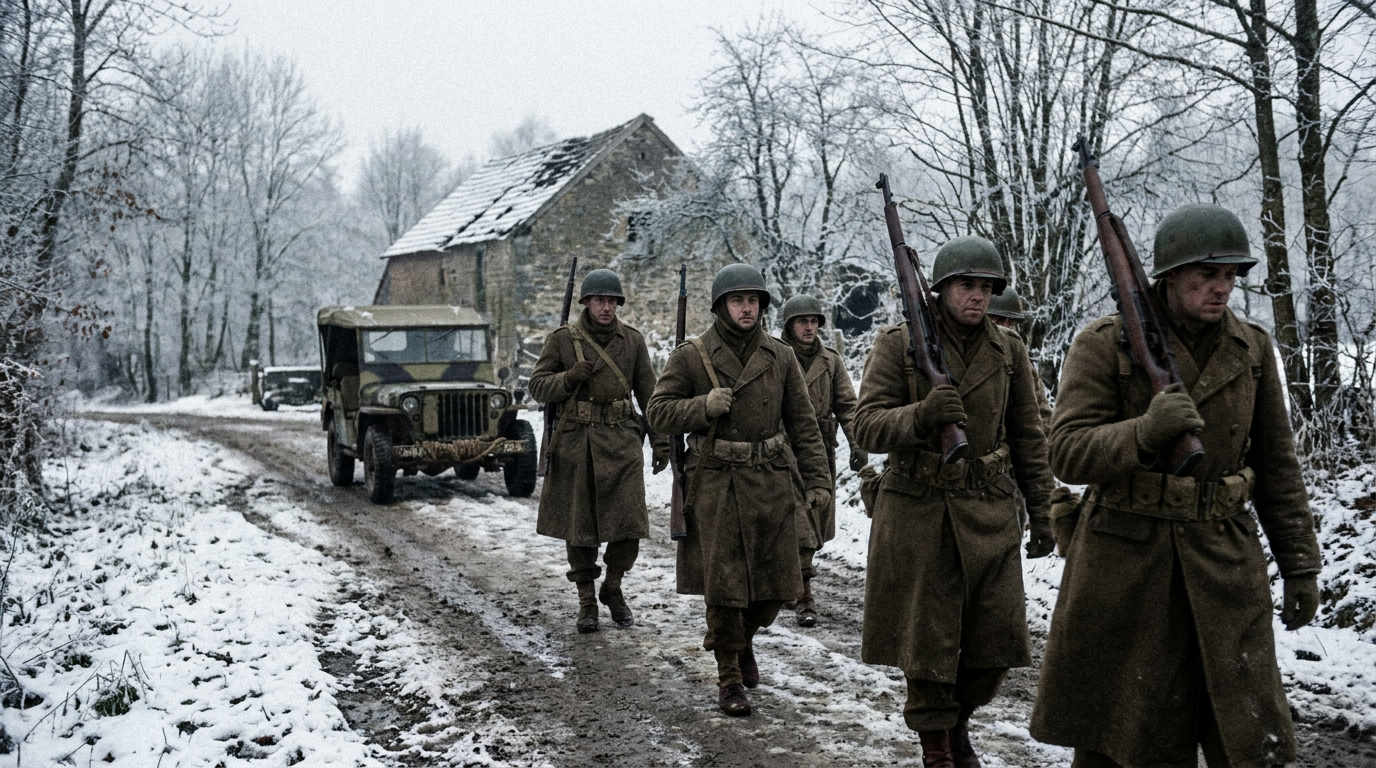
A story set during the Battle of the Bulge, Ardennes, Belgium — December 1944
I.
She heard the guns before she woke.
That was how it had been since Normandy — a part of her never fully slept, some small animal portion of the brain that stayed alert to the frequency of artillery, measuring the intervals, the direction, deciding whether this mattered or whether it could be absorbed into the general fact of war. By December 1944 she had grown fluent in that language. What she heard now, in the grey hour before dawn on the twentieth, told her two things: the guns were closer than yesterday, and there were more of them.
Lieutenant Margaret Calloway sat up on the folding cot and did not take a moment to orient herself, because there was no moment. She pulled her boots on by feel. Her hands already knew everything they needed to know about those boots — the left lace fraying at the aglet, the right sole slightly separated near the toe, the particular resistance of frozen leather that had never quite dried since the crossing into Belgium. She laced them anyway, pulled her field jacket over her fatigues, and pushed through the sacristy door into the nave.
The Church of Saint-Nicholas in Sainte-Croix had been built in the fourteenth century, which meant it was cold in the way that only stone is cold — a cold that had accumulated for six hundred years and was not interested in the kerosene heaters the 48th Field Hospital had positioned along the side aisles. The heaters burned with a low hiss. By now their smell — fuel oil and singed dust — was simply the smell of the room, part of the same texture as the carbolic, the ether, the specific mineral sweetness of blood that had been soaking into the flagstones for four days and could not be gotten out. Margaret had stopped noticing the smell when she noticed it. It was there and then it was not there, the way the guns were sometimes there and then were not there, though they had not entirely stopped since the sixteenth.
The cots ran the length of both aisles and packed the transept. Sixty-two men when she had done her last count at midnight. Several of the worst had not lasted the night. She could see that without looking closely — a certain stillness, a particular arrangement of a man's hands, told her things her brain registered before she had consciously decided to look. She made a note in her mind and moved past them.
There was light at the altar end. Captain Brennan and the two enlisted medics, Kowalski and a boy from Alabama whose name she kept forgetting, were working under the big surgical lamp they'd run from the generator outside. She could hear the generator over the artillery if she concentrated. It made a sound like a large tired animal.
"Good morning," Brennan said, without looking up. He was working on a chest. The man on the table was either unconscious or dead; she couldn't tell from here.
"How long have you been up?"
"I haven't been down."
She moved to scrub.
II.
The boy from Tennessee was in the third cot from the left on the north aisle. He had come in the previous afternoon on the back of a deuce-and-a-half with eleven others, all of them from somewhere along the line near Clervaux, all of them with the same expression — not pain exactly, or not only pain, but a kind of profound bewilderment, the look of men who had been told one thing about the world and had very recently discovered that the world had not been consulted.
His name was Tatum, Roy, PFC, 19 years old. She knew this from his dog tags. He had been largely unconscious when they brought him in and had not been lucid enough to tell her much of anything, only that his leg hurt, which she already knew, and that he did not want to go to sleep, which was the one thing she could not promise him.
The wound was a through-and-through gunshot to the right thigh. The femur was intact — she'd had Brennan confirm it — which meant she could work with this. She'd packed the entry and exit wounds with sulfa powder, applied dressings, started plasma. The plasma had nearly frozen in the bag overnight and she'd had to hold it against her own body for twenty minutes to get it flowing again. She did not mention this to anyone. It was simply what needed doing.
When she reached his cot that morning, Tatum was awake. His eyes tracked her as she approached, which was the thing she always looked for first: tracking, recognition, the animal signal that the mind was still there and still interested in its own survival.
"How's the leg?" she said.
"Like somebody left a campfire in it." A pause. "Ma'am."
"That's the infection talking. We'll deal with it."
She unwrapped the dressing. The wound was angrier than she'd have liked — the tissue around the entry site had gone a color that required watching — but the drainage was not the color of gangrene, and she took this as the day's first good thing. She had learned to collect good things in small increments. It was the only arithmetic that held up over here.
"I need to clean this again. It's going to hurt."
He gripped the edge of the cot with both hands. His knuckles went white and stayed white, but he didn't make a sound except for his breathing, which became controlled and deliberate in a way that was far older than nineteen years.
"You're doing well," she said.
"My buddy," he said. "Corporal Lewis. You seen a Lewis? He's from—"
"I don't know who came in after midnight." She kept her eyes on the wound. "I'll ask."
He didn't say anything. She did not look at his face.
Outside, the artillery shifted slightly — a new battery, opening up from what sounded like the northeast. Closer still. The candles on the altar guttered even though the windows were sealed with canvas and there was no draft she could account for. Some trick of pressure. The stone walls absorbed it and gave nothing back.
III.
By mid-morning there were more trucks.
She was in the middle of a dressing change on a sergeant with a shrapnel wound across his back when she heard the engines, and she made herself not turn around, because the dressing change was not finished and the sergeant was not done mattering. She finished, tucked the last strip of tape, and turned.
They were unloading in the square. Kowalski was out there directing. She pulled on her coat and went to the door.
The cold hit her like a wall. It was a cold with intention behind it — not merely the absence of warmth but something active, something that reached into the lungs and pressed. The temperature had not risen above minus fifteen in three days, and the snow that had fallen on the eighteenth lay undisturbed on the rooftops and the cobblestones and on the roof of the vehicle shed across the square, perfect and completely indifferent. The pines on the ridge above the village were bent slightly with the weight of it. One of the priests of this church had told her, in his careful schoolteacher's French, that it was the worst winter in forty years. He'd said it with a kind of exhausted wonder, as if he understood that the winter and the war were separate catastrophes but could not entirely separate them in his mind.
She understood that feeling.
The men being unloaded were bad. She could see that from ten yards. Several were on litters; two appeared to be walking wounded who had stopped walking and were sitting on the tailgate looking at their own hands. She moved toward the nearest litter.
Frostbite, first assessment. The hands, the feet, the face — she'd seen it enough now that the grading came automatically: superficial, partial, full. The man on this litter had feet that were the colour and texture of a wax candle, the skin beginning to blister where it had thawed slightly in the vehicle. She did not look at his face because his face would make him a person in a way that the injury did not, and she needed to be a function before she was a person for a while longer yet.
"Get him inside," she told Kowalski. "Slow rewarming, not direct heat. And tell me where they're coming from."
"Sergeant says Houffalize road. Germans broke through someplace up near Longvilly. Battalion aid got overrun." Kowalski kept his voice even, but he was twenty-two years old and had been in theatre since October and she could hear what was underneath the evenness. "They got no idea where the line is, Lieutenant."
She nodded. This was not a surprise and yet it was always a surprise. The line was where it was until it wasn't, and then no one could tell you where it had gone.
"All right," she said. "Let's take them in order."
IV.
She did not stop again until two in the afternoon, when Brennan told her to sit down before she fell down. She sat at the small table near the sacristy door where they kept the morphine log and the plasma inventory and the running list of names, and she drank half a cup of coffee that tasted of the tin canteen and something that might have been chicory, and she looked at the list.
Eighty-one names. Fourteen of those names had a line drawn through them in Brennan's handwriting, neat, decisive. He never left the line incomplete. She had noticed that early.
She looked at the list for a moment and then looked at the door to the nave.
She had a brother named David. He was twenty-four and in the Pacific, aboard a destroyer escort somewhere she was not allowed to know, doing something she was not allowed to know. His last letter had been postmarked October 14th and had taken six weeks to reach her. In it he had said very little about anything that mattered and a great deal about a card game he'd won and the quality of the food, which he said had improved, and at the end he had written: I think about you every day. Don't do anything I wouldn't do, which was the closest either of them got to saying what they meant. She had written back immediately and had no idea if the letter had arrived.
She was doing this — the counting, the inventory of what she had and had not lost — and she became aware that she was doing it, which meant she needed to stop. She stood up and poured the rest of the coffee back into the pot and went back into the nave.
V.
Tatum was running a fever by four o'clock.
She had known it was possible. She had known it the way she knew all the bad possibilities now — not with dread exactly, but with a kind of professional attentiveness, the way you know a door might not open before you try it. She felt his forehead with the back of her hand and then checked the thermometer twice, not because she didn't believe it the first time but because the second time felt like doing something.
103.4. Not catastrophic. Not yet.
She sat on the edge of the cot and opened the dressing and looked at the wound. The surrounding tissue was more inflamed. She added sulfa powder — they were running low on sulfa and she made a note of that in her mind, the way she made notes of everything now, a running ledger of deficits — and put on a clean dressing.
Tatum watched her work.
"You do this like you don't have to think about it," he said. His voice was rougher than this morning.
"Six months of practice."
"Before the Army. What'd you do before?"
She smoothed the edge of the tape without looking up. "Trained at County General in Madison. Wisconsin."
"I never been north of Kentucky."
"Cold, isn't it."
He produced something that was approximately a laugh. "I thought I knew what cold was."
Outside, there was a sound she recognized — not artillery, but the specific shriek of something incoming that was not aimed in the general direction of somewhere else but arriving with a particular kind of personal intensity. She was flat on the floor before she had consciously decided to be flat on the floor, and the explosion came from the direction of the square, close enough that she heard glass breaking somewhere and felt the vibration in her sternum. Then the stone above her rained dust, and then there was quiet, and then the men who could make noise made it, and she got up.
Tatum was still on the cot. He had pulled himself as flat as the wound allowed and was white around the mouth.
"You okay?" she said.
"Yes, ma'am."
"Good."
She was already moving.
VI.
The shell had hit the vehicle shed. The generator was intact — she heard it, still running, its large tired sound unchanged — and the walking wounded who'd been sheltering in the shed had moved before it hit, which was either luck or some instinct she was glad they had. The shed wall had come down. Three men had been caught by it. She worked in the cold for forty minutes until Kowalski and the Alabama boy had carried the last of them inside.
When she came back in she was sweating inside her coat and her hands were shaking slightly, which they did sometimes and which she had long since stopped apologizing for. She stood near the altar where the lamp was and let the heat from the surgical light dry her face and thought about nothing in particular for thirty seconds, which was all she could afford.
The priest was there. He had been there every day, an old man with a face like carved wood and hands that seemed to know what to do in a hospital without being told. He had been carrying water and changing soiled linens since the first day, and she had not asked him to and he had not asked permission. He was standing near the station where they kept the water, and he looked at her with an expression she had no word for in French or English.
"Vous tenez le coup," he said.
She had enough French for this. You are holding on. Or perhaps: You are holding up. The difference mattered and she didn't have the grammar to ask.
"I have to," she said in English, and he nodded as though that was the same in any language.
VII.
She was back at Tatum's cot by nine that night.
The fever had climbed to 104.1 and she had used the last of his morphine allotment at six and had nothing to offer him but the aspirin tablets they'd started rationing, and a wet cloth for his forehead, which she understood was nothing, but she applied it anyway. His colour was bad. She had seen men go from this to much worse very quickly and she had seen men pull out of worse than this, and she could not tell with certainty which kind of man this was, which was the part of the work she had never learned to carry easily. You thought you had learned to carry it and then it turned out you had only learned to walk with the weight. Those were different things.
He was lucid though. That was something. His eyes tracked her, and when she sat on the edge of the cot he turned his head toward her in a way that was less like a patient seeking reassurance and more like a person trying to keep company.
"You get any sleep?" he said.
"Some."
"How much is some."
"Enough."
He studied her for a moment with the particular clarity that fever sometimes produced — not sharpness but a kind of stripped quality, as if the illness had taken away everything except the ability to notice. "My mama's a nurse," he said. "Back home. She works at the county hospital. She says the hardest part is the ones you can't fix."
Margaret said nothing.
"You think she's right?"
"I think she's experienced," Margaret said.
He was quiet for a while. The guns had moved north but not gone away. The kerosene heater nearest his cot ticked and hissed. Outside she could hear wind coming off the ridge and working at the canvas sealing the windows, a sound like something persistent and patient wanting in.
"Lewis," he said. "My buddy. You ever find out?"
She had found out at five o'clock. She had not yet decided what to tell him.
She made her decision now.
"He came in last night," she said. "He's at the other end. He's got a bad arm, but he's all right."
This was half true. Lewis was at the other end. The arm was bad in ways that would have permanent consequences, but the man himself had a reasonable chance, and the rest could be said by someone else in some other place when this boy was not running 104 and holding on by whatever Tennessee stubbornness he'd been given at birth.
Tatum let out a breath that she felt more than heard.
"Okay," he said. "Okay." He said it twice, the second time quieter, as if confirming something to himself. "I'm gonna sleep now."
"Good."
She sat for a moment longer on the edge of the cot after his breathing had slowed, her hands folded in her lap. The lamp at the altar threw long yellow light across the flagstones. In the shadows of the nave the cots went on and on. The priest was moving among them with a candle, his shadow enormous on the wall, bending to each man in turn.
She had not prayed since Normandy. She had prayed her whole life until the first week of July, and then she had stopped, not as a decision but as an impossibility — the words had simply lost their direction, like the letters she wrote to David, carrying all their cargo to some address she could not verify. She did not pray now. She sat on the edge of the cot and listened to the boy breathe and listened to the guns, which tonight were saying something she translated as: still here, still here, still here.
She stood up.
There were eighty-one names. Fourteen of them had a line through them. She had four hours before dawn.
She went back to work.
The Battle of the Bulge — Germany's Operation Wacht am Rhein — was launched on December 16, 1944, through the Ardennes Forest of Belgium and Luxembourg. The offensive caught the Allied line off guard at its thinnest point. More than 19,000 American soldiers were killed in the fighting that followed, with nearly 50,000 wounded. The winter of 1944–45 was the coldest recorded in Europe in forty years. Army Nurse Corps nurses served in evacuation and field hospitals within miles of the front lines throughout the campaign. Frostbite and trench foot accounted for more casualties than any single German action. The Battle of the Bulge was the largest land battle fought by the United States Army in the Second World War.
End