Battle of Panipat 1526 – Historical Witness Account

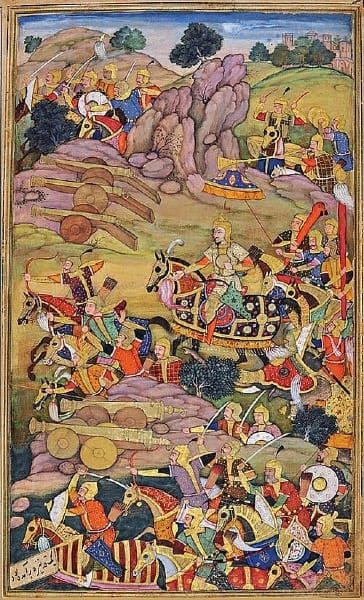
Panipat, 21 April 1526 — A Witness Account
I. Before Dawn
The slow-match smelled of burning rope and something older — sulphur, the scent of the underworld made portable, tucked into the fingers of men who stood fifty paces apart along the length of the cart-wall. Mirza Yusuf had smelled it every evening since Kabul. He had learned not to notice it, the way a man learns not to notice the smell of his own house. But that morning, in the blue-black hour before the sun came, it was all there was.
He stood on the bed of an ammunition cart drawn up behind the main line. Not a post of honour — no one had assigned it — but the cart was tall, its wheels sunk into the dry Panipat soil, and from it he could see both ends of what Babur had built. He had a clean sheet of paper folded inside his robe. He had no intention of writing on it. A chronicler who writes during a battle writes fiction. He would write afterward, if afterward came.
The line stretched left and right until it dissolved in the dark. Seven hundred carts, Babur's quartermaster had told him, lashed wheel-to-wheel with iron chains. Between each pair of carts: a gap. Through the gaps, the muzzles of the cannon pointed west. The guns were Ottoman in design — Babur had hired the gunners too, two brothers from Rum, who spoke through an interpreter and treated the weapons as a craftsman treats his tools, with a fastidiousness that made the soldiers around them uneasy.
Yusuf had watched them work the previous afternoon. They walked the line, checking the charge in each barrel, adjusting the elevation with wooden wedges, tapping with mallets, standing back, looking. They spoke quietly to each other in a Turkish he could not follow. The younger brother laughed once — a short, private laugh — and Yusuf had wondered what kind of man laughs the day before a battle, then understood: these were men for whom this was not a battle. It was an alignment problem.
The matchlock men stood between the cannon, two hundred of them by Yusuf's count, each holding his burning match away from the powder horn at his belt with the care of someone carrying an open lamp through wind. The match ends glowed in the darkness — a scattered constellation at waist height running the length of the wall. Yusuf looked at it and thought: this is what we are. Points of light in the dark, and behind us the guns, and beyond the guns, nothing visible at all.
Somewhere to the right — the north flank — a horse coughed. Then another. The army was waking.
II. The Arriving
The sun came up behind them. That was the plan, or part of it. Babur had chosen the ground partly for this: Ibrahim Lodi's army would advance with the morning sun in their faces. Yusuf watched it rise, fat and pale orange over the fields to the east, and felt the warmth reach his back. The plain ahead brightened slowly. Flat land, stripped of crops already — the villages for two miles in every direction had been emptied, the villagers gone to wherever people go when armies stop arguing about where to fight. Dry soil, the colour of old bread. A few scattered trees at the western edge, and beyond them, nothing.
For two hours, nothing moved on the plain.
Yusuf ate a piece of flatbread from his robe and watched the horizon. The soldiers around him had the stillness of men who had learned to wait — not the stillness of calm, but the stillness of something held. A rope pulled tight is still. The matchlock men tended their burning cords. The Ottoman brothers walked the line again, unhurried. A prayer was called from somewhere back in the camp and answered in fragments from a hundred directions.
He was looking at the treeline when he saw it.
Not an army. A change in the sky. A thickening, low and brown along the western horizon, the colour of the earth lifted and moving. He had seen dust clouds before — caravans raised them, herds of cattle, wind across empty fields. But this was different in its scale: a smear across the sky that grew as he watched, rising and spreading, far too wide to be anything but thousands of men and animals in motion.
"There," said a soldier beside him, unnecessary.
The dust cloud took half an hour to become an army. First the outriders appeared — horsemen at a canter, testing the ground, then pulling up short at whatever distance their commanders had set as the limit. Then behind them, slowly, the shapes resolved. Elephants first: their height made them visible before anything else, great grey shapes moving with a patience entirely at odds with what they were here to do. War elephants — Yusuf had seen them in Kabul, had read about their use at Panipat in the accounts he'd studied — carried howdahs, archers, iron-tipped tusks wrapped in chain. They were, by every measure of warfare that India had known, invincible. They broke formations by their presence alone. Horses refused to approach them. Men broke and ran from the sound of their trumpeting.
Behind the elephants: the infantry. More men than Yusuf had ever seen in one place. He tried to count the banners and gave up. He tried to estimate the frontage and could not see its ends. He stood on the cart bed and looked left, then right, and understood that Babur's line — seven hundred carts, two miles of chained iron and waiting guns — was already outflanked by the width of what was coming.
III. The Wall
It did not matter. That was the plan.
The Lodi army advanced slowly. This was not timidity — it was the nature of the thing itself. One hundred thousand men do not move quickly. They move like a tide: the weight of the mass behind pushing the front forward whether the front wills it or not. Yusuf watched the leading edge come within a mile, then half a mile. He could see the banners now, the Sultan's colours, the pennants of the Afghan nobles who had followed Ibrahim Lodi down from Delhi with their private armies and their complicated loyalties.
At the cart-wall, the Ottoman gunners took their positions.
Yusuf had been told what to expect. He had not believed it would be what it was.
The first cannon fired at roughly a quarter mile. He saw the flash before he heard anything — a sudden orange brightness at the left end of the line — and then the sound arrived: a crack that was also a blow, something that hit his chest before his ears understood it, a concussion that compressed the air in his lungs and made the cart beneath him shudder. He grabbed the side rail. Before the echo had finished — before the echo had properly begun — the second gun fired. Then the third. Then four at once. Then the line of them, rolling east to west, a sound that was not discrete explosions but a continuous tearing of the air, each cannon adding to what came before so that within thirty seconds it was not possible to hear individual shots.
He had read the descriptions. Babur's own account used the word *ra'd* — thunder. This was inadequate. Thunder ended. Thunder was a weather event, a natural thing with a beginning and a stop. This was something men had decided to make, and they had made it without mercy.
IV. The Tulughma
Across the plain, the effect on the elephants was immediate. They had been trained for war — trained against the shouting of men, the beating of drums, the screaming of horses. They had not been trained for this. Yusuf watched the nearest one rear, saw the howdah tilt, saw the archers scrambling for purchase. The elephant turned. It turned into the men behind it, and those men moved because they had no choice. A ripple went through the front of the Lodi army — not a retreat, not yet, but a flinching, a compression, the front-rank men pressing back into the second rank and the second into the third.
The cannon went on.
Between volleys — in the gaps between guns, which were not gaps but brief pauses in the assault on the ears — the matchlock men fired. One crack, then another, thin sounds after the cannon but with their own particular quality: higher, sharper, more deliberate. From the cart-wall, the smoke was already beginning to rise. White-grey, climbing into the April sky, drifting south on a wind too light to clear it quickly. Within twenty minutes of the opening shots, the western quarter-mile of the plain was vanishing behind it.
This was the moment Yusuf had asked about, the night before, when Babur had walked the line with his senior officers. He had followed at a respectful distance — his role was witness, not participant — and he had listened as the commander explained what would happen in the language of geometry.
The cart-wall, Babur had said, was not a defence. It was an anchor. It held the center while the flanks moved. And the flanks would move as the Lodi army was stalled — as it was funnelled toward the gap between Babur's right and the dry stream-bed on Babur's left. The Lodi commanders would see the cart-wall and the gaps in it and think: charge. They would push their men toward those gaps, concentrating their force in exactly the place that was most lethal. And while they pushed, the cavalry wings — the *tulughma* — would ride out wide, sweeping around the outside of the advancing army, hitting it from the flanks and rear simultaneously.
The pincer was a concept as old as Hannibal. What was new — what Babur had taken from the Uzbek wars and the lessons of his grandfather's campaigns and sharpened here on the Panipat plain — was the marriage of the pincer to fixed artillery. The cannon did not need to win the battle. They only needed to stall it. To compress the Lodi mass, to disorder the elephants, to fill the front ranks with a sound so alien that the army's experience of war became, for a few minutes, useless. And in those minutes, the wings would move.
Yusuf was still watching the smoke-hazed center when he heard the cavalry go.
He turned south — his right — and saw them: the left wing of Babur's cavalry, moving out at the trot, riding away from the battle rather than toward it, a column of horsemen sweeping wide around the southern edge of the Lodi advance. Five thousand men, perhaps more, the horses running in the disciplined near-silence of trained cavalry with somewhere to be. No shouting. The thunder of hooves reached him through the cart-bed, a vibration climbing up through the wood into his feet, distinct from the cannon's concussion — lower, more rhythmic, more alive.
V. The Crushing
He turned north. The same: another column, the right wing, swinging wide in the opposite direction. The two arms of the pincer opening.
He looked back at the center. The Lodi infantry was still advancing, still pressing toward the cart-wall, still channelling itself into the killing ground between the cannon. They had seen the cavalry go — it was impossible not to — but in the noise and smoke and chaos of the advancing front, the information could not travel fast enough. The men in the front ranks were not receiving messages from the commanders half a mile behind them. They were receiving pressure from the men behind them, and from the guns in front, and from the smoke that was thickening around them, and they were trying to do the only thing that made sense, which was to move forward and get through it.
The cavalry closed.
What happened next was not visible from where Yusuf stood. He heard it.
When the cavalry hit the flanks of the Lodi army — wrapping around from south and north, striking the sides and rear of a force that was fully committed forward — the sound changed. The cannon were still firing. The matchlocks were still firing. But underneath and through that sound came something else: a human noise, enormous in scale, the sound of one hundred thousand men suddenly understanding that the battle they thought they were in was not the battle they were actually in.
It began as confusion — shouted orders that contradicted other orders, the particular sound of men trying to turn in a packed mass where turning was impossible. An army of that size has the properties of a liquid: pressure applied to one point distributes through the whole. When the flanks were struck and tried to fold inward, the men in the center felt it as a push they could not explain. When the rearward units tried to turn and flee, they compressed against the units still advancing from behind. The Lodi army had too many men in too small a space, and now it had cavalry hitting it from three sides and artillery hitting it from the fourth, and it had nowhere to go.
VI. Afterward
Yusuf watched an elephant emerge from the smoke — alone, without its howdah, running south at full speed away from the battle. It passed perhaps two hundred yards from the cart-wall, moving with a purpose that was perfectly clear and completely ungovernable. A panicking elephant weighs six tons. It does not stop because someone asks.
The fighting — if it could be called that; slaughter was the older word, and more honest — lasted perhaps two hours at the center. The flanking cavalry had hit the Lodi rear guard before midmorning. By the time the sun was high enough to make the April heat felt, the plain was no longer an army in motion. It was a field covered in men trying to leave it.
He did not see Ibrahim Lodi fall. No one near him did. The Sultan of Delhi died somewhere in the center of his own army, in the smoke and the press of men who had no more direction to offer him. The accounts would say afterward that he died fighting — that he refused to flee, that he was killed with his nobles around him. Yusuf believed it. A man does not march one hundred thousand men to Panipat to run.
Yusuf climbed down from the cart when the firing stopped. His ears were still shaking with it — not pain exactly, but a persistent resonance, the world muffled and ringing as if he were standing inside a bell that had just been struck. Around him, the soldiers were moving forward through the gaps in the cart-wall, stepping out onto the plain, and the sounds they made — voices, hoofbeats, the clank of armour — reached him as if through water.
He walked out through the gap between two carts. The iron chain linking their wheels was warm from the sun. He touched it briefly — the links were heavy, well-made, ordinary in the way that the tools of decisive events are always ordinary — and stepped onto the plain.
The smoke had not cleared. It drifted in pale sheets across the ground, lower now, catching in the dips in the earth. The smell was extraordinary: sulphur and burnt powder, yes, but underneath it something the texts never mentioned — the particular scent of turned earth, of soil disturbed by hooves and feet and the bodies of the fallen, mixed with blood (which smells of copper and iron, a metal smell, a smell that sits in the back of the throat), and over everything the dry-grass smell of the Panipat plain in April, ordinary and insistent, as if the earth beneath the battle had simply continued being itself.
He walked west.
The ground was rough with the evidence of what had passed over it. He picked his way carefully, not from squeamishness but from a chronicler's instinct: look at things, do not look away, but look at them with enough care to remember them correctly. He was already composing sentences. He would write of the cart-wall — the genius of it, the simplicity of its logic: that a charging cavalry or infantry needs open ground, and that open ground can be replaced with iron chain and cannon barrel, and that an army which cannot charge cannot fight in the way it has been trained to fight. He would write of the cannon, and how the sound of it could undo an elephant, which was the oldest war weapon in India, the thing that had ended battles before they began for two thousand years, and how in thirty minutes of the Ottoman brothers' craft, that weapon became a liability, a source of panic rather than terror.
He would write of the tulughma — the encircling move, the pincers closing — and he would note that Babur had not invented it. The Mongols had used it. Timur had used it. The genius was the combination: the thing that held the center while the wings moved, the thing that bought the time the encirclement required. The cart-wall was not a wall. It was a clock. It gave the cavalry the minutes they needed to circle, and minutes on a battlefield are worth more than ground.
He came to a place where the ground was marked deeply by something large that had run across it. Elephant tracks — unmistakeable, each print a wide, round impression pressed several inches into the dry soil. He stood in one of them. His foot did not cover it.
A soldier was walking past him, heading back toward the camp, carrying a helmet that was not his own. Yusuf stopped him.
"The Sultan?" he asked.
The soldier looked at him without expression. "Dead," he said, and kept walking.
Yusuf stood on the Panipat plain in the April heat and took the folded sheet of paper from inside his robe. He unfolded it. He looked at the blank surface for a moment. Then he took out his pen case, uncapped the inkwell, and wrote two words at the top of the page:
Tuzuk-i-Baburi.
He would give these pages to the court historians in time. They would make something larger of it. But the two words were enough for now — the title of the account he would write, in Persian, for whoever came after, whenever they needed to understand how a smaller army defeated a larger one at a place called Panipat, on a morning in the fourth month of the year 932 of the Hijri calendar, by building a wall of carts and chains and doing something no army on the Indian plain had ever done before, which was to teach the elephants fear.
Historical Note
The Battle of Panipat, fought on 21 April 1526, ended the Lodi Sultanate and established the foundation of the Mughal Empire. Babur's forces numbered roughly 12,000 against Ibrahim Lodi's estimated 100,000, with perhaps 100 war elephants. The decisive innovations were two: field artillery of Ottoman design, unprecedented on the Indian subcontinent, and the tulughma — a flanking encirclement drawn from Timurid and Mongol tactical tradition. Ibrahim Lodi was killed in the battle. Babur's own memoir, the Baburnama, written in Chagatai Turkish, remains one of the most remarkable autobiographical accounts in the history of world literature — a commander's record of conquest written with uncommon frankness and literary intelligence.