THE FOG DOES NOT LIFT

A Story of the Fourth Battle of Kawanakajima
Hachimanbara Plain, Shinano Province. The eighteenth day of the ninth month, Eiroku 4.
What the West would call October, 1561.
I.
Ōishi Ryōken set out his needles in order of length.
This was a discipline from his first campaign, thirty years ago — a panicked retreat in which his bag had been overturned, and he had spent precious minutes on his knees in the mud groping for the right instrument while a man beside him ran out of blood. The lesson had entered his hands permanently. Now he arranged them without looking, in the darkness before the Hachimanbara dawn, by touch alone.
Around him the plain breathed. Eight thousand men make sounds that are not quite silence: the soft clank of armored bodies adjusting weight, the low voices of officers moving between units, horses blowing against the cold in the lines to the east. The Chikuma River lay a few hundred yards to the west, unseen but audible — a low, continuous sound beneath everything else, patient, utterly indifferent to the fact that twenty thousand men had spent the night arranging themselves along its banks for the purpose of killing each other.
He was fifty-three years old. He had been the Takeda clan's physician for twenty-two years, through four lords if you counted Nobutora, and he had stood at the edge of many battlefields. Not in the fighting — he had never drawn a sword in his life except to show a patient how to move against a scar's tightening. But close enough to see the shape of things, to read the face of a battle as he read the face of a patient. A physician learns to look at what is happening, not at what should be happening. The distinction had saved his life on three separate occasions and he expected it to matter today.
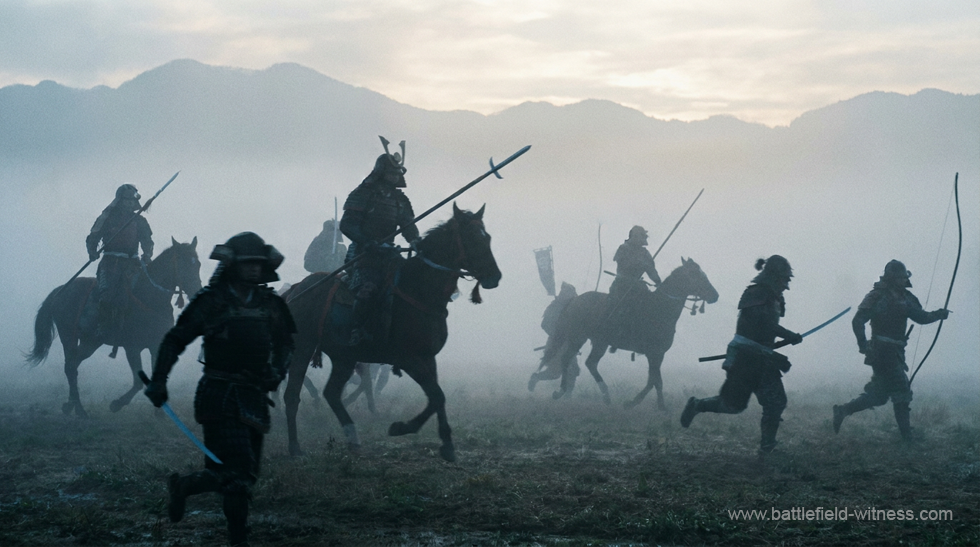
The fog had come in during the night, rolling off the river in slow, dense layers until you could not see thirty feet in any direction. October fog, heavy with river cold and the smell of turned earth and dying sedge grass. The soldiers nearest him were shapes in it, moving or still, their lacquered armor occasionally catching the light of distant braziers and returning it as a brief glint before disappearing again. They were ghosts already, he thought, and immediately told himself not to think that way.
The plan — as he understood it, as any man in camp had understood it by now — was elegant. Yamamoto Kansuke had spent his whole life earning that word, and this was perhaps his finest application of it. Twelve thousand men had gone up the mountain in silence the night before, ascending the dark mass of Mount Saijo to strike the Uesugi encampment before dawn. The Dragon of Echigo — Uesugi Kenshin — had held that mountain for weeks, watching the Takeda positions in the valley below with the cold patience he was famous for. He would find his patience ended, this morning, at the point of twelve thousand spears.
The flanking force would drive the Uesugi down off the mountain toward the plain. And here, waiting, in the Kakuyoku — the Crane's Wing formation — Shingen's eight thousand would receive them. Not as a wall receives a wave. As a closing hand receives a fly. The formation was designed for exactly this: enfolding a routed enemy, turning their flight into the mechanism of their destruction. It was named for the crane, that long-legged bird, because of how the crane stands in shallow water and waits, and then the wings come around, and the fish does not escape.
The night before, Ryōken had overheard one of the younger officers explaining it to another — a man of perhaps twenty or twenty-one, who had used his hands to show how the formation's wings would fold, his voice carrying the particular pride of someone repeating a plan he hadn't made but wished he had. The other officer had nodded as though understanding war, which he didn't yet.
Ryōken had listened without speaking. He had laid out his instruments and sharpened his cauterizing irons and prepared his tinctures of mugwort and goldthread, and he had thought about what a Crane's Wing was good for and what it was not. A crane's wing is good for one thing: receiving an enemy already in motion away from you, spent and disordered, running in the direction you have predicted. It requires the world to cooperate. It requires the enemy to come to you, on schedule, in the condition you have imagined.
He knew this the way he knew which medicines turned toxic in combination — not from principle but from watching what happened when the conditions weren't met. At Uedahara, seventeen years ago, the Takeda had met Murakami Yoshikiyo and learned the specific price of a plan that presumed the enemy's compliance. They had paid it in good men. Ryōken had treated those men, and some of them had lived, and some had not.
But that was seventeen years ago. Kansuke had learned since then. Everyone had. He secured his bag and sat back on his heels and waited for the light.
II.
The light, when it came, came wrong.
Ryōken noticed this before he could have said what he noticed. The sky to the east shifted from black to a deep grey-blue, and the fog around the camp did not lift — it brightened instead, becoming a luminous white nothing, so that the soldiers nearest him became solid shapes while everything beyond twenty feet dissolved into the same featureless pale. Sound was strange in it. Voices came from unexpected directions. A horse somewhere to his left made a sound he had never heard a horse make, a low and sustained vibration that was not quite a whinny and not quite a groan.
The morning came. Nothing else came with it.
By an hour after first light, there had been no sound from the mountain.
He watched the men around the honjin — Shingen's command standard, planted on slightly raised ground near the center of the formation — and he read them the way he read patients waiting for a diagnosis. Senior officers held their positions. They stood and looked north, toward the mountain, and the set of their shoulders was the set of shoulders carrying weight that had not yet been acknowledged. One man — Sanada Yukitaka, who had been fighting before Ryōken arrived and would, in all likelihood, still be fighting after Ryōken was dead — clasped his hands behind his back and unclasped them and clasped them again, which was not something Ryōken had ever seen him do.
There were twelve thousand men on that mountain. Twelve thousand men descending a slope in dawn fog, driving a routed enemy before them, would be audible. You would hear the crack of bows, the percussion of armored bodies, the voices — even muffled by distance and fog, you would hear something. War is not quiet. It announces itself.
The mountain was quiet.
Ryōken stood up slowly, because his knees required persuading in the cold. He was not a soldier and had no role in whatever was being decided in the honjin thirty yards away. But he walked to where the ground opened toward the Chikuma River road, the flat stretch between the camp and the water, and he looked west into the fog.
Something was moving in it.
III.
It came out of the white like a dream acquiring weight.
First the sound — a low, complex sound his mind needed a moment to name, because it was not the sound of men running. It was the sound of men advancing. The muffled shuffle and clank of a disciplined army in motion, measured, deliberate. The deep, even beat of war drums, not the staccato of pursuit but the steady pulse of men who had set their own pace and held it. And underneath it, closer than he had expected, the sound of the Chikuma River parting around moving bodies — men crossing, many men, water speaking around their thighs as they came.
He heard a soldier beside him say something. He did not hear the word. He heard the tone.
The fog began to show him what it had been hiding.
They came out of the white in ranks. The Uesugi vanguard — fully armored, battle-ready, their sashimono back-banners rising out of the mist one by one as their carriers crossed the last stretch of open ground, until the western edge of the Hachimanbara plain was thick with them. They moved with the composure of men who had prepared for this morning and were now simply arriving at it. Not a routed force. Not men driven down from a mountain in fear. Men who had chosen their moment and were keeping their appointment.
There was no flanking force descending from Mount Saijo. There was no enemy in retreat.
There was, instead, the full army of Uesugi Kenshin — ten thousand men or more — crossing the Chikuma in the calm and deliberate manner of men who had spent the night reading the Takeda positions and were now stepping onto flat ground to exploit everything they had read.
Ryōken understood it then. All of it. In the way that understanding sometimes arrives — not as thought but as the sudden absence of confusion, the recognition that the thing you were told was impossible has simply happened.
The cooking fires at Kaizu Castle. He had heard men speaking of it a week before — how the garrison had maintained extraordinary fires, visible from the mountain, a display of readiness so large it seemed almost theatrical. And perhaps it had been intended as theatrical. Perhaps someone in the Takeda command had decided that the spectacle of preparation would unsettle Kenshin on his mountain perch, drive him down in panic before the flanking force even arrived.
Kenshin had seen the fires. He had understood something else entirely. He had understood that a large force was coming for him in the dark. And he had moved his entire army off the mountain — silently, in the night, in the fog the river had so helpfully provided — turning the trap inside out with the quiet precision of a man who had been studying Takeda strategy for eleven years and had arrived, this morning, at his examination.
The Crane's Wing was a formation for receiving a fleeing enemy.
The enemy was not fleeing.
Ryōken picked up his bag.
IV.
The battle opened with ten thousand voices and did not pause for breath.
He had been in battles before, but this one did not build from order to disorder the way battles were supposed to. It went from the armed stillness of two armies facing each other across a narrowing strip of plain to full violence in the space of a few minutes, as the Uesugi vanguard struck the Takeda center with the organized force of something that had been prepared rather than provoked.
Kenshin used the Kuruma Gakari. The Turning Wheel. Ryōken would not have had a name for what he was seeing in those first minutes — the name came later, from other men — but he felt its mechanism immediately, in the nature of the wounded who began arriving.
The first came quickly. Within twenty minutes of the first exchange of arrows, men were walking or being carried back from the line, and what struck Ryōken was how fast it was. The lines were close. There was almost no distance between the initial contact and the moment casualties began. He set up where he was, on the raised ground near the honjin, and he worked.
An ashigaru with a spear wound through the lower arm, bone intact, bleeding manageable — he bound it and sent the man back. A senior retainer with an arrow in the gap beneath his arm guard — he packed the wound and kept the man still while he cut the shaft. A boy of sixteen, perhaps younger, with a blow to the side of his head that had left him upright but absent — he sat the boy against a tree and told him not to move and knew he would not be able to return to him.
In the intervals, he looked up and read what he could.
What he read told him one thing, over and over: the Takeda were fighting men who were not tired.
This was the mechanism of the Turning Wheel. He had heard Kansuke describe it once, with the controlled appreciation of a strategist explaining a problem he admired. You rotate your units so that each wave brings fresh men against an exhausted line. The defending formation is fixed. They fight and tire. The attacking formation is fluid. They fight for a period, pull back, rest, return. What the defenders experience is not one army. It is an endless succession of fresh opponents, each as vigorous as the first, appearing to materialize endlessly out of the fog and the morning.
He could see it in the faces of the men coming back from the line. They had expected to be the hammer. They had spent the night cold and tense, ready for the satisfying and comprehensible work of striking a routing enemy. Instead they had met an organized, rotating force that did not weaken, and they carried in their expressions the specific bewilderment of men whose bodies had prepared for one kind of effort and found another. Exhaustion they could have named and borne. This was something harder to name. This was the battle refusing to behave.
He worked. The morning advanced without his attention.
V.
Word of Kansuke reached him an hour before the evidence did.
A runner came to the honjin, urgent voices, then quiet. Ryōken could not hear the words. But Sanada Yukitaka came to where he was working and stood for a moment as a man stands when he has come for something and lost the certainty of how to ask for it.
"The strateg," Sanada said.
Ryōken looked up from the wound he was cleaning. Sanada's face was doing several things at once, and grief was only one of them.
"He charged their lines." A pause. "He would not stop. He would not be recalled." Another pause, shorter. "Alone."
Ryōken nodded and looked back at the wound. "Is there a body?"
"Not yet."
He had treated Kansuke for years — the hip injury from Uedahara that had never healed cleanly and produced a characteristic rolling gait on cold mornings, the old eye wound that predated Ryōken's service but whose scarring told a long story, the accumulated history of a man who had spent his entire adult life in the path of other men's weapons. Once, before the third Kawanakajima, he had sat with the old strategist in a field tent while rain hit the canvas, and Kansuke had asked about Chinese military medicine and about the Portuguese traders' accounts of their European wars, and Ryōken had talked for an hour while the strategist listened with the particular attention of a man storing information against a need he could not yet specify.
He understood the charge without needing more description. A man who had spent his life thinking in the logic of consequence — who had designed this plan, who had placed Shingen and eight thousand men in front of the full Uesugi army without the flanking support that made the position survivable, who had watched the fog deliver the opposite of everything he had planned — such a man would see only one road forward. The charge was not courage. It was the only apology his world allowed.
He finished dressing the wound. He sent the man back to the line. He worked.
VI.
The figure came out of the fog like something from a high fever.
He heard the horse first — a single animal, moving faster than the situation around the honjin had any place for, and then the shouts of guards and the crash of entry and then a rider was inside the perimeter and off the horse in a single motion and there was a sword rising.
What Ryōken saw clearly, because it was twenty yards away and he did not move: Shingen, sitting.
The lord of Kai sat on the camp stool he used at every engagement Ryōken could remember — the same height as his war council table, because Shingen disliked looking up at his own men. He wore his full armor, the great lacquered chest piece in deep red and black, the kabuto with its crescent-shaped crest. He was fifty years old and had held command since he was twenty-one and every year of it was expressed, at this moment, in the simple fact of his stillness.
The rider struck at him. Three times — this would be the detail that survived in every account Ryōken later collected, as if the number had entered the record the instant it happened, preserved by the sheer improbability of the moment. Three cuts, vertical, delivered with the concentrated force of a warrior who had trained every day of his adult life and now brought that training to bear on a man sitting eight feet away.
Shingen deflected each one with his tessen.
The iron war fan was a command tool, not a weapon — a device for signaling formation changes when drums and horns were obscured by the noise of battle. It was folded iron the length of a man's forearm, and it was not designed to stop a sword. Shingen used it to stop three. He did not stand up.
This was what stayed with Ryōken. Not the deflection, which he could not fully see. Not even the audacity of the rider, which was extraordinary. What stayed with him was the deliberateness of Shingen's stillness. The way he remained on his stool as though the world were simply presenting him with one more problem to be solved from a seated position.
Eight thousand men on that plain were not watching this moment. They were fighting in a fog. But in the honjin, the officers were watching, and the guards were watching, and what they were watching was their lord decide, without drama, that he would not be moved. And because the lord was not moved, something held. In the chaos of a battle going badly, against an enemy that had outthought them, with the flanking force still absent and the line under continuous pressure from an army that didn't tire — because this one man on this camp stool did not stand up, the thing held.
There is a kind of experience, Ryōken had come to understand, that cannot be taught and cannot be inherited. It cannot be explained to a young officer using hand gestures the night before a battle. It lives in the body, in the specific memory of having been in a situation that should not be survived and having survived it, and in having learned from that experience not what to do — there is no formula — but how to be. How to be still when stillness seems impossible. How to keep the face composed when the face wants to show everything. How to make of your own body a kind of argument that the men around you receive without words.
Shingen had this. It was, Ryōken thought, perhaps the single most valuable thing the Takeda possessed, and it was a thing that could not be passed on. It had been made by everything that had happened to him, all of it, and it was his alone.
The guards took the rider down with spears. Ryōken went to treat him later — a man who had ridden alone into an enemy command post, delivered three sword cuts at its lord, and was still alive, which was not what he had intended — and learned nothing from the treatment because the man would not speak, only stared at something Ryōken could not see and kept staring as the wounds were dressed.
He looked back. Shingen had picked up his writing brush and was writing something. Around him his officers had resumed their positions with the careful composure of men imitating something they admired.
Ryōken went back to his patients, because the work was there and it did not pause.
VII.
The flanking force arrived in the early afternoon, and the plain briefly held twenty thousand men.
Twelve thousand soldiers descending from an empty mountain — having found nothing on Mount Saijo but cold cookfires and the ghost of an encampment — exhausted from a night march that had achieved nothing, confused by their own futility, arrived now at the edge of a battle that had been ongoing for five hours without them. They struck the Uesugi right flank and for a period, perhaps an hour, the numbers were enormous and the ground was too small for them.
Kenshin withdrew. He made this decision without hesitation, which told Ryōken something about the quality of the man even at this distance. He held the river crossing long enough to bring his army across, and then the Uesugi were gone, back into the fog and the Chikuma, and the Hachimanbara plain went terribly, abruptly quiet.
Ryōken worked until the light failed. He worked by firelight after that.
VIII.
He found Nobushige near the river road at the end of the first night.
He was not looking for him specifically — he was moving among men who could not move themselves, making the practical determinations of a battlefield that had become a mile-long hospital. But he knew Nobushige's armor. He had repaired the padding inside the left shoulder guard the previous spring, after the old leather had cracked and the metal edge had begun to chafe the skin beneath, and he recognized the repair in torchlight the way you recognize a thing you made with your hands.
Shingen's younger brother had commanded the left wing throughout the day. He had held it through the rotating pressure of the Turning Wheel, through the hours of fresh men coming against tired ones, and he had held it until he had not.
There was nothing to do. Ryōken knelt beside him in the mud of the Hachimanbara and thought about the afternoon, two or three years before, when Nobushige had come to see him about a toothache and had stayed for three hours asking about Roman military medicine — had the legions really carried physicians? How many? Were they soldiers also or only physicians? — and Ryōken had answered each question while Nobushige sat forward on the treatment stool with his elbows on his knees, genuinely interested, the way curious men are curious, without performance.
He closed the eyes and moved on.
By midnight he had the names. Nobushige. Morozumi Toratada, who had fought for the Takeda since Shingen's father's time, whose presence in a unit had functioned for thirty years as a kind of anchor — not because of anything mystical, but because experienced men around other experienced men do not rout until the experienced men rout, and Morozumi had never routed. Yamamoto Kansuke: confirmed by dawn, the body found, the evidence of seppuku unmistakable to a physician. Twelve or fifteen others, senior retainers whose names he knew because he knew their old wounds, their recurring complaints, the specific histories of their bodies.
There was no name in any language for what he was understanding, walking that field. The modern world, arriving in centuries that Ryōken would not live to see, would call it institutional memory — the accumulated knowing that lives not in records but in people, in the specific experience of having done a thing and survived it and understood what you'd done wrong, in the capacity to sit across from a young officer before a battle and say I have seen this. I have seen what it becomes. I have seen what you must not do, and I am telling you now before it is too late. The knowledge that could not be written down because what you write down is the fact, and the fact is useless without the texture of lived experience that tells you when the fact applies and when it does not.
Ryōken thought of it simply as experience. And he walked among the dead of the Hachimanbara and understood that a great quantity of it had been removed from the Takeda today, and that it would not come back.
IX.
The official dispatches described the battle as a Takeda victory. Kenshin had withdrawn. The Uesugi had abandoned the field. By the conventions of their age, this was correct.
Ryōken filed his medical report and said nothing.
He was not a strategist. He could not calculate what Nobushige's absence would mean to the management of future campaigns, or what the death of Kansuke — the intellectual weight of him, the specific quality of his thinking, the experience he carried in the only place experience can be carried — would mean to the plans that followed. He could not predict the particular shape that the wound would take. He only knew that it was there, and that it was the kind of wound that does not announce itself immediately. It was the kind that healed on the surface and continued its work beneath.
He had seen this in patients. Men who had taken blows to the abdomen and seemed to recover and then, a week or a month later, failed in ways that could no longer be treated. The damage was done at the moment of impact. The consequences arrived later, when some demand was placed on the injured organ that the injury had quietly made impossible. You could not see it in the face. You could not feel it by pressing. You only knew it when the demand came and the capacity was not there.
Fourteen years from now, in a field called Nagashino, Shingen's son Katsuyori — impulsive, gifted, surrounded by younger men who had not been at Hachimanbara and did not carry what the men of Hachimanbara had carried — would order his cavalry to charge against a line of matchlock rifles and destroy the Takeda in a single afternoon. The experienced voices that might have said I have seen this before, I have seen the price of this, do not do this had been quieted in the fog of the Hachimanbara. The thing they might have prevented was still fourteen years away. But the prevention had ended here.
Ryōken did not know this. He was standing in the aftermath of the battle, not at its far edge in time. He only knew what his trade had taught him to know. He read it in the field the way he read it in a body: not what the injury showed, but what the injury would eventually cost.
X.
Before the army moved out he went back to the honjin and stood in it for a while.
The camp had been stripped. The stool was gone, the table, the standards, the accumulated material of a field headquarters. There was only the ground, churned by horses and feet, and the long marks where tent ropes had been anchored, and the places where the cooking fires had burned, their ash still holding faint warmth.
He stood where Shingen had sat and looked out over the Hachimanbara plain. It was ordinary in the morning light. Flat autumn grass already recovering from three days of soldiers, already tilting back toward vertical in the weak sun. The Chikuma River a silver line to the west. The mountain to the north just a mountain.
The fog was entirely gone.
He had been a physician on battlefields for thirty years, which had made him a specific kind of witness — not a soldier's witness, who sees the battle from inside and cannot see its shape, and not a commander's witness, who sees the shape from above and loses the texture. He was the witness who saw the cost before any account was drawn up. Who walked the interval between what the battle had been, strategically, and what it had made, in the particular currency of human bodies and human experience.
He had watched Shingen stay seated when standing would have ended everything. He had seen what composure at the center of chaos actually looks like, as opposed to what it is described as looking like in the accounts that follow. He understood, in a practical way, that the battle had not been lost — and also that something had been lost, something that did not appear in the dispatches, that would not appear in the histories, that was not recorded anywhere except in the absence it would eventually produce.
He picked up his bag. He walked north, toward the rest of the army. The plain behind him was very clear, and very still, and the river moved through it without commentary.
There is a kind of lesson that can only be learned by surviving the thing that teaches it. It lives in the body of the man who survived it and nowhere else. When the man dies, the lesson dies. What remains is only the gap where the lesson was — invisible until the moment arrives that requires it, and it is not there.
The fog does not lift to reveal a conclusion. It lifts to reveal the ground, which was always there, which is now empty of everything but the marks of what happened.
Ryōken walked until the honjin was behind him and the army was ahead, and he did not look back.
"The veterans who died in the fog on Hachimanbara were the only ones who could have prevented the clan's final destruction under Katsuyori's command."
— From the analytical record, compiled after Nagashino, 1575
END
Author's note on historical sources: The Fourth Battle of Kawanakajima (1561) is extensively documented, though many of its most dramatic details — including the identity and actions of the strategist Yamamoto Kansuke, and the duel between Kenshin and Shingen at the honjin — remain contested by modern historians. The primary source, the Kōyō Gunkan*, was compiled approximately forty years after the battle. A letter by the court regent Konoe Sakihisa, contemporary to the event, confirms that Kenshin personally drew his sword during the battle — an action considered remarkable for a commanding general. The* Kitsutsuki Gakari (Woodpecker Strategy), Kakuyoku (Crane's Wing), and Kuruma Gakari (Turning Wheel) formations are documented in the sources. The cooking smoke from Kaizu Castle as the intelligence that undid the Takeda plan is part of the traditional record. Ōishi Ryōken is a fictional character.