Battle of Austerlitz Story – Witness Account ver 2

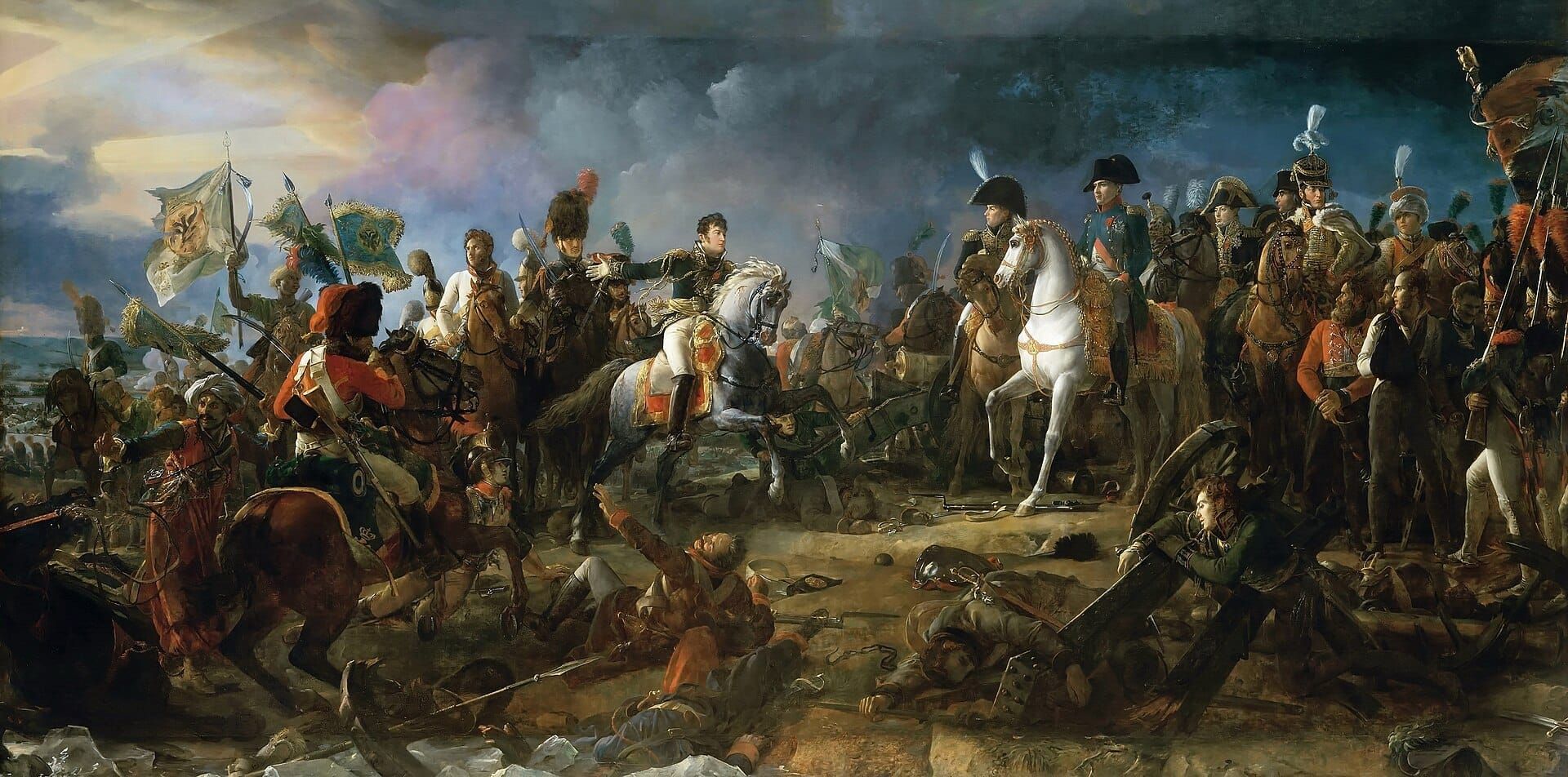
December 2, 1805 — A Witness Account
Moravia, in what is now the Czech Republic. Napoleon Bonaparte commands 73,000 French troops against an Austro-Russian coalition of 85,000. It is the first anniversary of his coronation as Emperor. By nightfall it will be called his masterpiece.
04:30 — The Camps Before Dawn
You hear the army before you see it.
Long before first light, the plain below Brno is alive with sound — the low, continuous murmur of men who cannot sleep. Eighty thousand French soldiers have been awake for hours, and their noise is not the noise of panic or disorder. It is the sound of something enormous preparing itself: the clank of equipment being checked in the dark, the low voices of officers moving through bivouacs, somewhere the sharp crack of a fire being rebuilt. The horses shift and stamp against the cold. There are tens of thousands of them.
The temperature is several degrees below freezing. A December fog has settled across the valley and the low ground around the Goldbach stream, sitting dense and white between the ridgelines, swallowing the landscape below your position. Standing on the Žuráň hill — a modest rise that Napoleon has chosen as his command post — you can see almost nothing of the terrain that will decide the day. You can hear it, and smell it, and feel it through the soles of your boots: the faint, rhythmic tremor of too many men moving in the dark.
Earlier tonight, Napoleon passed through his camps on horseback. His soldiers recognised him and lit straw torches — hundreds of them, then thousands, the fires spreading from unit to unit across the darkness until the whole army seemed to be holding light. The men cheered; the sound rolled across the valley. He told them, in the proclamation read aloud to every regiment: "The positions they occupy are formidable, but I shall attack them with my columns." The soldiers already knew something the Allies did not: that their emperor had spent two weeks engineering this moment, this ground, this fog.
The Allied campfires are visible to the north and east, scattered across the heights. There are more of them than there are of ours.
06:00 — The Mist and the Manoeuvre
Dawn comes reluctantly in early December, a slow grey lightening that reveals almost nothing. The fog is thicker now, pooling in the hollows, obscuring the village of Telnitz to the south and the Pratzen Heights to the east. The Allied army — Russians and Austrians under General Kutuzov, nominally commanded by the young Tsar Alexander I — has been moving since before light. They are going south.
This is what Napoleon planned for.
The Allied strategy is to sweep around his right flank, cut the road to Vienna, and destroy him. It is a reasonable plan with one catastrophic flaw: to execute it, they must thin their centre. They must drain the Pratzen Heights — the broad, commanding ridge that dominates the whole battlefield — of troops, and send those troops marching south through the fog. Napoleon has spent two weeks making them believe his right flank is weak and his position desperate. He told his marshals yesterday evening: "One sharp blow, and the war is over." He has been watching the Pratzen like a man watching a door he intends to walk through.
From the Žuráň hill, through the occasional thinning of mist, you can see the dark columns of Allied troops moving south along the far ridge. They move steadily, in good order, brass buttons catching what little light there is. Forty thousand men, perhaps more, descending from the high ground that controls everything. By the time they realise what they have done, it will be too late to undo it.
The French army is in its positions, mostly concealed in the folds of ground to the west of the Goldbach. Marshal Davout's corps holds the far right — badly outnumbered, ordered to hold whatever comes. Marshal Soult's corps, the pivot of the whole plan, waits below the Pratzen with two divisions ready to climb. Marshal Bernadotte is in the centre. The Guard is in reserve, at the Žuráň, here, within sight of the emperor.
The fog begins, just slightly, to lift.
07:00 — The Attack on the Right
You hear the right flank before the mist clears enough to see it.
A distant, rolling thunder begins from the south — artillery, the distinctive flat percussion of field guns distinct from the deeper boom of the larger pieces. Then musketry: a sustained crackle like a very large fire, uneven, building, occasionally broken by the sharper crack of a volley fired in unison. The sound travels strangely in fog: it arrives in pulses, distorted, sometimes seeming closer and sometimes further than it can possibly be.
Davout's men are fighting for the villages of Telnitz and Sokolnitz against the Allied southern columns. The numbers against them are overwhelming — perhaps three Allied soldiers for every one of theirs. What saves them is not numbers but time: they do not need to win, only to hold long enough for the main blow to fall elsewhere. Marshal Davout had ridden forty miles through the night with his corps to be here. His men are exhausted. They fight anyway.
In the fog around Sokolnitz, an infantryman of the 26th Légère loads, fires, and loads again without being able to see more than twenty yards in any direction. He knows the enemy is there because the men around him are falling. The smoke from his musket mingles with the mist until he is firing into a white wall that occasionally fires back. A roundshot — a cast-iron ball nine pounds in weight — passes somewhere nearby; he hears it before he understands what it is, a sound like a very fast door being slammed in another room, and then nothing to show it passed except a gap where a man was standing.
To his left, the Goldbach stream is barely knee-deep but its banks are steep and slick with frost. Men cross it, slip, curse, cross it again. The fog smells of sulphur now. It is not yet eight o'clock in the morning.
09:00 — The Sun of Austerlitz
The fog breaks.
Not gradually, not partially — it tears open in a single movement, burning away in minutes as the winter sun rises above the horizon, and the whole battlefield is suddenly, brutally visible. The Pratzen Heights stand clear against a pale blue sky. The Allied southern columns are far down the slope, committed, unable to turn back. And the Heights themselves — the high ground that controls everything, the ground the Allies have spent the last two hours abandoning — are very nearly empty.
Napoleon, watching from the Žuráň, is reported to have said to Soult: "How long will it take your divisions to reach the top of the Pratzen?" Soult replied: "Less than twenty minutes, Sire." The emperor waited another fifteen minutes. Then: "One sharp blow."
The drums begin.
The French drums of this era beat a specific rhythm for the advance: the pas de charge, a rolling, insistent, accelerating beat that every French soldier knew in his body. It began with one regiment and spread laterally until the whole of Soult's corps — perhaps 16,000 men — was moving to it. From the Žuráň the sight is extraordinary: column after column emerging from the folds in the ground, bayonets catching the new sun, moving east and upward in perfect order. The drums carry clearly across the cold air, and they have not yet encountered anyone.
The Allied troops on the Pratzen — those who remain — hear the drums, and then they see the columns, and by then the columns are already close.
10:00 — The Battle for the Heights
The battle for the Pratzen Heights is the hinge on which the day turns, and from the Žuráň it is both the most visible and the most terrible thing you have ever watched.
The French columns hit the Russian regiments near the village of Pratze at a run. At this range — fifty yards, thirty, twenty — musketry is not accurate so much as overwhelming. A volley at twenty yards does not miss. The Russian battalions, caught in the open on ground they were in the process of abandoning, formed squares and fired back, and for a long moment the two forces stood and killed each other at close range, neither breaking. The smoke from their combined fire built quickly into a white column visible for miles; within ten minutes of engagement, the men fighting could not see the men they were fighting. They navigated by the sound, by the direction of the volleys, by the instinct that comes from drilling the same movements five thousand times until the body executes them without asking the mind.
From up here, you can see what the men in it cannot: the French line is broader than the Russian line. The columns are wrapping around both flanks. The Russian officers can see it too, and their reserve battalions are coming forward at the double, and the French flanking forces adjust, and somewhere in the smoke of the Pratzen a regiment of Russian grenadiers — the tall men in their tall mitred caps — breaks through a French line and reaches the crest, and for perhaps fifteen minutes holds it.
Soult's second division comes up through the gap and takes them in the flank.
By 10:30, the Pratzen Heights belong to France.
11:00 — The Centre Breaks
There is a moment in every battle where the outcome is decided before the people fighting it know that it is. That moment at Austerlitz is probably somewhere around eleven in the morning, although the men dying have no way of knowing this.
The Allied army is now in three pieces, cut apart by the French occupation of the Pratzen. The northern force, under Prince Bagration, is fighting Lannes and Murat near the Brno road and holding, just, but with no prospect of reinforcement. The southern force is still engaged with Davout's exhausted men around Telnitz and Sokolnitz, pressing hard, succeeding — and then the French columns on the Pratzen begin to descend behind them. The Allied southern force does not know this yet. The smoke is too thick, the fog still lingers in the low ground, and the messenger trying to reach General Buxhöwden with the news will not arrive in time.
On the Pratzen, Napoleon brings forward the Grand Battery: forty-two guns, positioned on the heights and pointed south, directly into the rear of the Allied southern columns. The battery opens fire.
An artillery crew working a 12-pounder field gun in the Napoleonic era consists of eight to ten men in constant choreographed motion: the sponger thrusts a wet mop down the barrel to kill any remaining sparks from the last shot; the loader inserts the cartridge, then the ball; the rammer drives them home; the gunner lays the piece, adjusts the elevation screw, steps back; the ventsman places the friction primer; the gunner pulls the lanyard. The whole process takes perhaps thirty seconds for a well-drilled crew. The barrel, after an hour of sustained fire, is hot enough to blister bare skin.
The Grand Battery fires thirty rounds per minute, collectively, into a mass of men who did not know it was behind them. The sound, even at this distance, is not so much heard as felt — a continuous physical pressure against the chest, a vibration in the ground underfoot. Witnesses on the Žuráň describe being unable to speak to the person standing next to them, not because of the noise exactly, but because the noise had made speaking feel pointless, a small thing inside something enormous.
13:00 — The Frozen Ponds
The Allied southern force breaks in early afternoon, and it breaks towards the only route it has left: south and east, across the frozen Satschan ponds.
The ponds lie in low ground behind the Goldbach, three or four kilometres south of the main battle. In December they are frozen, or mostly frozen — the ice near the edges thin, the ice in the centre perhaps thick enough to bear weight. Forty thousand men, the guns of the Grand Battery firing behind them, the French following from three sides, flow onto the ice.
It is hard to know exactly what happens next — it always has been, and even the accounts written in the days immediately after contradict each other. What is not in dispute is this: Napoleon ordered his artillery to shift its fire to the ice. The guns on the Pratzen, reloaded and laid at lower elevation, begin firing at the frozen surface of the Satschan ponds.
The effect of a nine-pound iron ball striking ice — and then the ice cracking, and then the water coming up through the cracks, and then men in greatcoats and equipment going down — is something that has been written about many times and always in the same language of helplessness. There are accounts of horses screaming as they slid. There are accounts of men holding their muskets above their heads as the water came to their chests. The ponds are shallow — perhaps four feet at the deepest — but a man in a saturated wool greatcoat in December water cannot stand up in four feet of water for very long.
The number who drowned in the Satschan ponds has been debated for two centuries. Napoleon himself, in a bulletin written the next day, claimed two thousand. Modern historians think the number was far smaller. The truth is that the ponds were drained in the months following the battle and relatively few bodies were recovered from the mud. What the Satschan ponds actually represented was not mass drowning but mass surrender — thousands of Allied soldiers who could not advance, could not retreat, could not fight, and simply waited for the French to arrive.
The guns stopped firing before the ice failed completely.
16:00 — The Day Ends
By mid-afternoon the battle is effectively over, though the sound of it continues in the south for another hour. The light goes fast in December; by four o'clock the plain is shadowed and cold, the smoke sitting in a low layer over the ground, the fires of the battle — a barn somewhere, a village at the edge of the fighting — providing the only warmth.
Napoleon rides from the Žuráň into the field.
What he finds, riding south from the Pratzen, is the aftermath of a battle that has killed roughly nine thousand of his men and somewhere between twenty-five and thirty-six thousand of the enemy. The dead are everywhere, in the attitudes of the dead, which is to say lying in the directions they were facing when they fell, dressed in the colours of five nations — the dark blue of France, the white of Austria, the dark green of Russia. The wounded are louder than the dead. The horses are the loudest of all.
A soldier who walked that ground the following morning, writing in his memoirs forty years later, remembered the way the smoke lay over everything like a low ceiling, and the way isolated fires gave the scene a strange, stuttering orange light, and above all the sound: not of combat any longer, but of the aftermath of combat, which was harder in some ways to bear. He did not write this in a spirit of complaint. He wrote it as a statement of fact.
Napoleon, it is reported, stopped frequently to speak to the wounded — to the French and to the others. "Take care of these men," he told the surgeons following in his wake. "They have suffered for France." Whether this is exactly true or not, it sounds like him: the instinct, even in the hour of the greatest victory of his life, to be seen among the cost of it.
After Dark — What It Meant
Three empires met on the plain of Moravia and only one left intact.
The Austrian Empire signed the Peace of Pressburg within three weeks, ceding vast territories and paying a punishing indemnity. The Russian army retreated into its own vastness, broken for now. The Holy Roman Empire — the thousand-year institution that traced a notional line back to Charlemagne — was formally dissolved the following August, in large part because Austerlitz had made it impossible to pretend it still functioned. Napoleon was thirty-six years old.
The victory was complete enough that it changed the vocabulary. Le soleil d'Austerlitz — the Sun of Austerlitz — became a phrase in French that meant the moment of perfect fortune, the instant when everything aligns. Napoleon would invoke it in later years when he needed things to align again. On Saint Helena, in the years of his captivity at the end of his life, he would say that of all his victories, Austerlitz was the most perfect.
He had other battles after this. He had Jena and Wagram and the crossing of the Niemen. He had Borodino, where ninety thousand men were killed or wounded in a single day and nothing was settled. He had Leipzig, where four nations broke him simultaneously. He had Waterloo, where the mathematics of coalition finally caught him, and the Old Guard broke in the evening light, and Wellington wrote his dispatch in a house in Brussels and wept while he was writing it.
But he had Austerlitz first. And on the night of December 2nd, 1805, riding back through the dark towards Brno with the fires of the battlefield behind him, he had not yet lost anything. The empire was whole. The war was won. The smoke was drifting south across the frozen ponds.
A Note on the Numbers
The French lost approximately 9,000 men killed or wounded at Austerlitz. The Allied coalition lost approximately 36,000 — killed, wounded, or captured. Of the roughly 278 Allied cannon on the field, 186 were taken. The battle lasted from approximately seven in the morning until four in the afternoon.
The pas de charge beaten by the French drums — that insistent, accelerating rhythm that sent Soult's corps up the Pratzen — was recognisable to every soldier in Europe. It was the drum signature of the French Republic and then the Empire, drilled into recruits until the rhythm lived in muscle memory rather than mind. Veterans who survived the Napoleonic Wars reported hearing it in dreams for the rest of their lives.
The Battle of Austerlitz was fought on 2 December 1805, near the town of Austerlitz in Moravia (now Slavkov u Brna, Czech Republic). It remains one of the most studied engagements in military history.