Battle of Austerlitz Story – Witness Account
2 December 1805. A Moravian farmhand watches from the Pratzen Heights as Napoleon's trap closes on the Allied army. An immersive witness account of history's most perfect battle.

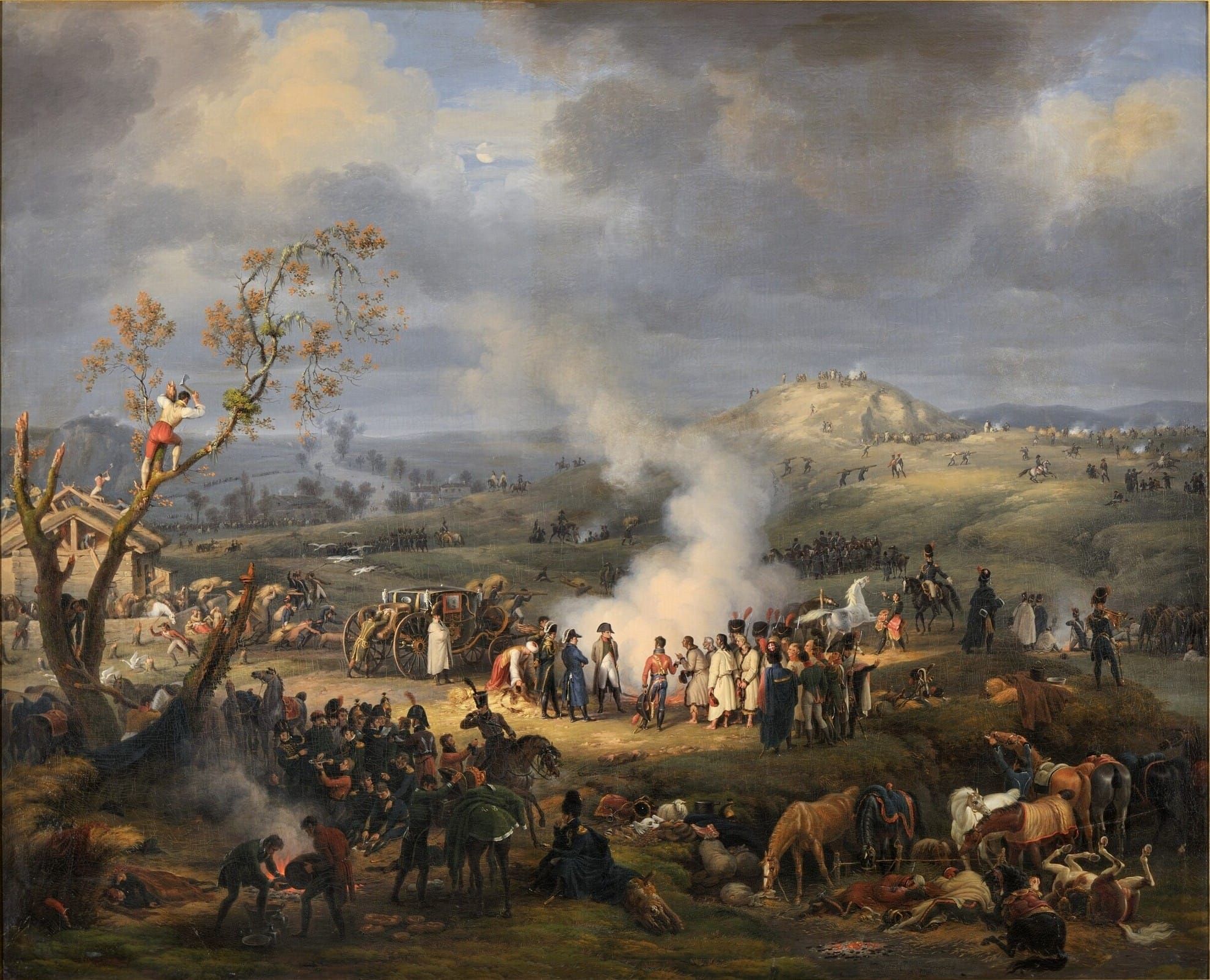
Before Dawn — approximately 4 o'clock in the morning
He smelled them before he heard them, and heard them before he saw them.
The smell came first on the wind from the east: woodsmoke, horse dung, something sharper underneath that he had no name for. He had stepped out to check on the mare, who had been restless since dusk, and he stood in the yard with his breath making small clouds and the frozen mud hard under his boots and the smell was wrong in a way he could not articulate. Not wrong like rot. Wrong like something that did not belong to this valley.
Then the sound reached him. Low, continuous, like water moving under ice. He stood very still and listened and it resolved, slowly, into the rumble of thousands of feet and wheels and hooves, all moving at once, all moving in the same direction, at a distance he could not judge. The sound did not stop. It went on and on. The mare shifted in her stall.
He went to the corner of the yard where the fence met the stone wall and looked south toward the plain below the Heights. What he saw was fire — not a fire, not a house burning, but fires, hundreds of them, stretching across the dark valley floor in both directions until they dissolved into the night. The distances were impossible to hold in the mind. Each fire was a point of orange against the black, and between them were the shadows of men and horses moving, and each moving shadow was a person, and there were so many of them that the mind simply refused to count.
He stood there for a long time. The cold came up through his boots and into his feet but he did not move.
His father had told him, three days ago, that the armies were coming. That the Emperor of France and the Emperors of Russia and Austria were somewhere in Moravia with their soldiers and that a battle was coming and that they should leave. His mother had said they could not leave — where would they go, and what would they come back to if they did? They had argued about it for two days and in the end they had not left, and now Václav stood at the fence and watched the fires and understood, in a way that argument had not made clear to him, that this was not something that happened to other people in other places. It was happening here. In the valley he knew better than he knew his own hands.
He went back inside and did not sleep.
II. Dawn — approximately 6 o'clock
The fog came up from the low ground before the light did.
By the time the sky had gone from black to a deep charcoal grey, the valley below the Heights was invisible beneath it — a white sea filling the hollows, spilling up the lower slopes, perfectly still. The fires were gone, swallowed. The sound of movement continued below the fog. He could hear it from the yard: the creak of wagon wheels, the clink of metal against metal that he now knew was weapons, the occasional sharp call of an officer's voice cutting briefly through the low rumble and then gone again.
Then they came over the ridge.
They came from the east, from the Russian lines, and they came in columns so long he could not see the end of them. The first soldiers appeared on the crest of the road perhaps three hundred yards from the house — not running, not hurrying, just marching, rank after rank, the whites and greens of the Russian infantry emerging from the grey morning like something being steadily revealed. He pressed himself against the wall of the barn and watched.
He had never seen so many men in one place. The columns filled the road and spilled into the fields on both sides, thousands of boots breaking the frost-hardened earth into dark mud, and behind the infantry came the guns — squat, black, on wooden carriages, each one pulled by four or six horses whose breath made great white plumes in the cold air. The horses were bigger than any horses he had seen. The gunners rode on the carriages or walked alongside, their faces blank with the particular blankness of men who have been moving for many hours.
An Austrian officer on horseback passed within thirty yards of him and glanced at the house without stopping. Václav could see the man's breath, could hear the creak of his saddle leather. The officer's face was young and had the rigid expression of a man maintaining composure by force of will. He was gone.
It took a long time for the columns to pass. When the last of them had descended the western slope of the Heights and disappeared into the fog below, the plateau was quiet again — quieter than it had been the day before, because the morning birds had not sung. He noticed the absence of birds only once they were gone. The whole plateau was a held breath.
To the west, from somewhere in the fog-blind valley far below, he could hear drums. He did not know what they meant. Later, he would understand they were French.
III. Morning — approximately 9 o'clock
The sun came up and ate the fog.
He had never seen it happen so quickly. One moment the valley was white and sealed and formless, and then the sun cleared the eastern hills and struck the fog, and it began to dissolve — not slowly but suddenly, the mist burning away from the top down, the shapes of armies emerging from it the way features emerge from a face when a lantern is brought near. He was standing at the edge of the plateau by then, on the slope above the western village, and what was revealed below him stopped his breath.
The French were there. They had been in the fog all night, waiting.
He did not understand, at that moment, what he was seeing — he had no map in his mind, no framework of tactics or strategy to arrange the shapes into meaning. What he saw was this: a vast plain filled with soldiers, more soldiers than he had known existed in the world, arranged in formations whose geometry was precise and alien, and the formations were blue. Blue coats, blue equipment, and between them the gold glint of brass instruments in the new sun, and the white smoke of fires that had been burning all night, and the small moving shapes of cavalry on the flanks, dozens of them, then hundreds. The light caught their armour — the cuirassiers, though he did not know the word — and flashed back from it in cold bright points.
He looked behind him. The Heights were empty. The Allied army had marched down off them, and the French were below, and he was standing between them on the plateau that everyone — though he did not know this — had been looking at for three days.
The drums below changed. He felt it before he heard it — a change in the rhythm, a quickening, something purposeful replacing something procedural. Then the cannon began.
The first shot was so loud that he dropped to his knees. Not from fear, though fear was there — from pure reflex, the body deciding before the mind that it needed to be lower to the ground. The sound was not what he had expected. He had heard thunder. He had heard the crash of the mill wheel failing, had heard his father strike the side of a grain cart with a hammer. None of those sounds had any relationship to this one. It was a concussion rather than a noise, a physical pressure that moved through his chest and into his teeth, and even after it stopped the air seemed to vibrate with the memory of it.
Then the second shot. Then the third. Then, from a different direction, a reply — and then, very quickly, what had been separate shots became a continuous roar, an unbroken wall of sound that had no gaps, that went on and on and on, and the ground under his knees was vibrating steadily, like a great machine running underground.
He put his hands over his ears and it made no difference.
IV. Midday — the crisis
Smoke.
Within an hour, the valley to the west had vanished. It had simply ceased to exist — replaced by a bank of grey-white smoke that rose and spread and merged and thickened until it was not possible to say where it ended and the sky began. He had moved back, and back again, until he was in the lane behind the church, and still the smoke came, drifting east on the cold air, carrying with it a smell that settled in the throat: sulphur, burnt cloth, something animal and hot beneath.
Through the smoke he could hear, but not see, what was happening. The drums were closer now — the French had taken the Heights, he understood this now because the cannon fire was coming from the plateau rather than the valley, coming from behind him, coming from the place where the Allied columns had marched through the farmyard in the grey dawn. He had not seen the French come up. He did not understand how it had happened so quickly.
From the south, through a gap in the smoke, he saw cavalry.
They were perhaps a mile away and moving at speed — not the careful trot of a column on a road, but the leaning, urgent canter of horses in formation closing on a target. He could feel them before they came into proper view. The ground gave them away: a low, continuous trembling that climbed up through the frozen earth and into his feet and legs, different from the artillery trembling, more rhythmic, more alive. He stood at the edge of a field and watched several thousand horsemen pass at a distance that was close enough for him to see the men's faces. They were not looking at him. They were looking at something ahead, something in the smoke, and their expressions were locked around whatever they were looking toward.
The sound of that many horses at the canter was the loudest living sound he had ever heard. Not a thunder — something more intimate than thunder, more insistent. The individual hoof-falls had merged into a roar that came up from the ground rather than down from the sky.
Then they were gone into the smoke. He heard them for a long time after. Then he heard something else: screaming, human and animal both, from the direction they had gone, and he turned away from it.
He found his mother in the kitchen. She had not moved in three hours. She was sitting at the table with her hands flat on the wood and her eyes open, listening. They did not speak. There was nothing to say that the noise outside was not already saying, louder, in a language that did not require translation.
V. Afternoon — the rout
The cannon fire from the south stopped at around two o'clock. He knew this because the silence of it was louder than the silence before it — a sudden subtraction that his ears registered as a positive thing, a new sound. He went out.
The smoke was thinning. The wind had shifted, coming now from the north, and it drew the battle-smoke south and east and revealed the plateau in stages, like a tide going out. What the smoke left behind was the field.
He walked to the western edge of the Heights and looked down.
The valley floor was covered in men. Not marching, not in formation — simply there, the way objects are there when they have been put down without care. There were men in the road and men in the fields and men at the edge of the stream that ran along the foot of the slope, and many of them were not moving. Between them moved other men who were moving very purposefully, going from one still shape to another, and he watched for a long time before he understood what they were doing.
Farther south he could see the ponds. They were Moravian winter ponds, shallow and wide, and they had been frozen for three weeks. He could see, even at this distance, that the ice was broken — not at the edges where ice always broke, but in the middle, in wide dark patches, and around the patches were dark shapes that he did not want to look at for long. He had heard the cannon fire from that direction around noon. He had not known what it was aimed at. He understood now.
A French soldier climbed the road from the valley and passed him without acknowledgment — a young man, not much older than Václav, with black powder burned into the skin around his right eye and a cut on his chin that had bled and dried. The soldier was singing something, quietly, to himself. He went up the road and around the corner of the church and was gone.
VI. After Dark — the field at evening
He went down to the valley before the light was fully gone, because his father had gone down at midday to lead the mare away from the approaching lines and had not come back.
He found his father sitting on a milestone at the side of the road, unhurt, with the mare's reins in his hand and a look on his face that Václav did not recognize — not afraid, not relieved, simply changed in some way that could not be easily named. Around them the field was being tidied by men with lanterns. There were a great many things to tidy.
They walked home. Neither of them spoke. The mare walked between them and her breath was warm on Václav's shoulder and he was grateful for it.
The guns had been silent for two hours, but his ears were still ringing, and when he lay down that night he could still feel the vibration of the artillery in the bones of his jaw, in his back where it pressed against the mattress. It faded very slowly. He was not sure it ever entirely left him.
In the morning, he learned that it was called the Battle of Austerlitz, that it had lasted perhaps nine hours, that the French Emperor had called it the finest thing he had ever done. He also learned that approximately nine thousand French soldiers had died, and thirty-six thousand Russians and Austrians — enough men to fill every village in Moravia ten times over, killed in the same nine hours, on the same ground, in the same cold.
The Pratzen Heights were a mile from end to end. He had walked across them his entire life.
He walked them again that morning, before the burial parties had finished their work, and the frost was back on the ground between the places where the earth had been torn open. The birds were back too — the crows especially, working the field with a calm and professional industry that he did not watch for long.
The grass where the columns had marched was pressed flat and dark. By spring it would be upright again. By summer you would not know.
He was not sure whether this was a comforting thought.
Historical note: The Battle of Austerlitz, fought on 2 December 1805, is widely considered Napoleon's tactical masterpiece. He deliberately feigned weakness on his right flank, inducing the Allied command to strip the Pratzen Heights — the dominant terrain feature — to reinforce what they believed was a French retreat. When the morning fog lifted, French infantry stormed the undefended Heights and split the Allied army in two. Late in the battle, as Russian and Austrian troops fled south across the frozen Satschan ponds, Napoleon ordered artillery to fire onto the ice. The ponds broke. The "Sun of Austerlitz" — the winter sun that burned through the fog at the critical moment — became one of Napoleon's most potent symbols. Ten years later, on the morning before Waterloo, he pointed at the horizon and told his staff: "It will be as fine as at Austerlitz." It was. But he lost that battle.