A story of New Sweden, 1638–1655

The Far Shore
I. The Deserter's Bargain
Gothenburg, November 1637
They found Anders Persson in a fish cellar in Majorna, three weeks after he'd walked off the muster field outside Wolgast with his boots wrapped in sacking because the army had stopped issuing boots to men it no longer paid. He had been a soldier of the Crown for four years by then, in Pomerania, in the mud of a war that no longer had a shape he could name, and he had decided, one grey morning, that he would rather be shot walking away than standing still. Nobody shot him. Nobody came at all, for eleven months, until a provost-sergeant with a list found him gutting herring for a woman who wasn't his wife.
The choice they gave him was not really a choice. Prison in Gothenburg, where men died of the flux before their trials were heard, or a berth on a ship sailing for a place with no name he recognized, to serve out his desertion as a soldier of the New Sweden Company. He chose the ship the way a man chooses the branch that is merely lower than the one that broke.
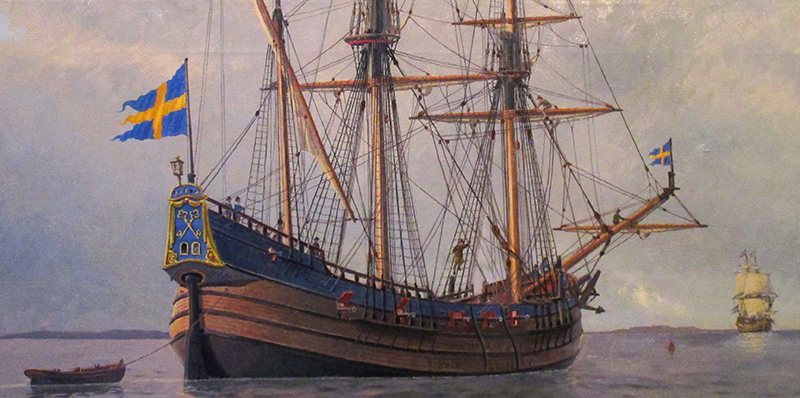
Kalmar Nyckel sat low and black at the Company quay, a Dutch-built pinnace with twelve six-pounders run out along her waist, and beside her the smaller Fågel Grip, a skuta that looked, Anders thought, like something a larger ship had misplaced. Lieutenant Måns Nilsson Kling stood at the gangway with a muster roll and did not look up as the tvångsrekryterade — the forced men, the deserters, the ones who owed the Crown a debt only distance could pay — filed past him onto the deck. Twenty-three soldiers. One bookkeeper, thin as a quill, already seasick at the pier.
They cast off in the last week of November, into a North Sea that seemed personally offended by the ships' presence. Three days out, a storm took the rigging apart above the topsail yard and drove both vessels toward the Dutch coast with water coming green over the rail. They limped into Texel for repairs that stretched into weeks, and it was there, in the long grey wait, that the enthusiasm — such as it had ever been — finally broke. A third of the crew went over the side at night, into Friesland, into whatever lives could be built from nothing in a foreign country, rather than face the ocean again. Anders considered it. He had nowhere in Friesland to go to, which was, in the end, the only reason he stayed.
He was seasick for the first time in his life on the crossing that followed, and he watched men older and harder than him drink themselves past the misery because there was no other remedy the ship carried. The bookkeeper died. Somewhere past the Azores a rumor went through the lower deck that they were sailing off the edge of what God had bothered to make, and nobody laughed at it, because by then it did not feel impossible.
They sighted land in March — low, forested, a green so continuous it looked less like a coast than like the sea itself had grown fur — and on the twenty-ninth day of that month the ships came up a river the Dutch called the South and turned into a smaller water, and Peter Minuit, who had governed New Amsterdam once and lost it, and who knew this coastline the way a man knows a debt he means to collect, brought them alongside a stone shelf that made a natural wharf on the western bank. The men called it, from the first hour, simply the Rocks. Anders stood at the rail with his sacking-wrapped boots and smelled woodsmoke from a source he couldn't see, and cedar, and mud flats at low water, and thought: this is either a grave or a life, and no one on this ship can tell me which.
II. The Treaty and the Timber
The Christina River, April 1638
The earthwork went up before the first true building did — that was Minuit's order, and no one argued it, because the fort was the difference between a colony and a grave marker. Turf and packed earth, a ditch, a palisade line sketched in stakes; the men worked in the wet spring ground with blistered hands and looked up often, at the tree line, where nothing moved that they could see and everything, they were certain, watched them.
Five sachems of the Lenni Lenape came aboard Kalmar Nyckel on the eighth of April to make the purchase formal — the land from the Rocks inland, in exchange for kettles, cloth, axeheads, the ordinary hardware of another world laid out on a ship's deck like a dowry. Anders was not close enough to hear the words exchanged, only to see the shape of the meeting: the sachems unhurried, deliberate, dressed for the occasion in a way that made the Swedes' travel-stained coats look like what they were; Minuit talking through an interpreter with the particular patience of a man who has negotiated for a colony before and lost it once already. Something was signed, or marked, or agreed to in whatever manner passed for signing when one side had no letters for it. The kettles went ashore in Lenape canoes. The Swedes got their earthwork, their fort, their claim.
Nobody told Anders whether the five men understood the paper the way the Swedes understood it. He was a soldier, not a diplomat, and it was not his business to ask. But he noticed, in the weeks after, how the Lenape who came to trade at the Rocks watched the log walls go up with an expression he had seen before, on farmers back home watching a landlord's surveyor walk a field — not hostility, not yet, but the particular stillness of people recalculating what a piece of paper was going to cost them.
The building itself he understood better than the diplomacy. The men who had come from Finland and the forest districts of Sweden — Anders was neither, but he had soldiered beside enough of them to have learned the trade with his hands — raised the first knuttimrade stugor, notched log cabins, the corners locked without a single nail, the gaps between the logs packed with clay and moss against a cold none of them had yet felt but all of them had been warned about. It was faster than anything built with sawn plank and frame, and it worked with the only resource the country had given them without asking — the forest went on, in every direction, past any horizon a man could walk to in a week, an amount of standing timber that would have made a Swedish parish rich for a generation, wasted here on a coastline nobody in Stockholm could find on a map without help.
Anders built his first roof in June, sweating through a shirt gone stiff with salt and resin, and understood for the first time since Wolgast that his hands were doing something that would still exist in a year. It was a small thing. It was the first thing in four years that had felt like it.
III. Riitta of the Ashes
The western bank, 1641
She came on the Kalmar Nyckel's third crossing, in the spring of 1641, with a group of families the Company had recruited from the Finnish-settled forest parishes of central Sweden — households the Swedish Crown had grown tired of chasing off land they burned and cleared by the old method, svedjebruk, slash-and-burn, a whole rye harvest coaxed out of ash where no plough had ever gone. In Sweden this had become, by royal decree, a nuisance and eventually a crime; in the Delaware wilderness, where clearing land by any method at all was the entire labor of survival, it was suddenly the single most valuable skill a settler could carry off a ship.
Her name was Riitta, daughter of Eskeli, and she arrived a widow at twenty-six, her first husband dead of a fever on the crossing and buried, like the bookkeeper before him, in water instead of ground. She did not weep where anyone could see her do it. Anders noticed this before he noticed anything else about her — a woman standing at the rail of a boat with a dead husband three days behind her, dry-eyed, watching the tree line the way a person reads a letter for what it does not say.
They did not fall in love the way the ballads back home described it, in one clean strike. It happened the way most things happened at the Rocks that year — around labor, around necessity, around the fact that a widow with a hatchet was more useful to the colony than a soldier without a farm, and Anders, tired of garrison rations and the particular loneliness of a rented cabin, had land granted him on the western bank and no one to help him burn it clear. She showed him how the Finns did it — cut in autumn, let the felled timber season and dry through the winter, burn in a good spring wind when the ash would spread but the fire wouldn't run wild into standing forest, sow the rye directly into the warm grey bed before the first rain. It should not have worked in a country this wet, this wooded, this unlike Savonia. It worked anyway, and by the second summer they had rye where there had been oak, and a marriage neither of them had planned to want, made mostly of shared labor and the specific, undramatic tenderness of two people who have each already survived the worst thing they expected life to do to them.
They built their stuga on a low rise above the river, close enough to smell the water on warm evenings, far enough that the spring floods never reached the door. Karin was born there in the autumn of 1643. Olof followed in 1646, delivered by a Lenape woman from the nearby settlement who had midwifed half the farms on that stretch of river and took payment, that year, in salt.
IV. Printz's Peace
The Delaware farms, 1644–1652
Governor Johan Printz arrived in 1643 the way weather arrives — announced well before he appeared, and undeniable once he had. He was, by the accounts that reached even the outlying farms, a monstrously large man, so heavy that the Lenape who came to treat with him at his manor on Tinicum Island called him, without much malice, Big Belly — and so furious in temper that Company clerks reportedly wrote home describing arguments in which he seemed prepared to eat the furniture. He built forts, extended the colony north to Passayung, drove the fur trade to a volume the little colony had never managed under Minuit's successors, and did all of it with the specific relentlessness of a man who knew Stockholm had sent him to a posting nobody else wanted and meant to make it matter anyway.
For Anders and Riitta, Printz's decade was not a governor's decade at all. It was tobacco set in neat rows along the river terrace, cut and cured and loaded eventually onto whatever hull would carry it back across the ocean for a price fixed by men who had never smelled the leaf wet. It was the particular rhythm of a frontier farm: Riitta's hands, cracked every winter and healed every summer, moving between the cookfire and the loom and the two children who grew, as children do in places like that, half-wild and entirely capable, barefoot on ground their parents had cleared by fire.
It was also the Mingo. The colony's inland trading partners — Susquehannock people the Swedish administration had taken to calling, with the particular warmth reserved for those who make you money, their "special friends" — passed the farm twice a year on the trail down to the fort, canoes and packs loaded with beaver pelts bound for Company warehouses and, eventually, hatters in Amsterdam and London who would never know the river the fur had come from. One trader in particular, a broad-shouldered man Anders came to know only by the name the Swedes used for him, Achtiwa, took to stopping at the stuga on his passes — first for water, then, as the years accumulated into something like acquaintance, for the specific hospitality of a fire and a meal shared by people who had decided, independently and without ceremony, to trust each other.
It was through Achtiwa's visits, more than through any Company report, that Anders began to understand what Printz's fur trade was actually costing. The Mingo alliance was good business and bad diplomacy in the same breath. The Lenape — the people whose sachems had signed the paper aboard Kalmar Nyckel seven years before, whose land this technically remained even as the Swedes farmed it — watched the Company's favor shift steadily to their rival trading partners upriver, and the shift did not go unnoticed or unresented. Menewessa, an older Lenape man whose family fished the same bend of river the farm looked out on, said as much to Anders directly one autumn evening, in the plain, unhurried Delaware trade-pidgin that had grown up between the two peoples out of necessity: that the Swedes had two hands, one open to the Mingo and one closed to the Lenape, and a man could not shake a hand like that and trust what the other one was doing.
Anders had no answer for him. He was a farmer with a Finnish wife and two children born on land that had been someone else's before it was anyone's paper, and there was no version of the truth he could offer Menewessa that made either of them more comfortable. He gave the old man tobacco instead, which was not an answer either, but was at least honest about what it was.
The disease came the way it always came in that world — quietly, in a season that should have been ordinary. Cholera one year, then something the Swedes called a putrid fever, then in '48 a wave of smallpox that emptied entire stretches of Lenape settlement along the river in the space of a single winter. Riitta lost no one to it; the farm's isolation, the very scatter of Nordic homesteading that had seemed, in the first years, like a strange and inefficient way to settle a country, turned out to be its own kind of protection. Menewessa lost three grandchildren in a month and did not come to trade again until the following spring, and when he did, something in him had gone quiet in a way Anders recognized, because he had seen it in his own face once, in a fish cellar in Majorna, in the year he had stopped expecting the world to be fair.
V. Ominous Season
The Delaware Valley, 1654–1655
By the time Johan Rising arrived to govern in the spring of 1654, Karin was eleven and could clear a rye field with an axe nearly as fast as her mother, and Olof was eight and spoke three languages badly and one of them — the Lenape trade-pidgin — better than his parents did, the way children absorb what adults only learn. The colony they had grown up in did not feel, to them, like the raw and uncertain thing it had been to Anders on the deck of Kalmar Nyckel. It felt like home, because it was the only one they had ever had.
Rising's first act of consequence was to seize Fort Casimir from the Dutch garrison at New Castle, a fortification the Company had watched sit seven miles downriver from Fort Christina for three years like a splinter nobody wanted to dig out. It was, by any honest measure, a provocation the colony could not afford. The Dutch West India Company had a governor in New Amsterdam — Peter Stuyvesant, a man with one leg and no patience left for Swedish encroachment on a river the Dutch had claimed first — and Rising had just given him a reason that even the most cautious burgher in Amsterdam would understand.
The warning, when it came, arrived through the same channel most warnings had always come through on that river: the Lenape. By the summer of 1655 the reports reaching Rising's officers had turned openly ominous — talk among the Renappi, as the Swedish records styled them, of settlers who might yet be killed, of the trade paths to the Mingo that might yet be cut, if the Swedish crown continued to treat the river's first people as an afterthought to its fur ledgers. Achtiwa, on his last pass through before the season closed, told Anders plainly that the Mingo would not be riding to any Swede's defense if the Dutch came, and that he should not expect otherwise, because friendship bought with kettles had never been the kind that survived a siege.
Riitta wanted to move the family inland, upriver, away from both forts, and for the first time in fourteen years of marriage Anders told her no and meant it in a way that ended the conversation. He was forty now, a deserter no army would want back, a farmer with rye in the ground and a roof his own hands had raised, and there was nowhere on this continent that was not, in the end, somebody's contested river. He would rather stand where he had already built something than run again toward a place he'd have to build it twice.
VI. The Ten Days
Fort Christina, September 1655
They heard the fleet before they saw it — not gunfire yet, only the particular low murmur that a great many people moving together makes across open water on a still morning, carried strangely far by the river's flat surface. Then, rounding the bend below the Rocks, the ships themselves: seven of them, sails slack in the light air, riding low with what everyone on the bank understood at a glance to be far more men than any Swedish garrison could answer. Stuyvesant had brought seven hundred.
Fort Christina held thirty.
Karin, twelve now, was the one who saw it first from the rise above the river, and she did not scream, because her mother had raised her not to waste breath on a thing that needed watching instead. Anders came up beside her with Olof already tugging at his sleeve, and the four of them stood in their own rye field and watched a war arrive at a pace no one could hurry and no one could stop.
The Dutch took Fort Casimir on the second day almost without a shot — the garrison there was smaller still, and the men inside it had seen the same seven ships the Ek family had seen, and had done the same arithmetic. Then the fleet came upriver toward Christina itself, and what followed was not a battle so much as a slow, methodical strangling: Dutch soldiers and hired mercenaries put ashore in numbers that made the Swedish palisade look, from the farm's rise, like a child's fence around a kitchen garden. Cannon were dragged up and dug in on the higher ground north of the fort, out of range of the earthwork's own few guns, and from the fourth day onward the air over the Christina River carried a new sound the family had never lived beside before — the flat, unhurried crack of siege guns finding their range, one shot every quarter hour or so, patient the way a man is patient when he knows the outcome and is only waiting on the other side to admit it.
Smoke hung low over the fort by the sixth day, not the black smoke of buildings burning but the grey-white drift of powder that never fully cleared before the next gun spoke, so that from a distance the little fort seemed to be dissolving into weather of its own making. Anders had heard old soldiers from the German wars describe exactly this — a battlefield that vanished behind its own fire until the men inside it were fighting a fog as much as an enemy — and he understood, watching it happen to a fort he had helped raise the earthworks of seventeen years before, that he had never actually believed those stories until now.
There was no attack on the farms. That was its own strange mercy and its own strange horror — the war stayed at the fort, methodical and contained, while life on the western bank went on in a kind of suspended, listening stillness, every family doing its chores with one ear turned toward the guns. Riitta kept the children at threshing through the worst of it, because idle hands in a house within earshot of cannon fire were worse than working ones, and because rye did not care what army was winning.
On the tenth day the guns stopped, and the silence that followed was worse, for an hour, than any of the noise had been. Word came up the river path by evening, carried by a boy on a borrowed horse: Fort Christina had surrendered. Thirty men could not hold what seven hundred had decided to take, and Governor Rising had signed the capitulation rather than watch the garrison die for a position that had been lost from the moment the ships rounded the bend. Political New Sweden — the flag, the Company, the governor, seventeen years of charters and correspondence with Stockholm — ended that afternoon in September 1655, on a piece of paper, the way it had begun on a piece of paper aboard a ship's deck in April of 1638.
VII. What Remained
The western bank, autumn 1655 and after
Stuyvesant renamed the fort Altena and sailed most of his fleet home within the month, having gotten, in the end, exactly what he came for and no more. He did not burn the farms. He did not expel the settlers. What he offered — what the Dutch West India Company had calculated, correctly, would cost less than a second campaign — was continuity: the Swedes and Finns could keep their land, their language, their Lutheran pastor if they could get one sent, their log cabins and their rye fields and their particular, scattered way of living on a river that now flew a different flag over a fort most of them had never set foot inside.
Anders and Riitta stayed. So did nearly everyone on that stretch of the Christina and the Delaware — not out of loyalty to a crown that had, in the end, sent them soldiers instead of settlers and lost the colony it built with those soldiers' unwilling hands, but because the alternative to staying was abandoning fourteen years of cleared ground, raised timber, and buried children's teeth under the doorstone for luck, and no flag had ever been worth that particular arithmetic. Menewessa's people, thinned by disease and pressed steadily westward by a tide of settlement that did not slow simply because the settlers now answered to Amsterdam instead of Stockholm, remained neighbors a while longer, and then, gradually, did not.
Karin married a Finnish cooper's son in 1661 under English rule — the flag had changed again by then, in '64, though almost nothing else on the farm had — in a service conducted by one of the Lutheran priests the Swedish Crown kept sending across an ocean to a colony it no longer owned, a strange and stubborn act of care that would continue, astonishingly, for more than a century after the last Swedish soldier left the river. Olof took over the clearing of a second farm upriver in the '70s, still speaking the trade-pidgin he'd learned as a boy, useful now mostly for old men's stories rather than active trade.
Anders lived to be an old man by the standards of that country, long enough to see a wooden church go up not far from the Rocks where he'd first smelled woodsmoke from a shore he couldn't name — the beginning of what would one day be called Holy Trinity, and would still be standing, a stone building by then, three and a half centuries after a deserter with his boots wrapped in sacking had decided that a lower branch was better than none. He never once, in all those years, called himself lucky. But he kept, until he died, the small stubborn conviction that the roof he had raised in his first June on that river was still standing somewhere, holding rain off some other family entirely, doing the only thing he had ever really asked of the New World: to let something he built outlast the reasons he had been forced to build it.
Author's note: Anders Persson, Riitta, Menewessa, and Achtiwa are invented figures — composites drawn from the documented experience of New Sweden's tvångsrekryterade soldiers, Forest Finn settler families, and the colony's Lenape and Susquehannock (Mingo) neighbors. Peter Minuit, Måns Nilsson Kling, Johan Printz, Johan Rising, and Peter Stuyvesant are historical figures, and the events surrounding them — the 1637–38 voyage and desertions at Texel, the 1638 land purchase and founding of Fort Christina, the fur trade and Mingo alliance, the 1654 seizure of Fort Casimir, and the ten-day siege and capitulation of September 1655 — follow the documented record.