A Story of Intelligence

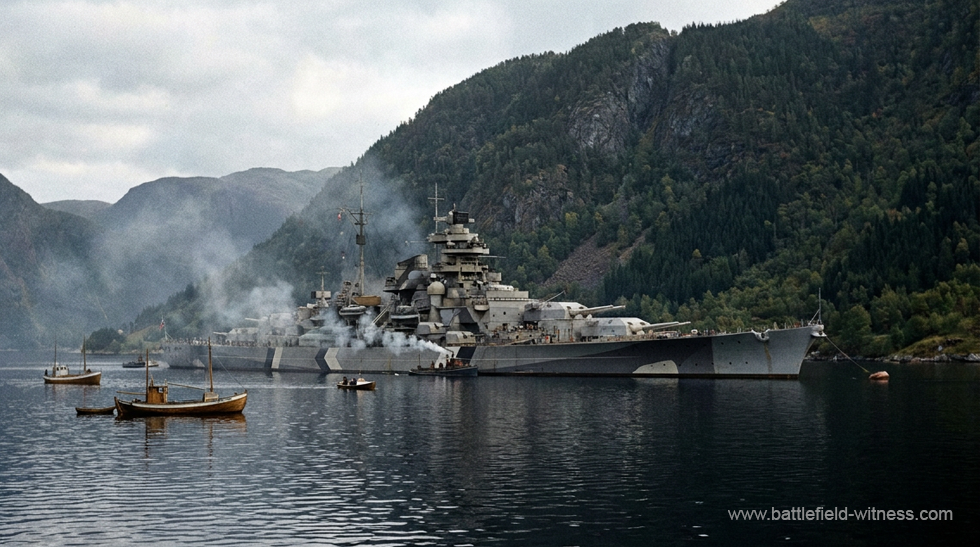
The Beast in the Fjord
Part One: The Cardinal, 1941–1942
The hut smelled of damp wool and cigarette ash, of men who had been awake too long thinking too hard, and of something else beneath that — the particular tension of people who know that what they are reading has already happened, that the men whose words they are deciphering are already dead or already sailing toward a rendezvous they cannot be warned away from in time.
Harry Hinsley sat at his desk in Hut 8 with a decrypted German naval signal in front of him and the feeling — he could not have named it precisely, it was more physiological than rational — that he was seeing something he had not been meant to see.
He was nineteen years old. He had been recruited to Bletchley Park straight from St John's College, Cambridge, where his tutor had described his mind as "aggressively non-linear" — a comment intended as mild criticism that Hinsley had accepted as the finest compliment of his life. His colleagues called him "the Cardinal," though not to his face, not quite. The name had originated with a section head who had watched him read three signals, set them aside, and announce with complete certainty that a German troop movement planned for the following Thursday had already been cancelled. He had been right. No one had asked him to explain his reasoning. The nickname stuck because no one could think of a better one for someone who seemed to operate by papal infallibility.
The signal in front of him was routine, on its face. A scheduling notation. Fuel requisition. The sort of administrative traffic that made up the vast majority of what came through, the sediment that buried the occasional bright stone.
Hinsley read it a second time. Then a third.
He stood up, put on his coat, and went to find Commander Norman Denning.
Denning was at the Admiralty's Operational Intelligence Centre, which occupied a set of rooms below the Citadel that smelled, in Hinsley's opinion, as though they had been designed by someone who believed that good thinking required poor ventilation. He found the Commander bent over a plotting table, moving a small marker that represented a German surface group reported somewhere off the Norwegian coast.
"I need to speak with you," Hinsley said, without preamble. Formality was wasted breath, in his estimation.
Denning looked up. He had learned not to express impatience with the young man from Bletchley, not because Hinsley outranked him — he did not — but because Hinsley had been right too many times.
"Go ahead."
"She's moving."
Denning put down his marker. He did not ask which ship. There was only one ship that mattered, in those months. The Tirpitz — 42,000 tons, eight 380-millimetre guns, armour belt 320 millimetres thick amidships, top speed thirty knots, a presence in the Norwegian fjords so strategically overwhelming that the Royal Navy was compelled to keep two battleships and a battlecruiser at Scapa Flow simply to counter the possibility that she might sortie. The Admiralty privately referred to her as "the Beast." Hinsley thought this showed a failure of imagination. Beasts could be hunted. What the Tirpitz represented was something more like a chronic illness — one that consumed resources without ever quite resolving into a crisis, that altered every calculation, that could not be safely ignored.
"Moving where?" Denning asked.
"Baltic. The traffic pattern suggests pre-invasion preparations. Norway."
"When?"
"The fuel requisition doesn't give a date. But the signal is marked urgent." Hinsley set the decrypted sheet on the table. "She's being repositioned for a demonstration. Political, not tactical. Hitler wants her visible to the Norwegians."
Denning studied the paper for a long time. Then he looked at Hinsley with an expression that the young man had learned to interpret as how can you possibly be certain overlaid with and yet I believe you.
"I'll inform the First Sea Lord."
Hinsley nodded and put his coat back on. He was halfway to the door when Denning spoke again.
"Hinsley."
He stopped.
"We need to think seriously about getting her out into open water. Into range."
"I know," Hinsley said. "I've been thinking about it."
The attempt happened six months later, in spring 1942, from the quarterdeck of HMS King George V at anchor in the vast, wind-scoured anchorage of Scapa Flow.
Hinsley had spent three days aboard Admiral Tovey's flagship, sleeping in a borrowed cabin that smelled of oil and the sea, eating in the wardroom where the officers regarded him with a mixture of curiosity and the faint embarrassment that professional naval men tended to feel around civilian intelligence staff. The Admiral himself had received him without ceremony, poured him a whisky he had not asked for, and listened to his proposal with the focused attention of someone who has learned to separate what he finds implausible from what he finds impossible.
The plan was elegant in conception and complicated in execution: a manufactured pattern of signals, fed through captured German frequencies, suggesting that a British convoy was assembling in conditions — weather, escort strength, timing — that would make it irresistible to intercept. The signals would pull the Tirpitz out of Trondheim and into waters where the Home Fleet could engage her.
For twelve days, the false traffic ran. Hinsley monitored the responses with the particular concentration of a man listening to music he has composed himself, alert to every deviation.
On the thirteenth day, she almost came.
The German fleet headquarters issued a sortie order. Hinsley could see it in the signals like a fault line in rock — the sudden compression of traffic, the distinctive frequency patterns of high-level authorisation, the silence of the Tirpitz's own radio operators that indicated the ship was at action stations and maintaining radio discipline. For two hours, he believed they had her.
Then the order was cancelled.
He never learned, not with certainty, what had given them away. Perhaps nothing — perhaps Hitler had simply lost his nerve, fearful of risking his most valuable ship against an uncertain engagement. Perhaps a German agent had seen something at Scapa Flow that didn't look quite right. Perhaps the false signal pattern had contained some error too subtle for him to identify.
He wrote up his analysis in six precise paragraphs and sent it to Denning.
In the final paragraph, almost as an aside, he wrote: The Beast will not come to us. We must go to her.
He did not specify how. He suspected that was a problem for other men.
Part Two: Through the Nets, September 1943
The X-craft were fifty-one feet long and smelled, inside, of machine oil, damp rubber, and the peculiar staleness of air that had passed through human lungs too many times. They were not submarines in any sense a naval architect from the previous century would have recognised. They were more like a gesture toward a submarine — the minimum viable configuration of a vessel that could submerge and move and carry enough explosive to matter.
Lieutenant Donald Cameron RNR had commanded X-6 for four months, which was long enough to know all the ways it could kill him and still not long enough to feel entirely confident it wouldn't.
He was twenty-four years old, a Scotsman from Carluke, the son of a solicitor. He had a broad face that tended toward redness in cold weather and a habit of understatement so ingrained that his crew had initially mistaken it for lack of emotion. Three months aboard X-6 had corrected this impression. Cameron felt everything very intensely. He had simply learned, through some combination of temperament and circumstance, that the most useful response to intense feeling was a slightly dryer version of whatever he had been about to say.
On the morning of the twenty-second of September 1943, he took X-6 through the net defences of Kåfjorden at a depth of sixty feet, navigating by chart and compass and a periscope he had learned not to trust completely because the prism had developed a small but definitive fog.
The anti-torpedo nets were German engineering at its most methodical: multiple layers of heavy steel mesh, suspended from surface buoys, anchored to the fjord bed, designed to trap anything larger than a fish. There were gaps where vessels passed through, and the gaps were watched. Cameron had studied the intelligence reports — which had come from Bletchley via a chain of transmission he was not privileged to know the details of, and from Norwegian resistance observers who had lain in the hills above the fjord with binoculars and done their counting with extraordinary patience — until he knew the timing of the net tenders as well as he knew the layout of his own vessel.
He took X-6 through the first gap at 07:40, following a German minesweeper at a distance of forty yards, riding the disturbance of its wake.
His first lieutenant, Sub-Lieutenant Goddard, was at the trim controls. Able Seaman Riddler worked the engine. ERA Lorimer handled the pumps. Four men in a cylinder fifty-one feet long, sliding through the black water of a Norwegian fjord in September with two tons of amatol strapped to their keel.
The periscope fogged again just inside the inner net.
Cameron swore, quietly, in the exact tone of a man who has predicted this problem and been correct in his prediction.
He navigated blind for eleven minutes by dead reckoning and the compass, which was reliable, and his own sense of depth and direction, which he had learned to trust more than he trusted most instruments.
When he raised the periscope again at 08:51, the Tirpitz was three hundred yards away.
She was so large that for a moment his mind refused to scale her correctly. He had seen photographs, had studied the dimensions until they were numbers he could recite in his sleep — 823 feet overall length, 118 feet beam — but the numbers had not prepared him for what she actually looked like in the grey September light: the great grey wall of her hull, the towers of her superstructure, the long gun barrels of her main armament trained fore-and-aft in their resting position. She looked less like a ship than like a piece of the landscape that had decided to float.
"There she is," he said, which was the truest thing he could think of to say.
He brought X-6 down to thirty feet and began the final approach.
Fourteen minutes later, six hundred yards to the southwest of X-6's position, Lieutenant Godfrey Place in X-7 was navigating through the inner anti-torpedo net by a method that he would later describe in his official report as "by feel" and in his private diary as "sheer bloody luck combined with a degree of desperation I would not recommend as a navigational technique."
X-7 had become tangled in the net at depth.
Place was twenty-two years old, the son of an architect, a chess player of some seriousness who had been described by his training instructors as possessing "an unusual ability to remain calm during irreversible events." This quality was being tested.
The net held them for seventeen minutes. During this time, Place tried five different combinations of motor speed and trim adjustment. None of them freed the X-craft on the first attempt. Several of them made things worse before making them better. The craft shuddered and yawed and the hull groaned in a way that Place did not record in either his report or his diary, because there are sounds a man hears in a submarine while it is entangled in steel mesh at sixty feet that are not communicable in any form he wants preserved.
On the sixth attempt, X-7 lurched free.
Place took her down to forty feet and drove her directly for the shadow of the Tirpitz's hull.
He placed his charges at 07:22. Cameron had placed his at 07:15.
They were four limpet mines each, two thousand pounds of amatol in total per vessel, attached to the keel of the largest warship in the German Navy, set to detonate on a time delay.
Both X-6 and X-7 were discovered and forced to the surface within the hour. Their crews were taken prisoner. Cameron and his men were brought aboard the Tirpitz itself — the ship they had just mined — and were below decks when, at 08:12, four thousand pounds of high explosive detonated simultaneously beneath the vessel's keel.
The force of it, Cameron would write later, was like being struck by a very large, very determined hammer that had no interest in killing you but wished you to know that it could have.
The Tirpitz leapt in the water. Her turbines were wrenched from their mountings. Her main armament was disabled. She took on water through ruptured compartments. She would not sail again under her own power for six months.
Cameron received the Victoria Cross in a ceremony in London the following year. When asked to describe the moment the charges went off, he said, with characteristic precision: "It was quite loud."
A third X-craft, X-5, commanded by Lieutenant Henty-Creer, had also reached the inner fjord. At 08:43, thirty-one minutes after the detonation, she was spotted on the surface near the Tirpitz, apparently disabled. The Tirpitz's anti-aircraft guns opened fire. X-5 sank. Henty-Creer and his three crewmen were never found. Their fate, whether they died in the attack or survived it briefly and drowned, remained unknown.
The official records noted the loss with the particular flatness that official records reserve for things that cannot be adequately expressed.
Part Three: The Problem of Proof, Summer 1944
Major William Harker, USAAF, had been a geography teacher in Des Moines before the war. This was not, in his experience, a detail that endeared him to pilots.
He was thirty-one years old, slight, with close-cropped dark hair and the habit — which he had acquired during five years of trying to make sixteen-year-olds understand the significance of things they could not see directly — of explaining complex observations by building from the simple to the difficult. This method worked well in a classroom. It worked poorly in the wooden briefing rooms of the 8th Air Force's intelligence sections, where the pilots who sat across from him had spent the last several hours flying at 25,000 feet through flak that was trying to remove them from the earth and were not, consequently, in the most receptive mood for methodical analysis.
"The strike photography doesn't support the assessment," Harker said, for the third time in the same meeting.
Colonel Raymond Polk, who commanded the 388th Bombardment Group and had flown forty-one missions and looked it, set down his coffee cup with the precision of a man controlling something that would otherwise result in violence.
"The strike photography," Polk said, "was taken at 23,000 feet through four-tenths cloud by a camera that was probably vibrating at the moment of exposure because we were in the middle of being shot at. My bombardier confirms the run."
"Your bombardier confirms a run," Harker said. "The question is whether the ordnance impacted the designated structures."
The room was quiet. There were eight other men in it — intelligence staff, bombardiers, a navigator, two other pilots — and each of them had the particular tension of men observing a disagreement they have opinions about but are choosing, for various reasons, not to express.
Harker understood what Polk was not saying, because he had come to understand this particular silence very well over the past eighteen months. The pilots trusted their own eyes. They trusted the testimony of men who had been present. They did not, at some fundamental level, trust the conclusions of people who had not been in the aircraft, who had not felt the aircraft move, who had looked at photographs rather than at the ground. There was a guild distinction at work, as old and difficult as any in human relations — the practitioner and the analyst, the man who acts and the man who evaluates. Each believed the other was missing something essential.
The problem was that both of them were right.
The strike photographs on the table in front of Harker were genuinely ambiguous. Smoke obscured the target area in three of the seven frames. In the remaining four, he could identify probable impact craters, but their precise relationship to the marshalling yard they had been sent to destroy was, in professional terms, unclear. The word unclear was the most precise word he had available, and it was not what Colonel Polk wanted to hear.
"I'm not questioning the bravery of the mission," Harker said. "I'm questioning whether the results justify removing this target from the priority list."
"The crew reports confirm—"
"Crew reports," Harker said, carefully, "are subjective assessments made under extraordinary stress by men who are simultaneously operating an aircraft and managing seven other crew members and trying not to be killed. They are invaluable data. They are not the same as objective damage assessment."
This was accurate. It was also, he had come to understand, the sort of accuracy that made enemies.
Polk looked at him for a long moment with an expression that contained, in roughly equal measure, anger, respect, and the exhaustion of a man who has survived forty-one missions and cannot decide whether the people who make his decisions are protecting him or insulting him.
"What do you need?" Polk said finally.
"A reconnaissance sortie over the target within forty-eight hours. Before the smoke clears, if possible, so we can correlate the photographs."
"That's another aircraft, another crew."
"Yes."
Another silence.
"I'll put in the request," Polk said, at last. He did not sound pleased. He sounded like a man who has decided that the argument has become less useful than the result.
The tension was not personal, though it felt that way. It was structural — built into the organisation of the air forces themselves, which had evolved from institutions whose culture was entirely operational, whose heroes were men who flew things and destroyed things, and which had acquired analytical functions as an afterthought of strategic necessity. The intelligence officers were often younger, often better-educated in certain technical respects, and almost universally lacking in the experience of physical danger that gave the operational men their authority.
In the British system, the problem had been addressed — imperfectly, but addressed — by the long tradition of the Directorate of Military Intelligence's photographic interpretation work at Medmenham, where civilians with backgrounds in archaeology and art history and geography had been given the authority to assess aerial photographs without reference to the operational conclusions of the crews who had taken them. The system worked because it was insulated from the pilots. The Americans had not yet built that insulation reliably.
Harker had been corresponding with a British colleague, a Wing Commander named Somerville at the Central Interpretation Unit at RAF Medmenham, who had the disconcerting habit of being right about photographs in ways that were impossible to verify until after the decisions had already been made. Somerville had once assessed the state of repair of a German ball-bearing factory from a single oblique photograph taken from three miles away and had been correct in every particular. He had spent the previous year working on the problem of the Tirpitz.
"The ship is not destroyed," Somerville had written, in one of his regular reports, "and will not be destroyed by the means currently being applied. The armour plate is not penetrable by ordnance below 12,000 pounds from medium altitude. The geometry of the fjord prevents the shallow attack profile that would be necessary for torpedoes. What is required is a weapon that defeats armour by means other than direct penetration — specifically, by exploiting the medium of the water and the earth beneath the ship."
Harker had read this assessment three times and sent a copy to Denning at the OIC.
He did not know, at that point, that the British had already begun building exactly that weapon.
Part Four: Earthquake, November 1944
The weapon was called the Tallboy.
Barnes Wallis had designed it the way he designed most things — by working backwards from the physics of what he wanted to achieve to the engineering of what would achieve it. The Tirpitz could not be destroyed from above by conventional bombs because her armour was too thick. She could not be destroyed from below by torpedoes because the fjord was too shallow. What could be destroyed was the structural integrity of the water and the earth supporting her — the environment she rested in rather than the ship herself.
The Tallboy weighed 12,000 pounds. Its casing was machined to precise tolerances so that it would not tumble in flight but would strike at near-sonic velocity with its hardened steel nose presented to the target. Its delayed fuse fired only after the bomb had driven itself deep into the seabed or through the ship's bottom plating. The detonation generated a seismic shock wave through the incompressible medium of the water — a wave that did to underwater structures what earthquakes do to surface ones.
On the fifteenth of September 1944, twenty-eight Avro Lancasters of No. 617 Squadron RAF flew from Lossiemouth in the north of Scotland to Kåfjorden. The distance was approximately 1,200 miles. They flew at high altitude, in broad daylight, and they were aware that they would have very little fuel margin for error.
Wing Commander James Tait led the formation. He was thirty-one years old, a Welshman from Builth Wells, a pilot of such skill and economy of movement that his crew sometimes forgot, during the bombing run, to be frightened, because everything Tait did conveyed the impression that he had already considered and solved the difficulties ahead.
The Tallboy that struck the Tirpitz on the fifteenth of September penetrated her bow section and exploded below the waterline. The flooding that resulted was so severe that the Germans could not repair it in situ. They towed the Tirpitz north, out of Kåfjorden — out of her carefully prepared sanctuary with its nets and smoke screens and surrounding mountains — to an anchorage off Håkøya island near Tromsø.
At Håkøya, the water was only fifteen metres deep. The Germans knew this. Their engineers began constructing an artificial sandbank beneath the ship, filling the seabed with dredged material until the Tirpitz rested on a prepared bed, so that even if she were holed and flooded she could not sink. She would simply settle. She would remain, wounded perhaps, but upright.
The German engineers were thinking about water. They were not yet thinking about what a seismic bomb does to sand.
Harry Hinsley heard about the September raid from Denning's office, where he had been reviewing the latest signals traffic relating to German surface units in Norway. He was twenty-two years old by then and had been at the work for five years, which was long enough to have developed a scar tissue of experience that he sometimes mistook for cynicism.
"They hit her," Denning said.
"She's not sunk."
"No. But she's damaged. She's been moved."
"To where?"
"Tromsø." Denning indicated the chart. "Shallow water. They're building something under her to keep her from capsizing if she's holed."
Hinsley looked at the chart for a moment. He thought about Barnes Wallis, about the seismic bomb, about what seismic shock waves did to saturated sand and clay.
"Tromsø is within range of Lancaster," he said.
"If they fly from Scotland."
"Yes."
He did not say anything else. He picked up his coat and his papers and went back to his office, where the signals were waiting for him — always waiting, the unending stream of German radio traffic that he had been reading for five years, that he sometimes thought he understood better than he understood his own correspondence.
That evening, working alone in Hut 8 after most of his colleagues had gone to the canteen, he drafted a brief memorandum noting that the Tirpitz's repositioning to Tromsø had changed the strategic calculation regarding her vulnerability and that renewed air attack with specialist ordnance was now the most viable option for her elimination.
He made his case in four paragraphs. The last paragraph was a single sentence: The Beast has moved within reach.
He sent it to Denning and went to bed.
Epilogue: Håkøya, 12 November 1944
The morning was grey and cold, as mornings in November above the Arctic Circle tend to be. The sun had not yet risen — at that latitude, in that season, it barely managed to clear the horizon at all before giving up and sinking again — and the fjord was dark and still. The Tirpitz lay at her moorings off Håkøya with the completeness of something permanent. Steam rose from her funnels. Her watch was set. She was, by the standards of a warship that had spent most of the previous year either under repair or under threat of attack, in reasonable material condition.
The smoke screens began at 08:00. German observers on the surrounding peaks had detected the incoming aircraft — thirty-two Lancasters, again from Scotland, a flight of nearly 2,400 miles return — and the smoke-generating equipment around the fjord began producing the great banks of obscuring cloud that were the Tirpitz's last defensive resource.
Tait brought his formation in at 14,000 feet.
He could see the smoke rising ahead and knew what it would look like when they arrived over the target: a white wall, the ship invisible beneath it, and the bombsight showing nothing. On the October raid, the smoke had won. They had dropped through it without seeing the target clearly and the bombs had fallen wide.
On the twelfth of November, the wind was wrong for the smoke.
It drifted south, driven by the light breeze off the fjord, and as Tait's aircraft crossed the headland and began the bombing run, the Tirpitz appeared — not slowly, not ambiguously, but suddenly and completely, as though she had simply chosen at that moment to exist.
He marked the target and called it clear.
The Tallboys came down in a pattern that the photographic interpreters would later measure with the careful pleasure of men whose predictions have been confirmed. Three direct hits. Several near-misses whose seismic charges drove craters in the sandy substrate of the seabed, the craters expanding and collapsing in the incompressible water, the shock waves transmitting through the hull like sound through bone.
The artificial sandbank, built with such methodical care by the German engineers who had been thinking about vertical loads and buoyancy, was designed to resist the weight of a sinking ship pressing down from above. It was not designed for the lateral forces of a seismic wave moving through the earth laterally, undermining the material from below and from the side, removing the support rather than the ship.
The Tirpitz began to list at 09:23.
She listed slowly at first — ten degrees, fifteen, twenty — and then, at some moment when the physics ceased to balance, she went quickly, rolling through forty-five degrees and then through ninety and then beyond, until the great grey hull that had paralysed the Home Fleet for three years was pointing at the grey sky with its keel, its propellers, its rudders. Its armoured belt, 320 millimetres thick, designed to defeat the largest shell in any Allied arsenal, was now facing upward, irrelevant.
Trapped inside were approximately 1,000 men. Rescue parties cut through the exposed keel in the hours that followed and pulled out perhaps eighty-seven survivors. The rest remained.
The BBC broadcast the news in the early evening. Hinsley heard it on a wireless in the Bletchley canteen, eating a sandwich he had not tasted and thinking about the signals pattern of the past forty-eight hours, which had shown the increasing anxiety of German naval headquarters as they attempted to understand what had happened to their fleet in being. He had been tracking the traffic all day, reading the distress in the frequency patterns, the fragmented quality of the communications, the long silences that meant either that the transmitters had been destroyed or that the operators had nothing to say that their superiors would wish to hear.
He finished his sandwich. He went back to his desk.
There was still work to do. The war in the Atlantic continued. The U-boats continued. The signals continued. He was twenty-two years old and he had been reading the enemy's private correspondence for five years and he knew better than most people alive how much of the war remained, how much still depended on the kind of slow and unglamorous and invisible work he did in a room that smelled of damp wool and cigarette ash.
But it was different now, marginally, in a way that was difficult to articulate. A weight had shifted somewhere in the calculations.
He picked up the first signal of the evening and began to read.
In Washington, Major William Harker received the cable about the Tirpitz from Somerville at Medmenham and read it twice. Then he drafted a memorandum for the 8th Air Force Intelligence Section on the lessons to be drawn from the photographic interpretation methodology applied to the Norwegian campaign, specifically the value of post-strike reconnaissance independent of crew assessment in establishing damage state.
He included, as an attachment, a brief technical note on the Tallboy's seismic effect and what it implied for future target selection methodology. The note argued — carefully, in language calibrated not to give unnecessary offence — that the analysis of photographic evidence by trained specialists insulated from operational pressure had been essential to understanding the Tirpitz's resistance to conventional attack, and that this model deserved formalization.
He sent the memorandum and did not expect it to be well-received.
It wasn't. But three months later, a revised damage assessment protocol — one that separated the crew's strike report from the photographic analyst's damage evaluation — was introduced across three bombardment groups in England.
He heard about it from a colonel he had never met, who sent him a brief note saying that the new system was causing friction but seemed to be producing more accurate results.
Harker filed the note and went back to the photographs on his desk.
In the Norwegian town of Tromsø, in the November dark, the overturned hull of the Tirpitz lay in the shallow water off Håkøya like the carcass of something vast. Local children would row out to look at her. The hull was sold for scrap after the war, and Norwegian salvage workers spent years cutting her apart and removing her piece by piece from the fjord, the armour plate that had made her impervious to conventional attack going, in the end, the only way all armour goes — yielding to patient labour and time.
Donald Cameron received his Victoria Cross in February 1944. Godfrey Place received his on the same day. They stood side by side in the palace and afterwards neither of them talked very much about what it had been like, which was perhaps because the most honest account of what it had been like would have sounded, to anyone who had not been there, either like boasting or like the sort of thing people say when they don't want to admit they were afraid.
Cameron was not afraid of having been afraid. He simply preferred accuracy.
Harry Hinsley went back to Cambridge after the war and taught medieval history and wrote the official account of British intelligence in the Second World War in five volumes, a work of such scrupulous precision that historians would be citing it sixty years later. He said in the preface that intelligence had shortened the war, not won it — a distinction he considered important, the sort of distinction that only a man who has spent years reading other people's secrets in the dark could fully appreciate.
He was right about that, as he had been right about most things.
The signals had always told the story. You only had to know how to read them.
Characters: Harry Hinsley (historical), Lieutenant Donald Cameron VC RNR (historical), Lieutenant Godfrey Place VC RN (historical), Wing Commander James Tait (historical), Commander Norman Denning (historical), Major William Harker and Colonel Raymond Polk (composite/fictional), Wing Commander Somerville (fictional).