A British rescue operation

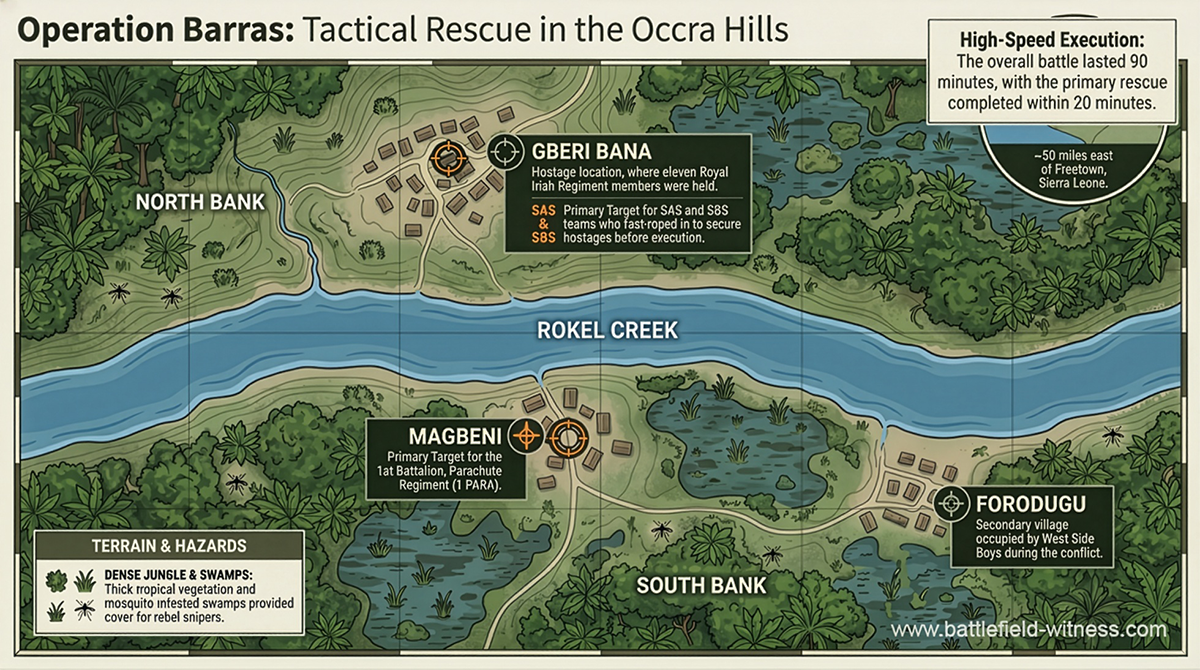
D Company, 1 PARA. Sierra Leone. 10 September 2000.
I.
The Chinook smelled of JP-8 aviation fuel, wet kit, and the particular quiet of men who had been told the odds and chosen not to discuss them.
Danny Kavanagh sat with his SA80 between his knees and the dark bulk of the jungle somewhere below. Twenty minutes out. He could feel the rotor vibration through the metal bench and through his spine and in the fillings at the back of his teeth. The man next to him, Walsh, had his eyes closed. He wasn't sleeping. Danny had seen him sleep and this wasn't it.
They had called it Certain Death in the briefings — the men's name, not the official one. Someone had written it on the whiteboard in Freetown and the RSM had erased it and written BARRAS, which told them nothing. The objective was a village called Magbeni on the south bank of Rokel Creek. The hostages were across the river, in Gberi Bana. That was the SAS job. Danny's job was to stop the rebels in Magbeni from crossing to help their friends, and to do it before the West Side Boys woke up enough to organise.
The intelligence said many of them would still be drunk. The British negotiators had been generous with alcohol over the past two weeks, for exactly this reason.
Danny thought about that for a moment and then stopped thinking about it.
He was twenty-four years old. He had done eleven months in Kosovo, mostly watching engineers repair bridges. This was his first real thing. He knew it was his first real thing because of the specific quality of the weight in his chest, which was neither fear exactly nor excitement exactly but something that sat between the two and did not have a name he knew.
Outside, nothing was visible. Then for a moment, through the open side, the creek appeared — a black shine through the canopy, gone before he could hold it. They were low. Lower than he'd expected. Beneath them, SAS reconnaissance teams had been lying in the jungle for days, watching the village, counting weapons, tracking the guards. Danny had not met any of them. He had the feeling, not quite irrational, that they were an entirely different species of soldier.
The loadmaster held up ten fingers.
Walsh opened his eyes.
II.
The world outside was just beginning to be grey when the ramp went down.
What Danny remembered afterward about those first seconds was the smell. The jungle below the helicopter was breathing out — warm, organic, a deep green rot that had nothing to do with English countryside. It came up through the open ramp like something alive. Wet vegetation and dark water and underneath it, faint, the sweetness of woodsmoke from fires that were still smouldering in the village.
Then he was in the swamp.
He went in thigh-deep. The shock of it — not the cold he'd half-expected but the warmth, the strange body-temperature warmth of tropical water — stopped him for a full second. Black water. Something soft and giving underfoot that wasn't mud but wasn't quite anything he had a name for. The weight of his kit dragged at him. Walsh went down to his waist on the right and cursed without sound.
Above them the Chinook was pulling away. The rotor wash flattened the grass and scattered the surface of the water in every direction and then it was gone and the sound dropped and what filled the gap was the jungle, which had been holding its breath since the helicopters appeared and now, very slowly, began to exhale again. Somewhere in the canopy above him, birds were calling — short alarm cries in the dark that had no human equivalent.
Across the creek, on the north bank where Gberi Bana was, the other Chinooks were going in. He could hear it — not individual shots yet but a deepening, a thickening of the air, the way sound becomes texture when there is enough of it. Then the Lynx gunships opened up and the sound tore a line across the grey sky and the jungle lit from the far bank in one long pulse and he stopped trying to parse any of it and pushed forward.
The water sucked at every step. Walsh was moving just to his right, Briggs just ahead. The secondary jungle along the creek bank was a wall — grass and fern and climbing plants matted together into something that required hands as much as feet. The vines caught at the barrel of his weapon, at his webbing straps, at everything. Visibility was perhaps four metres. Perhaps three.
He could smell cordite already, coming from across the water on the breeze.
Somewhere ahead of him, Magbeni was waking up.
III.
The first mortar round came in before they cleared the riverbank vegetation.
Danny heard it the wrong way — the explosion first, then the sound of the tube that had fired it catching up through the jungle a half-second later. Forty metres to his left. He went flat into the water without deciding to and came up with his face dripping and his weapon clear and heard Sergeant Briggs already shouting, already reorganising, and then a voice he didn't recognise — he's hit, the boss is hit — and then the chaos sorted itself the only way it ever does, into forward motion, because that was the only option available.
The rounds coming back were not disciplined. The West Side Boys were firing from windows, from gaps between buildings, from the tree line beyond the compound — three directions at once, badly aimed, some of it going almost straight up. A few rounds were very close. The signature sound of supersonic AK fire is not the crack of the weapon but a double event: the round passing, like a slap of air against the ear, and then the distant report arriving a beat behind it. Danny heard that double note many times in the next four minutes. He counted them without knowing he was counting.
They broke through the tree line into the compound at what felt like a run but wasn't — it was the fastest movement possible through sucking mud, through men already firing in every direction, through the particular unreality of a firefight before full light when you can see the muzzle flashes but not always what is behind them.
The village was low — mud-brick and corrugated iron and palm-thatch, the buildings spread out along the bank, cooking fires still burning in the gaps between them. Danny could smell marijuana even now, above the cordite, above the swamp — a sweet, acrid layer over everything, the West Side Boys' idea of breakfast. Empty bottles of palm wine everywhere. A man was running across the compound without a shirt, without his weapon. Danny did not shoot him. The man disappeared into the tree line and was gone.
The Mi-24 Hind gunship came in from the east and the noise of it compressed everything else for three seconds — not the familiar sound of the Lynx but something deeper and more Soviet, a sound you felt in the chest — and then it was past and had done its work on the far end of the compound, and the tree line there was burning orange in the grey morning.
He moved up against a wall. Breathed. One long breath.
The mud was above his knees and his kit was wet through and the battle across the creek was constant, coming through the earth itself.
Walsh appeared at his shoulder.
"You good?"
"Yeah."
Neither of them said anything else.
IV.
The boy was in the third building.
Danny came through the doorway already low, rifle up, and the smell of the place hit him first — palm wine, ganja, the unwashed heat of bodies in a small space — and he registered the room in pieces. A man face-down and snoring on a reed mat, drunk past the noise of everything. Two others against the far wall who saw him and ran for the back opening without looking back. And then, in the far corner, still.
The boy.
He looked perhaps thirteen years old. He might have been older — it was impossible to judge, with malnutrition — but Danny's mind said thirteen and held to it. He had a red bandana around his forehead and an AK-47 that was too large for him, the stock reaching below his hip. He wore one trainer on his left foot and nothing on his right. Around his neck, on a cord, there were several objects — fetishes, Danny would understand later, talismans of braided leather and small animal bones that the West Side Boys believed made them proof against bullets.
He was not pointing the weapon yet.
He was looking at Danny with an expression that Danny could not name and would not manage to name for a long time afterward. It was not fear. It was not aggression. It was something older than both of those. Some species of recognition, perhaps. Or its opposite — a blankness at the core, where recognition should have been, that had been put there by whatever the boy had been given and whatever he had been made to do.
Danny's sights were on the boy's chest.
Outside: shouting in Krio, Walsh's voice calling the compound clear, a burst of fire from somewhere to the north. The room was very small. The man on the reed mat snored and did not wake.
Danny said, in the phrase they'd been given: "Put it down. Put the weapon down."
The boy looked down at the AK in his own hands as if he had forgotten it was there. Then he looked back up.
He raised the weapon.
Not fast. Not like a soldier. More like a question he was putting to the air.
Danny made his decision in the space between one heartbeat and the next, which is the only space that is ever available for decisions of that kind, and which is smaller than it sounds. There was no thought in it exactly. There was training and there was necessity and there was something else beneath both — an understanding, precise and terrible, that the child in front of him had been placed in this room by men who were not in the room, and that this fact did not change what the room required.
V.
Magbeni was secured by half past seven in the morning.
Danny sat on an ammunition crate outside one of the buildings and watched the creek. Across the water, Gberi Bana was quiet now in a different way — the kind of quiet that comes after, that is defined by what came before it. He could see movement on the far bank. He could not see the hostages from where he sat but the radio had told him six minutes into the assault: all seven safe. All seven unharmed.
He thought about the word unharmed for a while.
The morning was coming in properly — West African morning, which is nothing like English morning, which does not arrive tentatively but drops over you like something warm and enormous and immediate. The jungle at the creek's edge was already steaming where the sun touched it. A bird was calling from somewhere in the canopy, the same four notes, the same order, patient and indifferent to everything that had happened beneath it.
Walsh sat down next to him and they shared a water bottle without speaking.
There were Land Rovers at the edge of the compound — the vehicles that had belonged to the Royal Irish patrol sixteen days ago, recovered now, muddy and dented and still in one piece. At the north end of the village, about twenty civilians had come out of a building when the firing stopped. People who had been held here, Danny did not know for how long or for what. They were sitting in the shade, some of them, or moving carefully with the particular movement of people who are testing whether movement is permitted again.
Later, someone on the ship would say the name Brad Tinnion quietly, and Danny would understand from the way it was said that he was dead, and that he had been SAS, from Gberi Bana. He would not find out until much later that the man had been twenty-seven years old, from Hereford, that he had taken a round in the chest during the assault across the river. In the moment he heard the name, what Danny felt was not grief exactly — he had not known the man — but something adjacent to it. The knowledge that the sum was not zero. That the accounting was not clean.
A Chinook appeared over the tree line on the far bank and climbed and banked south, heavy, moving with the weight of the seven people inside it.
Danny watched it go.
He thought about the boy in the red bandana. About the cord of talismans. About the one trainer on one foot and the bare foot on the other, standing on a dirt floor in the corner of a room, and whether the boy had understood in the last moment what the talismans were worth, which was nothing, because they were the invention of men who needed other people to believe in something so they would keep moving forward through the dark.
He thought about the talisman and what it was made of. He thought about the cord and wondered who had tied it around the boy's neck, and whether that person was still alive, and where.
He thought about the hostages in the Chinook and what they would say when they landed and what they would not say.
Walsh handed the water bottle back.
"It's done," Walsh said.
"Yeah," Danny said.
The Chinook was a speck above the green. He watched it until it was gone and then he watched the place where it had been, which was just sky, blue-white and enormous, the morning coming into it properly now, burning off the mist from the creek, making everything visible.
One historical footnote: Operation Barras freed all seven hostages without a single casualty among them. It took less than twenty minutes. The militia group West Side Boys was effectively destroyed as a fighting force. Its leader, Foday Kallay, was convicted of war crimes and sentenced to fifty years in prison. The operation is still studied in military colleges as one of the most precisely executed hostage rescues in British military history.
The child soldiers scattered into the jungle. Most were never accounted for.